
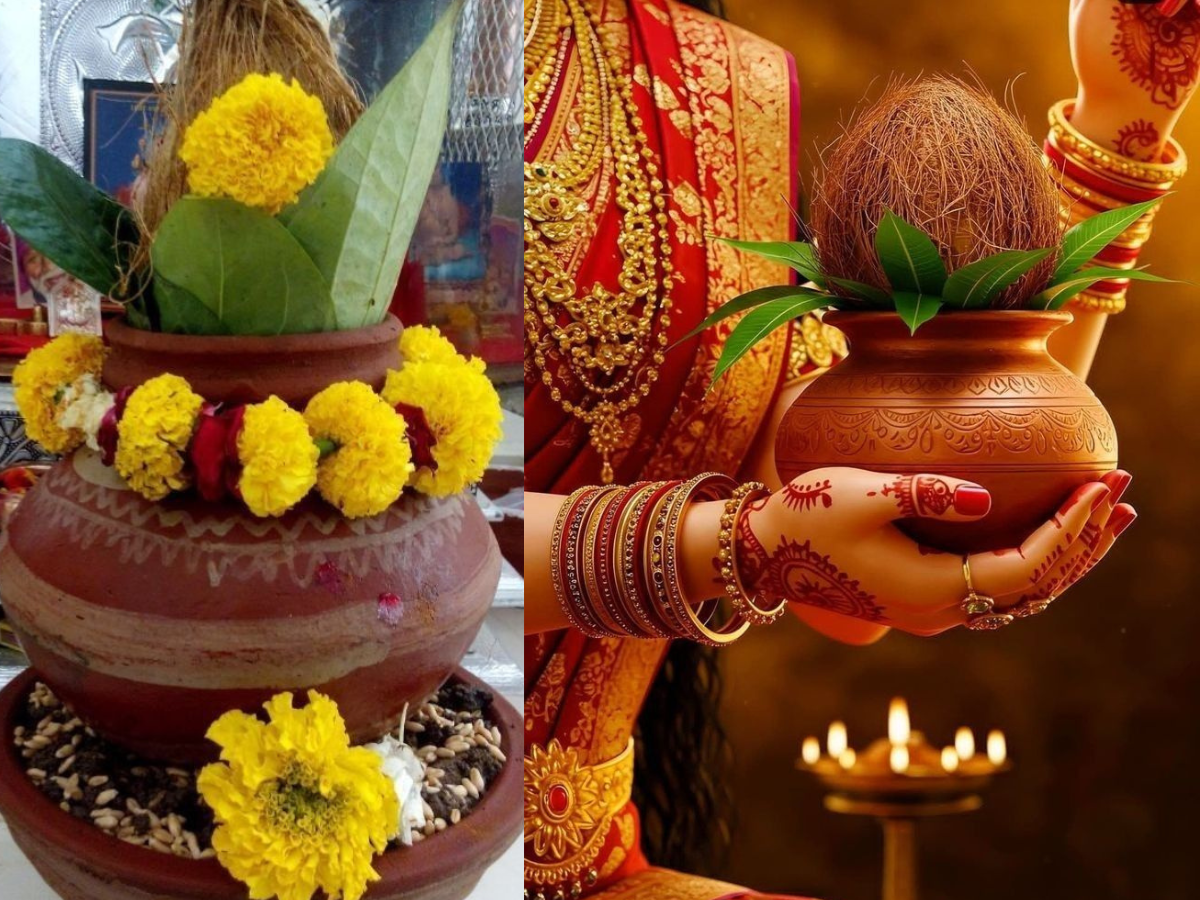
Ghatasthapana, or Kalash Sthapana, is the first day of Navratri, a highly sacred Hindu festival, celebrated, to honor Goddess Durga. “Ghata” means pot and “Sthapana” means establishment or positioning. Combined, Ghatasthapana can be translated as the process of putting a sanctified pot (Kalash) of water, grains, and spiritual items at the center of worship for all nine days of Navratri.This practice is not only symbolic; it is filled with our spiritual, cultural, and scientific significance.
Meaning and Symbolism
Kalash (pot) is a microcosm of the universe. It symbolizes creation, fertility, purity, and abundance. All the materials, which we use in Kalash are symbolic:
- Pot (Kalash): The universe and the human body.
- Water within the pot: Source of life and energy.
- Mango or Ashoka leaves: Natural energy and freshness.
- Coconut on top: Success and spirituality.
- Grains (barley or wheat) around the pot: Development, fertility, and new starts.
It is believed that Kalash invites Goddess Durga into the home of the devotee, bringing vigor, well-being, and prosperity to the family.
The Right Time for Ghatasthapana
Ghatasthapana is performed on the first day of Navratri, known as Pratipada. It has to be performed at a specific sacred moment (muhurat) as improper establishment will cause ill-fated results. Optimal positioning is typically after the sunrise but before noon when the cosmic energies are very favorable.
The precise muhurat is computed every year by priests and astrologers according to the Hindu calendar.
Step-by-Step Ritual of Kalash Placement
- Prepare the Place of Worship
- Clean the place nicely.
- Spread a layer of earth and plant wheat or barley seeds (which will be “Navratri Jawara” after nine days).
Filling the Kalash
- Fill the vessel with holy water (usually mixed with Ganga jal).
- Add coins, turmeric, betel nut, and few rice grains.
- Gird the neck of the vessel with a red holy thread (kalava).
Decorating the Kalash
- Place five or seven mango leaves in the mouth.
- Put a coconut wrapped in red cloth on the pot.
- Spread sandalwood paste or vermillion (kumkum) on top of the coconut.
Invocation of the Goddess
- The Kalash is given flowers, incense, and mantras.
- Worshippers pray to Goddess Durga to reside in the Kalash for the nine days.
Daily Worship
- Throughout Navratri, the devotees light a lamp (akhand jyot) and irrigate the barley seeds.
- The green sprouted shoots are accepted as a boon of growth and fertility.
The Secret Behind Ghatasthapana
Although the process seems to be very simple, it carries deep meanings:
- Spiritual Secret: The Kalash is rendered a vessel of spiritual energy. Goddess Durga resides there in Navratri.
- Scientific Angle: Seeds of wheat or barley being germinated inside the premises ensure fresh oxygen and purify the atmosphere.
- Psychological Effect: The activity of sowing seeds and nurturing them for nine days fills us with optimism and expectation, reminding us to be slow and observe growth in life.
Ghatasthapana is not merely a religious ceremony but also a blend of spirituality, tradition, and science.
ALSO READ: Navratri’s Lunar Connection: How Moon Phases Secretly Shape Rituals & Timings