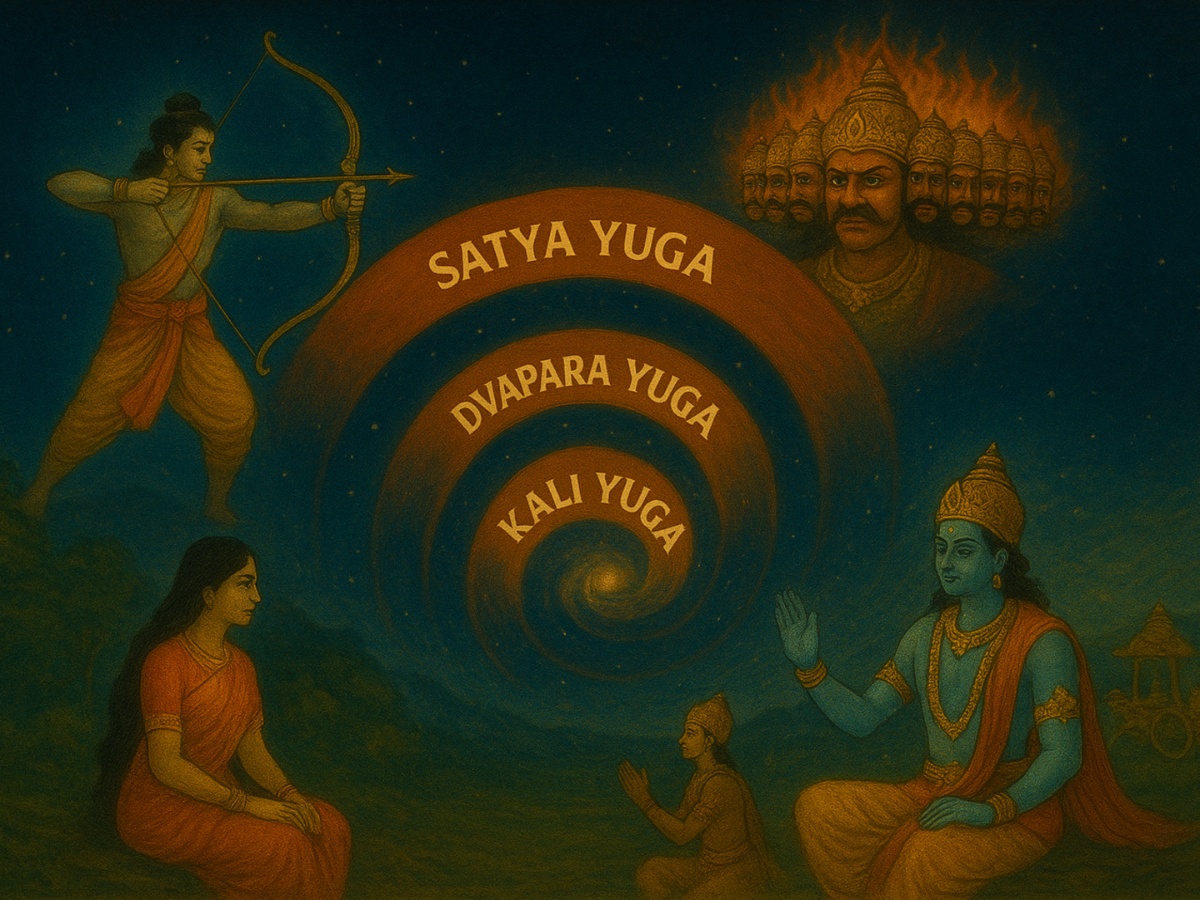
Hindu philosophy describes time as an eternal cycle and it does not move in a straight line but returns again and again while the four Yugas, together called a Mahayuga, repeat endlessly across cosmic time. In these cycles, great epics like the Ramayan and Mahabharat unfold not just once, but countless times. Sometimes the stories change in fascinating ways, yet the Purana versions we know today remain the most powerful and enduring also they show the victory of dharma over adharma, and they guide how we understand history, time, and destiny.
The Four Yugas and the Cosmic Cycle
- Satya Yuga (Krita Yuga): Age of truth, purity, and full dharma
- Treta Yuga: Dharma reduces by one quarter
- Dvapara Yuga: Dharma reduces by half
- Kali Yuga: Present age of darkness and moral decline
Read More: Is Kalyug Ending Soon? Are We Living in Its Final Years? Bhavishya Malika Reveals
Together, these four Yugas form one Mahayuga, which lasts about 4.32 million years.
One thousand Mahayugas equal a single day of Brahma, which spans 4.32 billion years.
After Brahma’s Day ends, there is a night of equal length. Then creation begins again.
This cosmic rhythm makes epics like Ramayan and Mahabharat reappear in every new cycle, sometimes with new twists.
Ramayan Through Endless Loops
The Ramayan does not belong to just one point in history. It repeats across Yugas in many different forms. In the Purana version, Rama defeats Ravana, restores dharma, and sets an ideal example of virtue. Yet traditions and folklore preserve strikingly different endings. In some cycles, Sita kills Ravana herself, turning the story into one of divine feminine power as well as in other tellings, Vibhishana sides with Ravana instead of Rama, shifting the flow of the war. Folk retellings also reshape Sita’s origins, sometimes even linking her as Ravana’s daughter. Each cycle gives the story a fresh shade, but the Ramayan of Valmiki and the Puranas stand as the most sacred version, where good triumphs and evil collapses.
Mahabharat Across Time
The Mahabharat also repeats with every cosmic cycle. The Purana Mahabharat describes how the Pandavas defeat the Kauravas in the great war of Kurukshetra, with Krishna guiding dharma to victory. But other versions tell a different tale. Some cycles describe Draupadi taking vengeance herself, killing the Kauravas directly. In certain alternate tellings, the Kauravas win the war, shifting the moral balance entirely. These variations underline the belief that while destiny repeats, its outcomes may differ from one cycle to another but still, the Mahabharat preserved in the Puranas remains the truest and most revered form, where dharma rises and adharma falls.
Read More: Bhavishya Malika: Is Kali Yuga Really Ending and Satyayuga About to Rise?
Living in a Cosmic Loop
According to Hindu belief, the Ramayan and Mahabharat have happened countless times before. They will continue to happen again in future cycles. We are living in Kali Yuga, the age of decline. Just as days and nights return, so too do Yugas, epics, and destinies. Life itself is part of this cosmic loop—birth, death, and rebirth turning without end. The only way out is through moksha, liberation from the cycle, which unites the soul with the eternal and ends repetition. Until then, the Ramayan and Mahabharat will echo through every age, retold in new ways but always carrying the eternal struggle between good and evil.