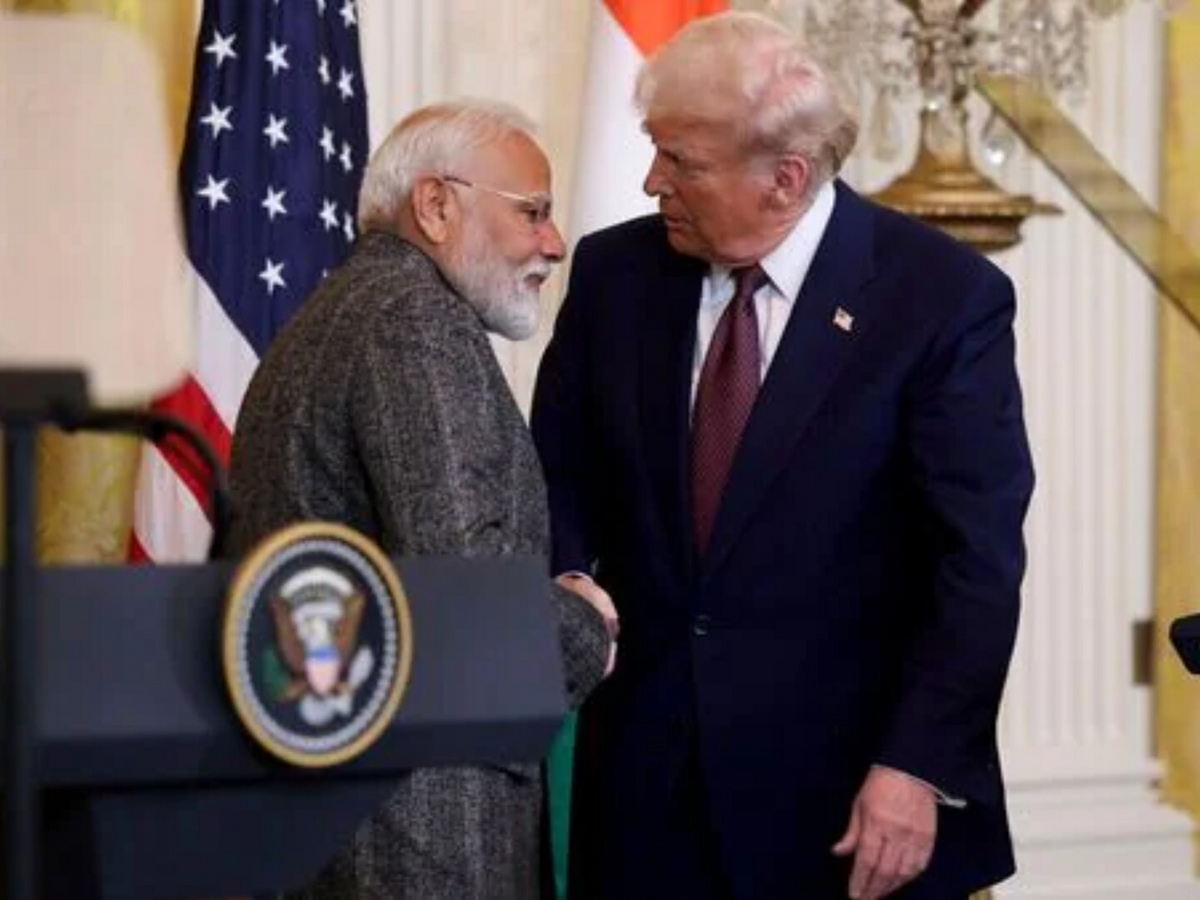
New Delhi: The trade agreement announced by Prime Minister Narendra Modi and U.S. President Donald Trump on Monday follows a prolonged negotiating process marked by public confrontation, sustained technical engagement, and a clear economic calculation in Washington on the costs of delay.
According to official data published by the Office of the United States Trade Representative, total U.S.-India goods and services trade stood at about USD 212 billion in 2024. U.S. exports to India were valued at roughly USD 41.5 billion, while imports from India were estimated at USD 87.3 billion, leaving the United States with a persistent trade deficit. These figures formed the baseline for the Trump administration’s demand for tariff rebalancing and expanded market access.
The negotiations were formally anchored in a framework announced by the USTR in April 2025, when both sides agreed on Terms of Reference for a proposed bilateral trade agreement. The framework outlined talks on tariffs, customs procedures, non-tariff barriers, technical standards, and aspects of digital trade. While it did not constitute a binding treaty, it provided the institutional structure for multiple rounds of negotiations through 2025.
Progress remained uneven. Senior Indian officials had indicated to this newspaper last year at an informal gathering that discussions had reached an impasse and that New Delhi was not prepared to push further for a comprehensive free trade agreement if its red lines on sensitive sectors and regulatory autonomy were crossed. That position, officials say, remained unchanged despite intermittent escalation in public rhetoric from Washington.
The Indian negotiating team was led by Commerce and Industry Minister Piyush Goyal. On the U.S. side, the talks were led by the Office of the United States Trade Representative, with Brendan Lynch, Assistant U.S. Trade Representative for South and Central Asia, heading the negotiations with Indian counterparts.
Officials familiar with the process said the U.S. trade and business negotiating team functioned with a degree of operational autonomy from the president’s public posture.
While President Trump continued to issue sharp and at times unsubstantiated public statements on matters related to India , the formal negotiations led by the USTR proceeded in parallel. The talks slowed at several points but did not break down, with working-level engagement continuing even during periods of heightened rhetoric. According to officials, this separation between political signalling and technical negotiation kept channels open until leadership-level intervention brought the process to a close.
From an economic standpoint, analysts say the cost to the United States of not concluding a deal would have been significant. Without an agreement, Washington would have had limited leverage to influence an existing trade deficit, while U.S. exporters risked falling behind competitors following the European Union’s recently concluded free trade agreement with India. Preferential access granted to European firms would have affected long-term investment decisions, supply chains, and procurement contracts, raising the cost of delayed U.S. engagement.
Economists also point to non-tariff barriers as a critical factor. Regulatory standards, customs procedures, and compliance requirements play a decisive role in determining export volumes in India. Without a negotiated framework, U.S. companies would have had little institutional recourse to address these frictions, constraining growth in a market where marginal expansion, rather than new entry, drives profitability.
At the firm level, the impact of the deal is concentrated in capital- and technology-intensive sectors. U.S. exporters of energy, aerospace components, industrial machinery, electronics, and medical devices already operate in India but face high fixed costs and regulatory uncertainty. Incremental tariff reductions and improved process access alter pricing, scale, and long-term investment decisions.
Agriculture and consumer goods, by contrast, are expected to see limited gains, reflecting India’s continued sensitivity in those areas.
Under the current U.S. tariff structure, India has emerged with a lower tariff rate than several competing export economies. India’s tariff has been set at 18 percent, compared with 19 percent for Indonesia, 20 percent for Vietnam and Bangladesh, and 34 percent for China. Analysts say this differential places Indian exports at a relative cost advantage over key Asian competitors in the U.S. market, even as India’s rate remains above those enjoyed by U.S. free trade agreement partners.
Energy trade is another area where the agreement carries economic weight. India is structurally dependent on imports, and any shift in sourcing creates substitution opportunities. Analysts note that without a deal, U.S. energy suppliers would have lost optionality in a competitive market where long-term contracts matter more than spot sales.
U.S. officials have said the agreement involves tariff reductions and broader commitments, including energy-related assurances. However, no full legal text or implementing instrument has yet been published on official U.S. government platforms. Sector-specific tariff schedules, timelines, and enforcement mechanisms therefore remain to be clarified.
Officials familiar with the negotiations say India’s decision to hold firm on its red lines, combined with sustained engagement within the USTR framework, ultimately forced a political decision in Washington. Rather than allowing talks to drift amid rising opportunity costs, both sides opted for a leadership-level agreement, with technical details to be finalised through subsequent processes.
The deal, analysts say, reflects a convergence of U.S. deficit-driven trade priorities and India’s insistence on strategic and economic autonomy.