
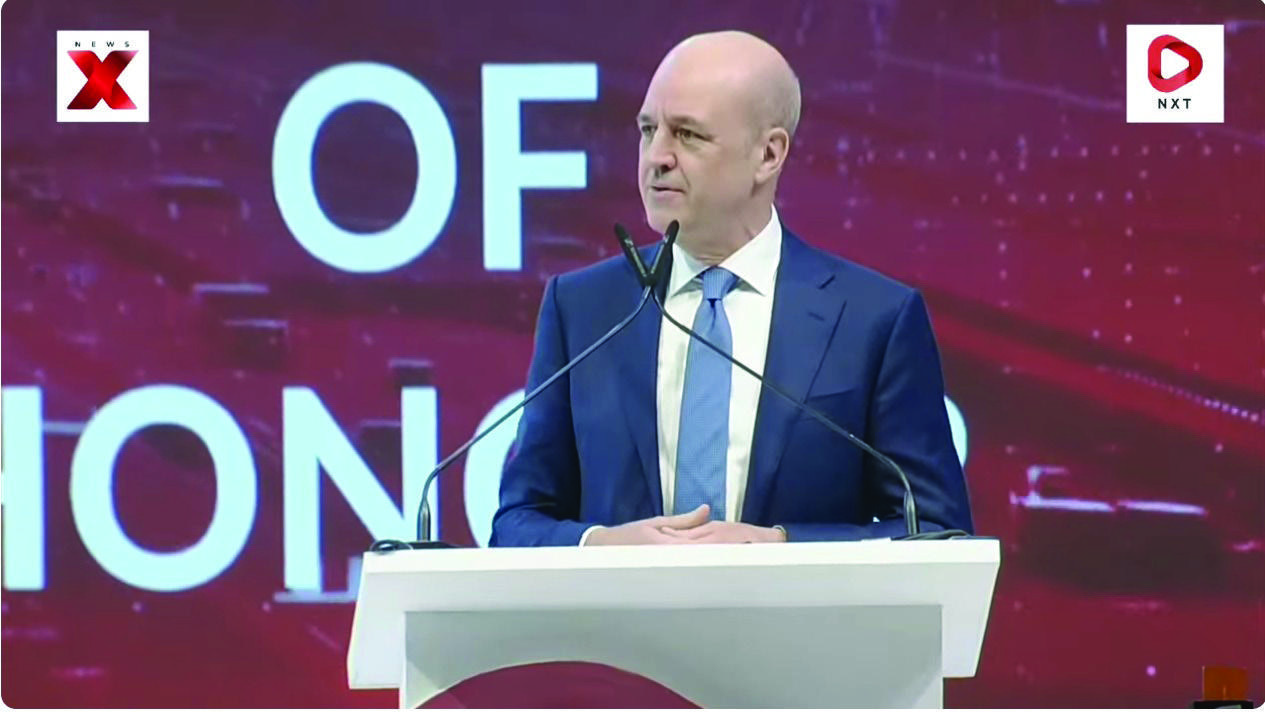
NEW DELHI: Former Swedish Prime Minister Fredrik Reinfeldt on Thursday emphasized the importance of strengthening India-Europe economic cooperation in a challenging global environment, highlighting trade, trust and rules-based engagement as key drivers of future growth.
Delivering a keynote address at the NXT Summit 2026 on Day 1 at Bharat Mandapam, Reinfeldt spoke on the theme of closer ties between India and Europe amid an uncertain global economy.
He noted that despite Sweden’s relatively small population of about 10.5 million, economic engagement with India has grown significantly over the decades. According to him, more than 280 Swedish-origin companies are currently active in India, collectively employing over two million people directly or indirectly. At the same time, around 70 Indian companies have established operations in Sweden, reflecting increasing two-way investment.
Reinfeldt highlighted that Europe’s historical experience with conflict led to deeper economic and political cooperation through the European Union, which was built on the principle that trade and cooperation reduce the likelihood of conflict and foster mutual respect among nations.
Referring to the ongoing India-EU Free Trade Agreement negotiations, he described the proposed deal as a significant step towards strengthening global economic partnerships. If implemented, he said, the agreement could connect nearly two billion people and account for roughly a quarter of the world’s GDP, creating a major trade bloc based on rules-based commerce.
The former Swedish leader also pointed to India’s demographic advantage in a world facing ageing populations and declining fertility rates. While many developed economies are experiencing shrinking populations, India’s relatively young and educated workforce places it in a strong position to drive economic growth in the coming decades.
He cautioned against the “weaponisation of trade” and stressed the need for predictable regulations and transparent legal frameworks to attract global investment. Entrepreneurs, he said, require stable rules and trusted institutions to expand businesses across borders.
Reinfeldt further underlined the importance of people-to-people exchanges, tourism and cultural engagement between nations, noting that such interactions help build long-term trust and understanding beyond economic ties.
Concluding his address, he urged global leaders to pursue openness rather than protectionism, saying stronger trade partnerships and mutual respect between countries such as India and those in Europe would be essential for navigating future economic challenges.