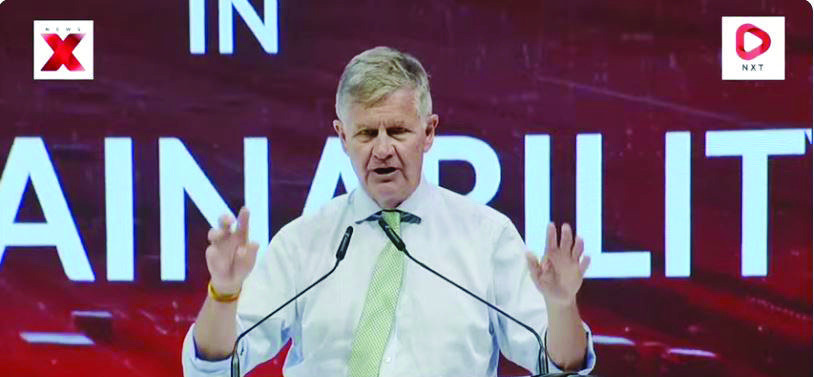
NEW DELHI: Former Norwegian Minister of Climate and Environment Erik Solheim on Thursday highlighted the transformative shift underway in global climate action, asserting that falling renewable energy costs and technological innovation have opened a new path where economic growth and environmental sustainability can progress together.
Speaking at the NXT Summit 2026 at Bharat Mandapam in New Delhi, Solheim reflected on the early struggles of global climate diplomacy, recalling the disappointment of the 2009 Copenhagen climate talks. Despite high expectations and the presence of world leaders such as Barack Obama and China’s premier, the summit ended without meaningful progress, leaving many participants disillusioned.
However, Solheim said the global climate narrative has changed dramatically over the past decade. The price of solar energy has fallen by nearly 90 per cent, making renewable energy not just environmentally desirable but economically advantageous. “For the first time in human history, there is no longer a choice between economic development and climate protection—we can achieve both,” he said.
Highlighting India’s growing leadership in renewable energy, Solheim noted that the country has emerged as the world’s third-largest producer of renewable power and is poised to soon become the second-largest after China. He pointed out that both India and China witnessed a decline in coal emissions last year, signaling a crucial shift in global energy trends.
Citing large-scale projects across India, Solheim praised initiatives such as the 7-gigawatt hybrid solar, wind and hydropower facility in Andhra Pradesh, which can provide round-the-clock renewable energy, and the massive solar and wind park being developed by the Adani Group in Gujarat’s Kutch region, expected to reach 30 gigawatts by 2030. These developments, he said, demonstrate the scale at which the green transition is taking place.
He also underlined the growing integration of environmental sustainability with economic growth. Initiatives such as eco-tourism circuits in Tamil Nadu and rooftop solar schemes for low-income households reflect how climate action can generate jobs, boost tourism and support local economies.
Looking ahead, Solheim stressed that the next phase of the green transition will combine renewable energy with artificial intelligence, enabling smarter and more efficient energy systems. India’s expanding metro networks, rising adoption of electric two-wheelers and cars, and the increasing number of electric buses in cities like Delhi are also accelerating the shift towards cleaner transport.
Solheim commended Prime Minister Narendra Modi’s approach of framing climate action as an opportunity for economic prosperity rather than merely an environmental obligation. He argued that such messaging could inspire other global leaders to focus more on the benefits of the green transition.
At the same time, he emphasized that greater financial support from banks and financial institutions is essential to sustain the momentum of the renewable revolution. Strong international cooperation—particularly between India and China, which produces much of the world’s affordable green technology—will also be key.
Concluding his address, Solheim said India’s vision of “Viksit Bharat” by mid-century could emerge not only as a developed nation but also as a model of green development, demonstrating how economic progress and climate responsibility can go hand in hand.