
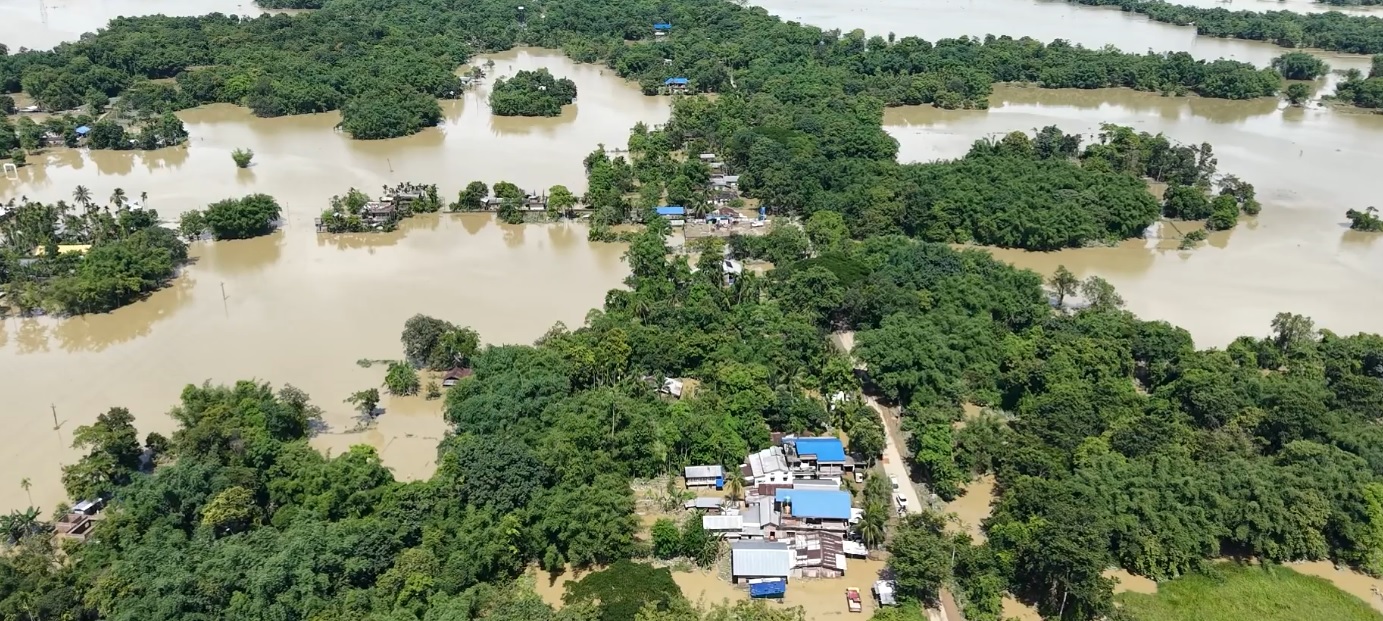
Hundreds of people remain stranded in waterlogged villages across Assam’s Sivasagar district as floodwaters continue to inundate low-lying areas, even though the overall flood situation in Upper Assam is gradually improving.
Villages in Naujan and nearby areas around Sivasagar town, including Khatopothar, Dorikapar, Serekapar, Hansara, Polakhani and Banmukh remain submerged. Many families are living on embankments, roadsides, rooftops under tarpaulins or in temporary relief camps after floodwaters entered their homes and cut off road access.
Residents said they are facing severe hardship. “The floodwater inundated our house within hours. We didn’t even get time to move our belongings. We don’t have proper food or drinking water. We collect water from flooded roads in bottles,” said Mitali Gogoi of Naujan.
The flooding was triggered by intense rainfall and a sudden surge linked to excess downpours in neighbouring Nagaland. Sivasagar Deputy Commissioner Mridul Yadav described it as the worst flood in 50 years for the district. At its peak, nearly four lakh people across 301 revenue villages were affected, with the Nazira and Sivasagar assembly constituencies among the worst hit.
Across Assam, the flood death toll stands at 68. No fresh deaths or missing persons were reported in the past 24 hours, marking the first such period without new casualties in a week. Around 4.45 lakh people continue to be affected across six districts: Charaideo (worst-hit with 1.88 lakh), Sivasagar (1.44 lakh), Jorhat (74,458), Golaghat, Nagaon and Kamrup (Metropolitan). Earlier, more than five to six lakh people had been impacted during the peak of the floods.
Around 90 relief camps are sheltering nearly 28,695 displaced people, with support from dozens of relief distribution centres. Rescue teams from the National Disaster Response Force (NDRF), State Disaster Response Force (SDRF), local volunteers and indigenous boats earlier evacuated about 20,000 people in Sivasagar alone. Helicopters also air-dropped nearly 10,000 kg of food and essential supplies to stranded families in remote areas.
The floods have caused extensive damage to agriculture and infrastructure. More than 37,000 hectares of cropland remain submerged, while over 26,000 animals have been washed away. Hundreds of houses have been fully or partially damaged, and roads, embankments and other infrastructure have suffered widespread destruction. The Dhansiri (South) river continues to flow above the danger mark at Numaligarh in Golaghat.
A five-member central team led by Ministry of Home Affairs Joint Secretary M. Ramachandrudu visited Sivasagar on Monday to assess the flood damage in Upper Assam. The team was accompanied by state ministers. Chief Minister Himanta Biswa Sarma said power restoration was making steady progress, with a significant reduction in the number of households without electricity. He also directed health teams to carry out disinfection and fogging drives to prevent outbreaks of water-borne and vector-borne diseases. Medical teams have been deployed to relief camps and affected villages.
The human impact of the disaster remains severe. In Nazira, septuagenarian couple Mukul and Bonti Bezbora spent 12 hours atop a floating wooden divan after floodwaters submerged their home before they were rescued. When they returned, they found their house filled with silt and debris and had lost almost everything. In other areas, families said livestock and pets were swept away after floodwaters rose within hours.
Meanwhile, Assam MLAs from all parties announced that they will donate one month’s salary for the relief and rehabilitation of flood victims. Assembly Speaker Ranjeet Kumar Dass and Deputy Speaker Habbey Teron led the initiative, while Assembly secretariat staff pledged one day’s salary. Leaders from the BJP, Congress, AIUDF, AGP, BPF and the lone Trinamool Congress MLA also joined the effort, with the contributions going to the Chief Minister’s Relief Fund.