New Delhi: The debate around the 8th Pay Commission has intensified as lakhs of central government employees and pensioners await clarity on salary, allowances and pension revisions. The month of July is being seen as crucial, with key meetings scheduled in Bhubaneswar on July 6 and 7, and in Kolkata on July 9 and 10, where suggestions from employee organisations, unions and other stakeholders are expected to be discussed.
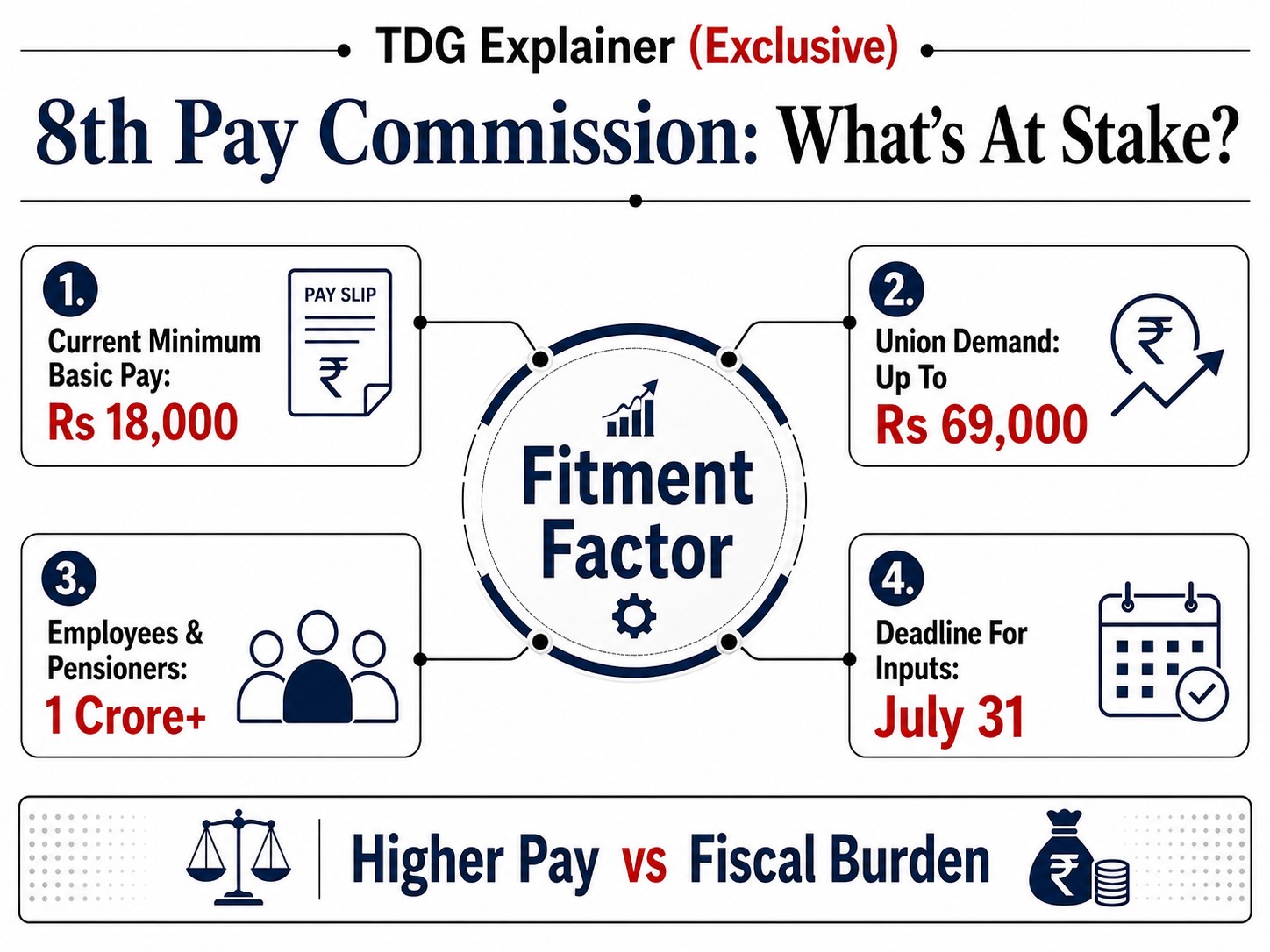
At the heart of the debate is the fitment factor, the multiplier used to revise basic pay. Employee unions have demanded a fitment factor between 3.68 and 3.83, which could raise the minimum basic salary from the current Rs 18,000 to around Rs 69,000. However, economists and policy observers believe the government may settle for a lower figure, given the financial burden such a revision would place on the exchequer.
Under the 7th Pay Commission, the fitment factor was 2.57. Experts say a factor above three may be difficult, with some estimating that the government may consider a range closer to 2.8 or 2.85. If the factor reaches three, the minimum basic salary could rise to Rs 54,000, while the minimum pension, currently Rs 9,000, could increase to Rs 27,000.
The Commission has extended the deadline for collecting data and suggestions from various departments to July 31. This indicates that the government is still assessing the wider implications of the revision, including its impact on salaries, pensions, allowances, service conditions and long-term fiscal commitments.
The proposed revision could directly affect more than one crore people, including around 55 lakh employees and nearly 69 lakh pensioners. Indirectly, experts say the impact could be much wider, as higher salaries and pensions may increase household spending and boost demand across sectors such as retail, tourism, hospitality, manufacturing and services.
Economists argue that putting more money in the hands of salaried employees can stimulate consumption and support economic growth. However, they also warn that a steep increase could substantially raise the government’s annual expenditure. Some estimates suggest that even a moderate revision could add a burden of nearly Rs 2 lakh crore annually, apart from arrears and retrospective payments.
The pressure will not be limited to the Centre. Once central pay scales are revised, state government employees and unions are also likely to demand similar benefits. This could strain the finances of several states, especially those already facing fiscal pressure.
Another key issue is the changing structure of government employment. Experts noted that while permanent central employees and pensioners stand to benefit from the Pay Commission, a growing number of workers are now employed through outsourcing or on contract. Such workers generally fall outside the Pay Commission framework and may not receive similar benefits in salaries, allowances or pensions.
Employee unions have also sought better retirement benefits, higher allowances, and the inclusion of certain components such as dearness allowance in basic pay, as many benefits are calculated as a percentage of basic salary. Any change in this structure could significantly raise the overall pay package.
For now, the government is expected to weigh employee expectations against fiscal constraints. The final recommendations will depend on data from departments, consultations with stakeholders, inflation trends, the state of public finances and the broader economic outlook.
The key question remains: how far can the government go in meeting employee demands without creating an unsustainable financial burden? The answer may begin to emerge after the July consultations and the Commission’s review of the data submitted by departments.