
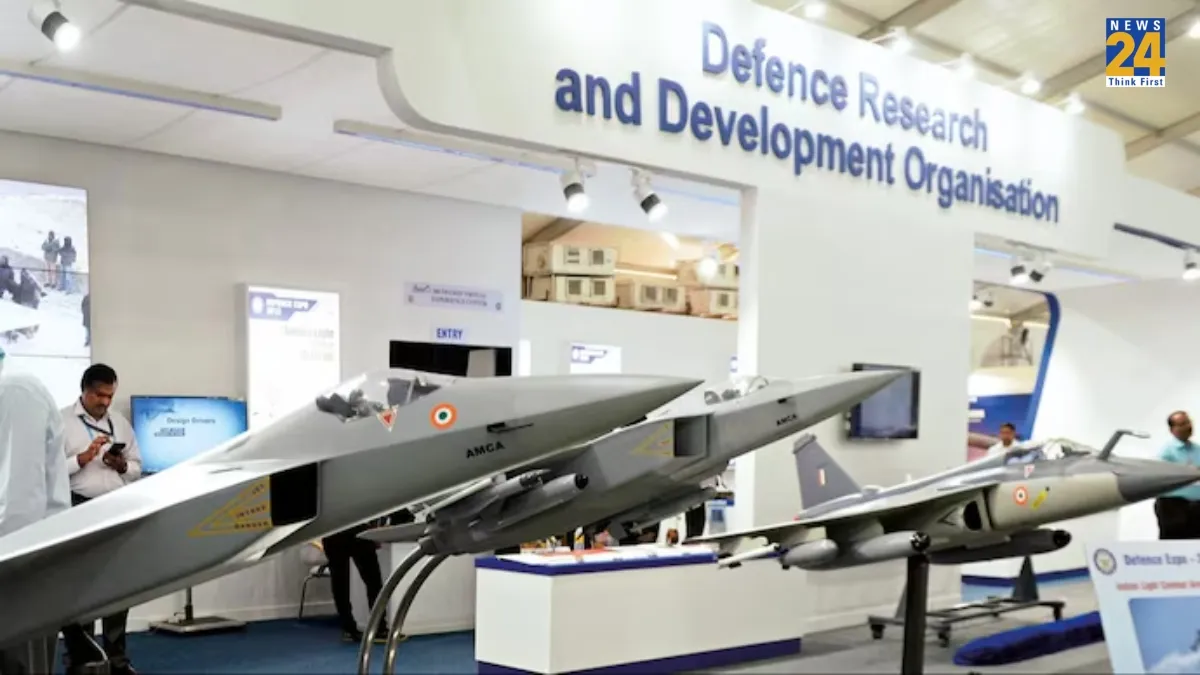
New Delhi: The government is expected to announce the next chief of the Defence Research and Development Organisation (DRDO) shortly, bringing to a close one of the most closely watched appointments in India’s strategic establishment.
Although the position is formally that of the country’s senior-most defence scientist, the contest has always been about much more than scientific accomplishment.
Distinguished scientists appeared before the search-cum-selection committee, although officials familiar with the process said the final deliberations largely centred on Dr. B.K. Das, who was granted an extension in April this year, and Prateek Kishore, 57, who, if selected, would become the youngest scientist to head the organisation.
The interviews were conducted by a high-powered search-cum-selection committee comprising Cabinet Secretary T.V. Somanathan, Defence Secretary Rajesh Kumar Singh, Principal Scientific Adviser to the Government of India Prof. Ajay Kumar Sood, and former ISRO Chairman Dr. A. S. Kiran Kumar
According to officials familiar with the process, the deliberations have concluded and a decision has been taken, with only the formal announcement awaited.
Those familiar with the interviews said the committee’s assessment extended well beyond the candidates’ scientific and administrative credentials. Among the principal issues discussed were their views on implementing the recommendations of the VijayRaghavan Committee, which has proposed the most sweeping overhaul of DRDO in decades. The committee has recommended consolidating the organisation’s laboratories into larger technology clusters, streamlining management, strengthening accountability and project execution, expanding collaboration with academia and private industry, and sharpening DRDO’s focus on frontier research while leaving a larger share of product development and manufacturing to industry.
The next chief is therefore expected not merely to lead the organisation but to steer one of the most consequential institutional reforms in its history.
To the average reader, the significance of the appointment may not be immediately apparent. DRDO is India’s premier military research organisation, responsible for developing technologies ranging from missiles, air defence systems and radars to electronic warfare equipment, drones, underwater platforms, armoured vehicles, combat aircraft technologies and life-support systems for soldiers. It has played a central role in programmes such as the Agni and Prithvi missile families, the Akash air defence system, the Astra beyond-visual-range missile and a range of indigenous sensors and battlefield technologies.
DRDO is also the Indian partner in BrahMos Aerospace, the Indo-Russian joint venture behind the BrahMos supersonic cruise missile, which has emerged as one of India’s flagship defence exports and is expected to be supplied to more countries in the years ahead.
With an annual budget of more than Rs 29000 crore and a network of over 40 laboratories employing thousands of scientists and engineers, DRDO occupies a pivotal place in India’s defence ecosystem. The organisation not only develops technologies for the Army, Navy and Air Force but also works closely with public sector undertakings, private industry, start-ups and academic institutions to advance the government’s objective of defence self-reliance.
The DRDO chief simultaneously serves as Secretary, Department of Defence Research and Development, and Chairman of DRDO.
The office is responsible for setting scientific priorities, approving major research programmes, allocating resources across laboratories, overseeing strategic projects worth thousands of crores, guiding collaboration with the armed forces and industry, and advising the Defence Minister and the government on critical defence technologies.
The incumbent also chairs the Indian side of BrahMos Aerospace, giving the office an important role in the strategic direction of one of India’s most successful defence programmes and its expanding export footprint.
Consequently, the recommendations of the DRDO chief carry considerable weight in matters relating to indigenous defence capability, technology acquisition, strategic partnerships and long-term military planning.
The significance of the office becomes even more apparent during periods of national crisis. Following the Pahalgam terror attack in April 2025, the then DRDO chief, who was on an official visit to a hill state, was asked to immediately return to New Delhi to participate in high-level deliberations and provide scientific and technological inputs as the government considered its response to the Pakistan-backed terrorist attack. The episode underscored the fact that the head of DRDO is not merely an administrator of laboratories but a key member of India’s national security architecture.
It is precisely because of these responsibilities that every change of guard at DRDO attracts attention well beyond the scientific community.
Veterans of the defence establishment recall that there was a time when the succession battle was viewed largely through the prism of two external camps, the American and the Russian. That world has changed dramatically.
Today, officials say, the contest attracts attention from business groups, regional political interests and a wider range of international stakeholders. Candidates are often quietly advocated by political patrons and influential networks from different parts of the country, each pursuing its own institutional, regional or commercial interests.
Delhi’s bureaucratic folklore is replete with stories illustrating the stakes involved.
One of the more enduring accounts suggests that a former DRDO chief secured the appointment after receiving strong backing from a sitting Chief Minister who was the head of a regional party. The said CM personally advocated his candidature before the Prime Minister. The PM had to oblige as his continuing in the power was dependent on the support of the MPs from the said regional party.
Another story, repeated for years in official circles concerns a leading industrialist who attended the wedding of the children of a serving DRDO chief (now retired) and presented gift in cash whose value was described only as “one followed by a long string of zeroes”.
There are other anecdotes, not too hard to verify, of gifts in cash and kind being given to few members of the media for positive coverage of potential candidates for the top post.
This year’s succession has been no different. In the weeks preceding the interviews, multiple complaints targeting different contenders reportedly reached the government. Most are understood to have remained unsubstantiated, but officials say they reflected attempts by rival camps to undermine candidates they did not wish to see emerge as the next chief.
When the government finally announces its choice, it will not merely be naming the country’s top defence scientist. It will be entrusting one individual with the responsibility of shaping India’s military research agenda, implementing the most ambitious restructuring of DRDO in decades, guiding strategic technology programmes and advising the political leadership at moments when scientific capability and national security intersect most closely.