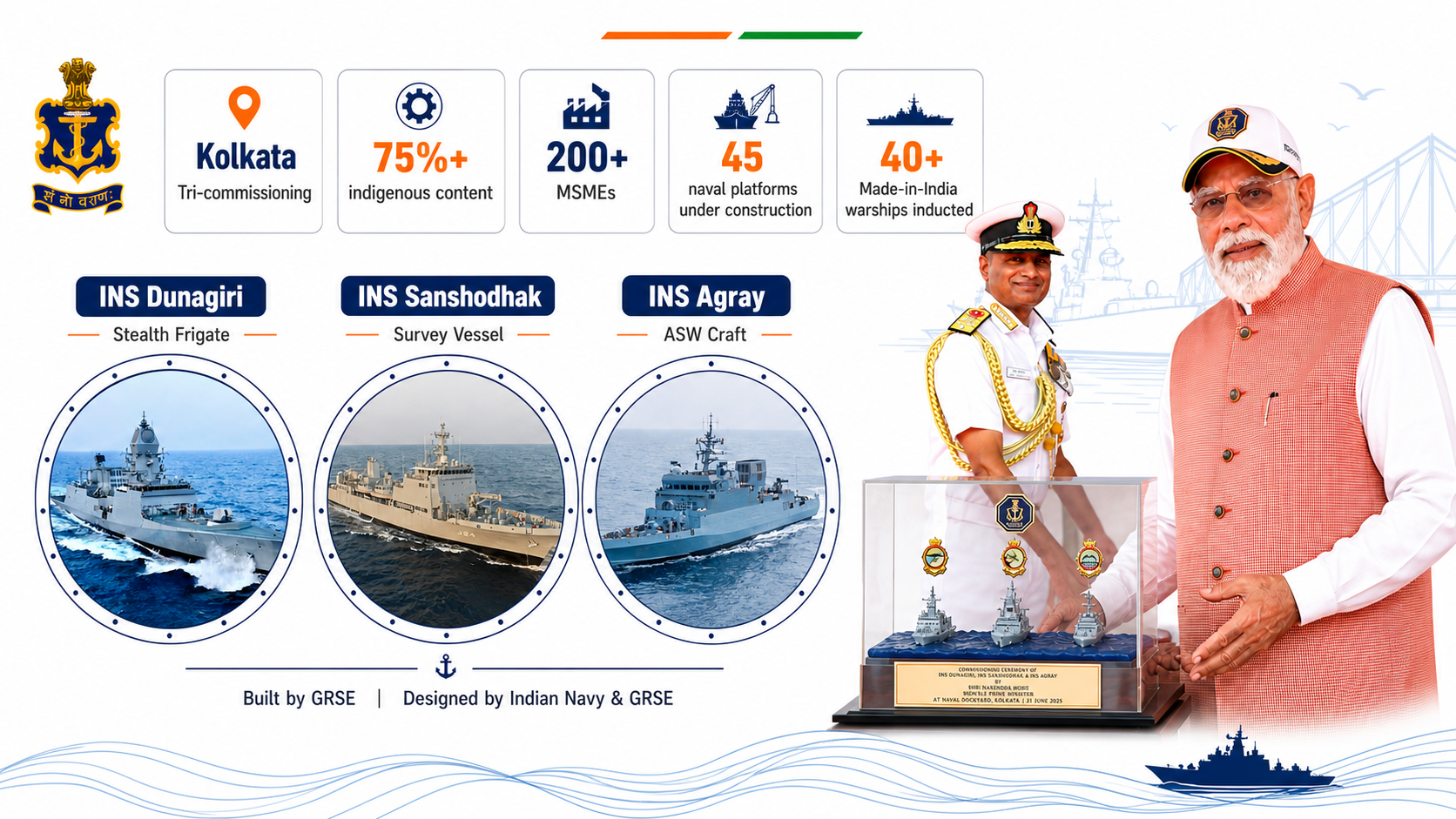
Prime Minister Narendra Modi commissioned three indigenous naval ships in Kolkata, calling maritime strength central to India’s security, prosperity and global rise.
Prime Minister Narendra Modi on Sunday commissioned three indigenously designed and built naval platforms — INS Dunagiri, INS Sanshodhak and INS Agray — into the Indian Navy at Syama Prasad Mookerjee Port in Kolkata, calling the event a major step towards an Aatmanirbhar, secure and developed India.
The three ships bring together frontline combat capability, hydrographic strength and shallow-water anti-submarine warfare capacity. INS Dunagiri is an advanced stealth frigate, INS Sanshodhak is a large survey vessel, and INS Agray is an anti-submarine warfare shallow water craft.
Addressing the ceremony, Modi said no nation could emerge as a major power without strong maritime capabilities. “Development, security and prosperity are closely linked to the oceans,” he said, noting that most global trade moves through sea routes and critical data networks run beneath the oceans.
The Prime Minister said India was preparing for a future in which critical minerals, deep-sea resources and new energy sources would increasingly be linked to maritime strength. He added that the journey from INS Vikrant to the latest three naval platforms reflected not only the induction of new warships but also India’s growing self-reliance in defence manufacturing.
All three vessels have been designed by the Indian Navy’s Warship Design Bureau and Garden Reach Shipbuilders & Engineers (GRSE), and built by GRSE in Kolkata. Officials said the ships have more than 75 per cent indigenous content and involved the participation of over 200 MSMEs, generating substantial direct and indirect employment.
INS Dunagiri, the fifth Project 17A stealth frigate, is equipped with advanced weapons and sensors, including BrahMos surface-to-surface missiles and medium-range surface-to-air missile systems. INS Sanshodhak, commissioned on World Hydrography Day, is designed for coastal and deep-water hydrographic surveys and oceanographic data collection, with advanced systems including autonomous underwater vehicles and remotely operated vehicles. INS Agray will strengthen the Navy’s shallow-water anti-submarine warfare capability with lightweight torpedoes, indigenous rocket launchers and sonar systems.
Modi said India did not wish to remain merely a buyer in the defence sector. “The strength of a nation’s military cannot be measured by its dependence on global markets, but by its ability to become self-reliant,” he said.
Highlighting India’s naval expansion, the Prime Minister said more than 40 Made-in-India warships and submarines had joined the Navy in recent years, while 45 major naval platforms were currently under construction. He also described the maritime sector as an employment engine for a developed India, citing its links with steel, electronics, machinery and thousands of supply-chain components.
He said the Rs 70,000 crore incentive package for the shipping sector was not merely an economic measure but an investment in India’s maritime future. He also noted that India’s defence production had risen from around Rs 40,000 crore in 2014 to nearly Rs 1.8 lakh crore.
Chief of Naval Staff Admiral Krishna Swaminathan said the tri-commissioning showed that India’s warship-building capability was gaining new speed in modern technology, self-reliance and confidence. Defence Minister Rajnath Singh, in a post on X, described the induction as a defining moment in India’s maritime capability development.
Modi said West Bengal, with its historic maritime links, was poised to become a major hub for India’s blue economy, maritime manufacturing, logistics and coastal development.