
How a series of people’s movements, landmark laws and judicial interventions have shaped India’s environmental consciousness—and why the recent protests at Dehradun’s Saat Mod are part of a much larger historical story.
The recent protests against the felling of hundreds of trees at Saat Mod on the outskirts of Dehradun have once again placed India’s forests at the centre of public debate. Citizens, students, environmental activists and local residents rallied against the proposed cutting of mature trees for a road-widening project, arguing that development should not come at the cost of ecological destruction. Following widespread public opposition and legal intervention, the tree-felling exercise was temporarily halted, offering a reprieve to one of the city’s remaining green corridors.
While the controversy may appear to be a local issue, it echoes a much older national story. India’s environmental history is marked by repeated struggles between infrastructure development and ecological conservation. Across decades, ordinary citizens have challenged policies that threatened forests, rivers and wildlife. They have hugged trees, marched through forests, petitioned courts and influenced governments to rethink development models.
From the women of Uttarakhand’s Himalayan villages embracing trees during the Chipko Movement in the 1970s to today’s urban citizens using courts, social media and public campaigns to save city forests, India’s environmental movement has continually evolved while retaining the same fundamental objective—protecting forests for future generations.
Forests: More Than Just Trees
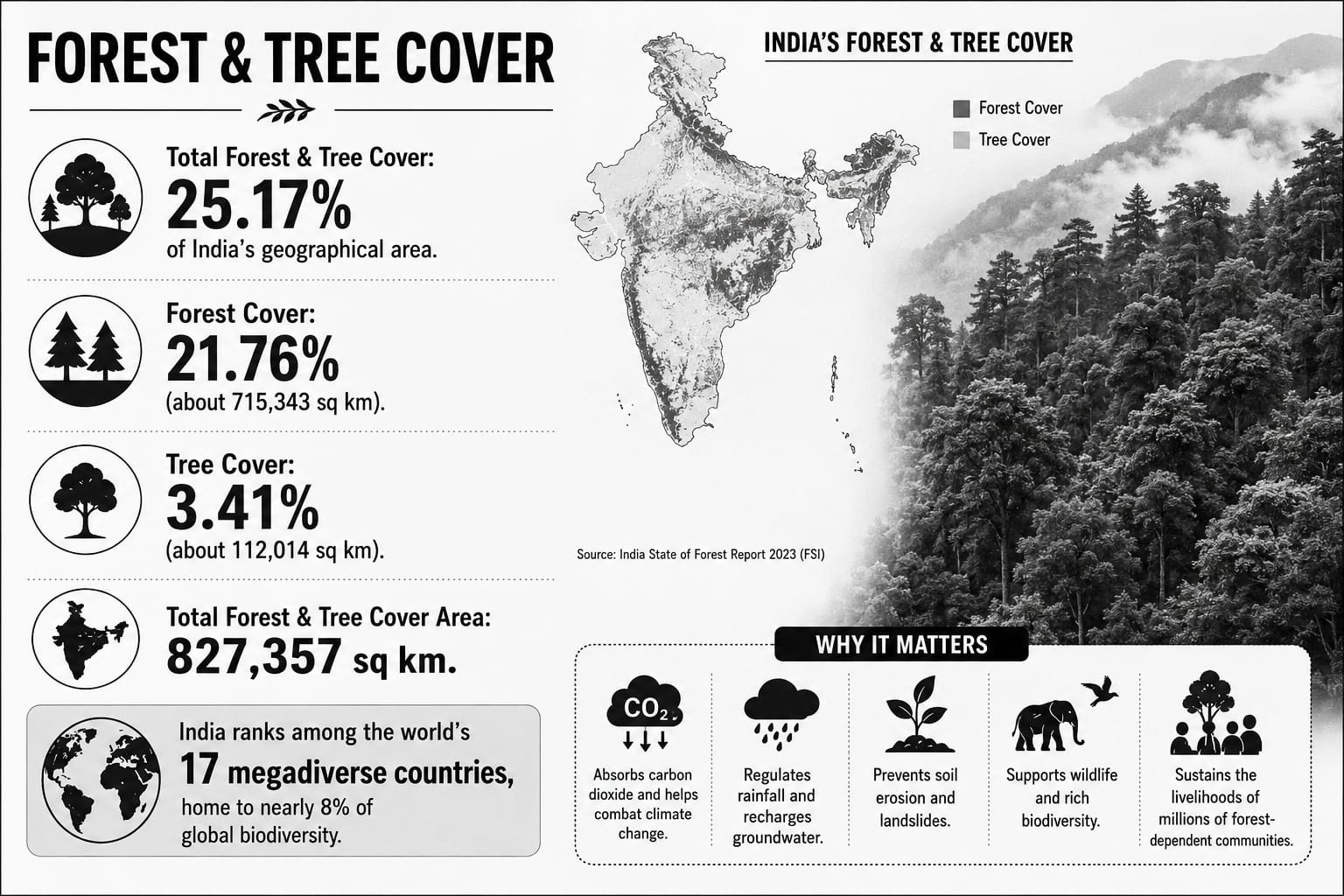
India possesses nearly one-fourth of its geographical area under forest and tree cover, making forests indispensable to the country’s environmental security. They regulate rainfall, recharge groundwater, prevent soil erosion, absorb carbon dioxide, preserve biodiversity and sustain the livelihoods of millions, particularly tribal and forest-dwelling communities.
Yet forests have also remained vulnerable to expanding roads, railways, dams, mining, urbanisation and industrial growth. Since Independence, India has pursued ambitious infrastructure projects to fuel economic development, often requiring diversion of forest land. This has created a recurring challenge: how to balance developmental aspirations with ecological sustainability.
The protests at Saat Mod are therefore not merely about saving a few hundred trees. They symbolise the continuing debate over whether India’s development trajectory can remain environmentally responsible.
The Chipko Movement: Where Modern Environmentalism Took Root
No discussion on India’s forest conservation history is complete without the Chipko Movement, regarded as one of the world’s most influential grassroots environmental campaigns.
The movement began in 1973 in the Chamoli district of present-day Uttarakhand. Commercial logging contracts awarded by the government threatened forests that local communities depended upon for water, fuelwood, fodder and agriculture. Villagers realised that losing forests would directly affect their survival.
Instead of resorting to violence, local residents adopted an extraordinary method—they physically embraced trees, preventing contractors from cutting them. The Hindi word chipko literally means “to hug.”
Among the movement’s defining moments was the leadership of Gaura Devi, who, along with women from the village of Reni, stood between loggers and the forest when the men were away. Their courage forced contractors to retreat.
Environmentalists Sunderlal Bahuguna and Chandi Prasad Bhatt later expanded the movement through public awareness campaigns, padyatras and policy advocacy. Chipko transformed environmental conservation into a national conversation, highlighting that forests were not simply timber reserves but ecological lifelines.
The movement eventually prompted the government to impose a 15-year ban on commercial green felling in the Himalayan forests, making Chipko a landmark victory for community-led conservation.
Beyond Chipko: Other Landmark Forest Movements
Although Chipko became the face of India’s environmental activism, several other people’s movements significantly influenced conservation policies.
Silent Valley Movement, Kerala
In the late 1970s, the Kerala government proposed a hydroelectric project inside the ecologically rich Silent Valley rainforest. Scientists, writers, environmentalists and citizens argued that the project would destroy one of India’s last remaining tropical evergreen forests and threaten countless endemic species.
After years of sustained public pressure, the project was cancelled, and Silent Valley National Park was established in 1984. The movement demonstrated how scientific research and citizen activism could work together to shape environmental policy.
Appiko Movement, Karnataka
Inspired directly by Chipko, the Appiko Movement began in Karnataka’s Western Ghats in 1983.
Villagers hugged trees threatened by commercial logging while promoting three key principles:
• Protect existing forests
• Regenerate degraded forests
• Promote sustainable use of forest resources
The movement broadened environmental awareness across southern India and highlighted the ecological importance of the biodiversity-rich Western Ghats.
Jungle Bachao Andolan
Beginning in the early 1980s in present-day Jharkhand, the Jungle Bachao Andolan opposed government plans to replace diverse natural forests with commercially valuable teak plantations.
Tribal communities argued that monoculture plantations would destroy biodiversity and undermine traditional livelihoods. The movement brought national attention to indigenous rights and questioned whether commercial forestry truly benefited local communities.
Evolution of India’s Forest Laws
Public movements alone could not secure India’s forests. Over the decades, legislation has played an equally important role in regulating forest governance.
Indian Forest Act, 1927
Enacted during British rule, this legislation primarily sought to consolidate state control over forests and regulate the extraction of timber and other resources. While it introduced organised forest administration, it also imposed significant restrictions on traditional community access to forests.
Many provisions of this colonial-era law continued after Independence and shaped India’s forest governance for decades.
Forest (Conservation) Act, 1980
One of India’s most important environmental legislations, the Forest (Conservation) Act sought to reduce indiscriminate diversion of forest land.
Its key provision required prior approval from the Central Government before any forest land could be diverted for non-forest purposes.
The Act significantly slowed uncontrolled deforestation by introducing stricter scrutiny of developmental projects involving forests.
Environment (Protection) Act, 1986
Enacted following the Bhopal Gas Tragedy, this law provided the Central Government with extensive powers to regulate environmental pollution and protect natural resources.
It strengthened environmental governance by enabling the issuance of notifications, environmental standards and impact assessment procedures.
Scheduled Tribes and Other Traditional Forest Dwellers (Recognition of Forest Rights) Act, 2006
Commonly known as the Forest Rights Act (FRA), this legislation sought to correct historical injustices faced by tribal and forest-dependent communities.
The Act recognises community and individual rights over forest resources while emphasising conservation through local participation. It marked a shift from exclusionary forest management to community-based stewardship.
Forest (Conservation) Amendment Act, 2023
The amendment introduced exemptions for certain categories of infrastructure and strategic projects while modifying the scope of land covered under the Act.
Supporters argued that the amendments would facilitate faster infrastructure development and improve national security projects. Critics, however, expressed concern that the changes could weaken safeguards protecting forests and reduce environmental oversight.
The legislation reignited debates about balancing conservation with developmental priorities.
Judiciary as the Guardian of India’s Forests
India’s higher judiciary has emerged as one of the most influential institutions in environmental governance.
T.N. Godavarman Thirumulpad Case (1995 onwards)
Perhaps the most significant environmental litigation in India’s history, the Godavarman case fundamentally transformed forest governance.
The Supreme Court adopted a broad interpretation of the word “forest,” extending protection beyond officially notified forests to areas that met the dictionary meaning of forests.
The judgment also established continuing judicial oversight over forest conservation, making the Supreme Court an active participant in environmental governance for nearly three decades.
Several committees, monitoring mechanisms and conservation guidelines evolved directly from this case.
Forests in the Era of Climate Change
Unlike the 1970s, today’s forest debates are increasingly linked to climate change.
Forests function as massive carbon sinks, absorbing greenhouse gases that contribute to global warming. They also regulate local temperatures, improve air quality, conserve biodiversity and reduce the frequency of floods and landslides.
Rapid urbanisation has created a new challenge—the disappearance of urban forests.
Trees lining roads and city green belts may not constitute dense forests, but they significantly reduce heat islands, filter pollutants and improve public health. Consequently, public opposition to tree felling in cities has become increasingly common.
Saat Mod: A New Chapter in Environmental Activism
The protests at Saat Mod reflect how environmental movements have evolved.
Unlike the Chipko era, today’s activists rely not only on physical demonstrations but also on public-interest litigation, scientific studies, satellite imagery, environmental impact assessments and digital campaigns.
Social media has enabled environmental issues to gain national attention within hours. Citizens increasingly demand transparency regarding developmental projects and insist that alternatives be explored before mature trees are felled.
The temporary halt to tree cutting at Saat Mod illustrates the growing role of public participation in environmental decision-making.
Development Versus Conservation: A False Choice?
India faces a genuine dilemma. Expanding highways, railways, renewable energy infrastructure and urban development are essential for economic growth. At the same time, environmental degradation carries enormous long-term costs through climate change, biodiversity loss, declining groundwater and worsening air quality.
Experts increasingly argue that the debate should not be framed as development versus conservation, but rather as sustainable development.
This involves careful route planning, compensatory afforestation, scientific environmental assessments, public consultation and minimising ecological damage wherever possible.
The Road Ahead
The journey from Chipko to Saat Mod reflects more than fifty years of India’s environmental evolution. People’s movements have inspired stronger laws. Courts have expanded environmental protections. Governments have increasingly recognised the importance of sustainable development.
Yet every generation faces new environmental challenges. Climate change, rapid urbanisation and expanding infrastructure continue to place unprecedented pressure on India’s forests.
The women who hugged trees in Reni village during the Chipko Movement may never have imagined that decades later, urban citizens would wage similar battles through courtrooms, digital campaigns and peaceful demonstrations. But the underlying message remains unchanged: forests are not obstacles to development; they are indispensable to the nation’s ecological security and human well-being.
The protests at Saat Mod are therefore not an isolated incident. They are the latest chapter in India’s enduring struggle to ensure that economic progress does not come at the irreversible cost of its green heritage. As the country moves towards faster infrastructure expansion and climate resilience, the lessons of Chipko continue to resonate—sometimes, protecting a tree is also about protecting the future.