NEW DELHI: The political journey of Tarique Rahman from 17 years in self-imposed exile in London to becoming the Prime Minister of Bangladesh stands as one of the most dramatic reversals of fortune in contemporary South Asian politics. Once convicted in absentia, politically isolated, and widely dismissed as a relic of dynastic politics, Rahman has returned home to lead the Bangladesh Nationalist Party (BNP) to a landslide victory and take charge of a nation navigating economic fragility and political transition.
His ascent is not merely a personal triumph. It signals a seismic shift in Bangladesh’s political landscape following the collapse of the Awami League government in August 2024 after months of student-led protests and mounting unrest.
A LANDSLIDE THAT RE-SHAPED THE POLITICAL MAP
In the 13th Parliamentary elections held on February 12, the BNP secured 209 out of 297 seats, while right-wing ally Jamaat-e-Islami captured 68 seats. The Awami League, led by former Prime Minister Sheikh Hasina, was barred from contesting the polls following its ouster.
The scale of the victory stunned observers. For nearly 15 years, the BNP had operated under intense political and legal pressure. Many of its leaders faced criminal cases; its organisational machinery had weakened; its public narrative had dimmed under the dominance of Hasina’s administration.
Rahman’s return in December 2025 electrified the party base. Within weeks, he transformed the BNP from a politically battered force into the central pillar of a new government.
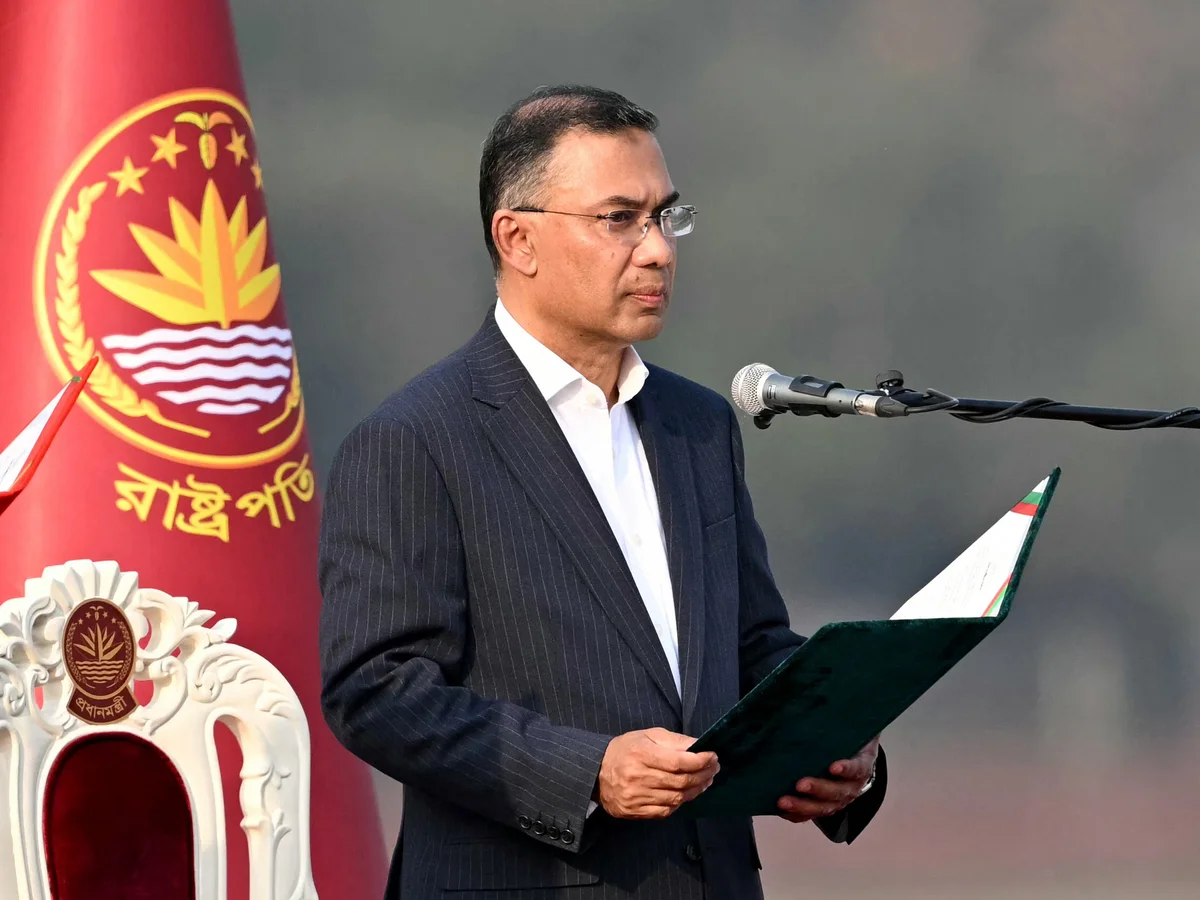
He was sworn in as Prime Minister by President Mohammed Shahabuddin, replacing interim government chief Muhammad Yunus, who had overseen the transition following the Awami League’s collapse.
BORN INTO POLITICS AND TURBULENCE
Rahman’s life has unfolded against the backdrop of Bangladesh’s turbulent political evolution. Born on November 20, 1965, in Dhaka, he is the eldest son of former President Ziaur Rahman and former Prime Minister Khaleda Zia.
His father, a military ruler-turned-politician, founded the BNP and shaped Bangladesh’s post-independence politics. After Ziaur Rahman’s assassination in 1981, Khaleda Zia took charge of the party and remained one of the country’s most powerful political figures for decades.
Rahman witnessed political upheaval from an early age. During the 1971 Liberation War, he and his family were detained and later released on December 16, 1971 — the day Bangladesh achieved independence.
He studied international relations at the University of Dhaka but did not complete his degree. Instead, he ventured into business, building interests in textiles and agro-products before formally stepping into frontline politics.
POWER, CONTROVERSY, AND EXILE
Rahman rose within the BNP ranks gradually but controversially. During the BNP government from 2001 to 2006 under Khaleda Zia’s premiership, critics accused him of operating an informal power centre despite holding no official government post. Allegations of influence-peddling and patronage networks shadowed his early political career.
In 2008, amid a military-backed caretaker government, Rahman was detained and later left the country for medical treatment. What was initially framed as a temporary departure became a 17-year exile in London.
During the Awami League’s tenure, he faced multiple corruption and criminal cases. The most serious was his conviction in absentia and life sentence in connection with the 2004 grenade attack on Sheikh Hasina’s rally, which killed 24 people and injured dozens. Rahman consistently denied the charges, calling them politically motivated.
The political tide turned dramatically in 2024. Following Hasina’s removal from office amid widespread protests, the interim administration led by Muhammad Yunus oversaw legal reviews that resulted in Rahman’s acquittal in the cases against him. His path back to politics was suddenly clear.
RETURN, GRIEF, AND REINVENTION
Rahman returned to Bangladesh in December after nearly two decades abroad. His homecoming drew massive crowds, a carefully choreographed display of political resurgence.
But the moment was tempered by personal tragedy. Within days of his return, his mother Khaleda Zia passed away after prolonged illness. The loss came at a pivotal juncture. Instead of retreating, Rahman stepped decisively into leadership, assuming full control of the BNP.
Observers say his long years abroad reshaped him. Those who met him in recent months describe a more measured, reflective leader. The fiery rhetoric of earlier years gave way to language emphasising reconciliation and institutional reform.
During the campaign, he avoided direct attacks on Awami League supporters and instead called for national unity. After the election, he declared that divisiveness would weaken democracy and pledged governance rooted in the rule of law.
When asked how he would reconcile with millions of Awami League voters, he replied simply: “By ensuring the rule of law.”
A REFORM-DRIVEN AGENDA
Rahman’s policy vision blends populism, economic recalibration, and institutional reform.
He has pledged to diversify Bangladesh’s economy, reducing reliance on garment exports by promoting sectors such as leather goods, toys, and agro-processing. Expanding social safety nets is another priority, with proposals to introduce “family cards” to assist low-income households.
On foreign policy, Rahman has indicated that Bangladesh will seek balanced international partnerships without aligning too closely with any single global power — a subtle recalibration amid shifting geopolitical currents in South Asia.
Perhaps most notably, he has proposed introducing a two-term or 10-year cap on prime ministers. The proposal is widely interpreted as a response to criticism of prolonged incumbency and authoritarian tendencies during previous administrations.
GOVERNING AMID CHALLENGES
Rahman inherits a country grappling with economic strain, weakened institutions, and concerns about law and order. Analysts caution that his greatest challenge may lie within his own party.
Over the past 15 months, BNP activists have faced accusations of extortion, harassment, and filling politically motivated cases against rivals. Media reports indicate that nearly 30,000 activists were expelled in an effort to restore discipline.
Maintaining internal cohesion while delivering governance reforms will test Rahman’s leadership.
FIRST DAYS IN OFFICE
On his first official day as Prime Minister, Rahman chaired the inaugural meeting of his newly formed cabinet. The administration includes 28 ministers and 24 state ministers — a broad coalition intended to stabilise governance after months of turbulence.
He is set to deliver his maiden address to the nation, outlining priorities for economic revival and institutional restoration.
Earlier, he paid tribute to his parents at their graves in Dhaka’s Sher-e-Bangla Nagar, symbolically linking his leadership to the BNP’s founding legacy.
A DEFINING CHAPTER
Tarique Rahman’s rise is a narrative of resilience, dynastic inheritance, political recalibration, and strategic timing. Once written off as a controversial heir apparent living in exile, he now stands at the helm of government.
But the euphoria of electoral victory will quickly give way to the demands of governance. Economic recovery, administrative reform, and national reconciliation will determine whether his transformation is lasting or temporary.
For Bangladesh, his premiership represents both continuity and change — rooted in a powerful political lineage yet shaped by years spent observing governance abroad. For Rahman himself, the journey from exile to executive power marks not just a comeback, but a defining test of leadership in a nation still navigating the balance between democracy, stability, and reform.