
New Delhi:
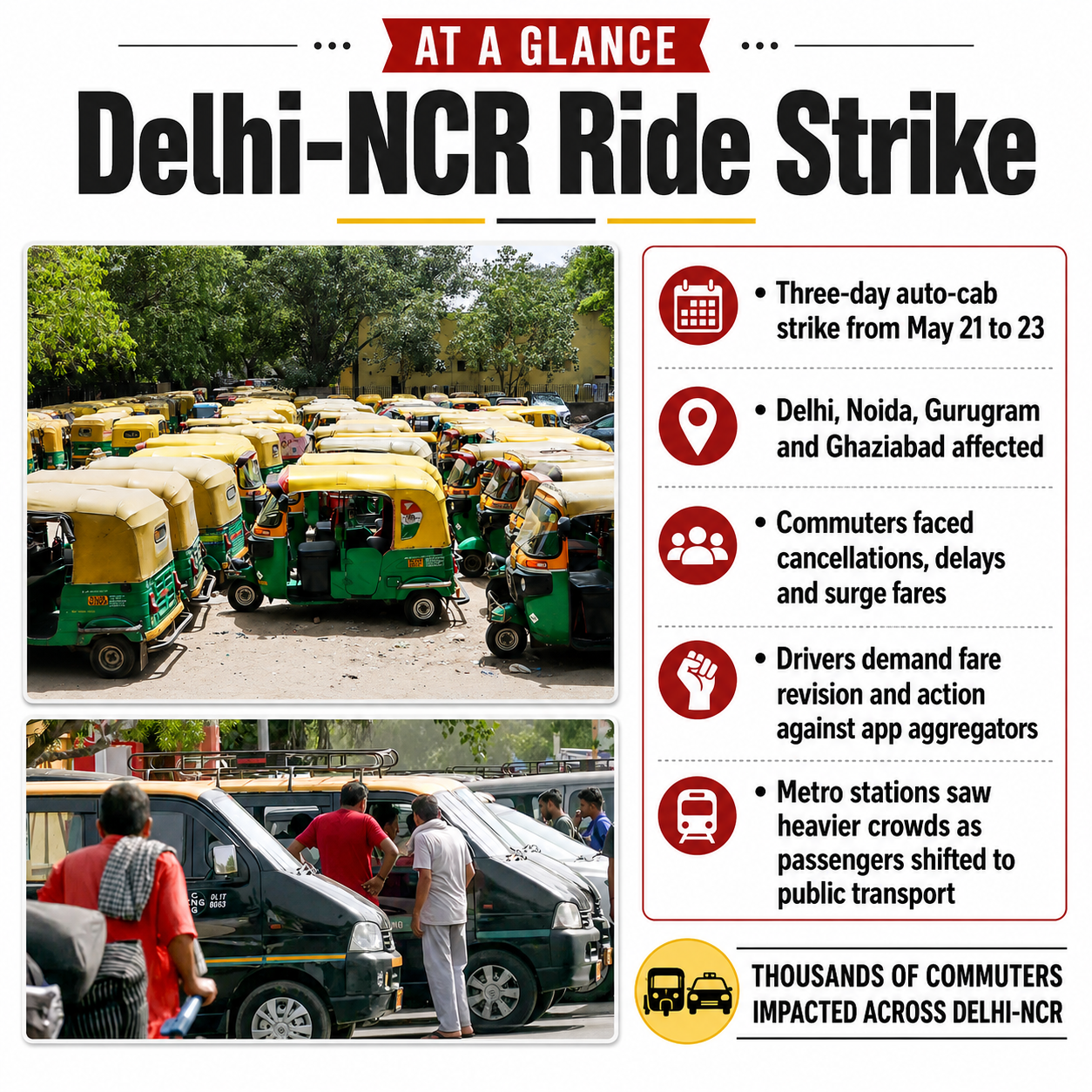
The strike, scheduled from May 21 to 23, has been called in support of a nationwide protest announced by the All India Motor Transport Congress. It affected transport services across Delhi, Noida, Gurugram and Ghaziabad, particularly during the morning office rush.
The impact was visible outside metro stations, railway terminals, bus stands and commercial centres, where commuters struggled to find autos and cabs. App-based services such as Uber, Ola and Rapido saw reduced driver availability, leading to longer waiting times, repeated cancellations and sharply higher fares.
At Rajiv Chowk Metro Station, long queues of passengers were seen waiting for transport. “I usually take an auto from the metro to my office, but today there were barely any available,” said office-goer Riya Sharma. “I waited nearly half an hour and finally had to share a ride with two strangers just to reach work on time.”
Passengers travelling to Gurugram and Noida reported steeper fares during peak hours. “The fare for my daily ride increased from ₹300 to almost ₹700 this morning,” said software professional Aditya Verma. “Even after paying extra, two drivers cancelled my booking before one finally accepted it.”
Railway stations also witnessed confusion, with passengers carrying luggage seen negotiating with drivers. At New Delhi Railway Station, student Harsh Beniwal, who had travelled from Jaipur overnight, said several autos either refused rides or demanded higher charges. “It took me nearly an hour to arrange transport,” he said.
The protesting drivers defended the strike, saying rising fuel prices, high maintenance costs and commissions charged by app-based aggregators had severely hit their earnings.
“We are not protesting without reason,” said auto driver Mohammed Irfan near Anand Vihar. “CNG prices have increased several times over the years, but fares remain almost unchanged. After paying for fuel and vehicle maintenance, there is very little income left for our families.”
Taxi drivers also accused app-based companies of reducing payouts. Speaking to ANI, driver Narendra Tiwari said Rapido had cut payments from ₹30 per km in April to ₹15-16 per km. Another driver, Dinesh Kumar, appealed to the government to address the long-pending issue of taxi fares.
The Chalak Shakti Union, in a letter submitted to the Delhi Lieutenant Governor, Chief Minister, Transport Minister and Police Commissioner, said taxi fares in Delhi-NCR had remained unchanged for nearly 15 years despite rising fuel and operational costs. The union also alleged that companies such as Ola, Uber and Rapido were operating arbitrarily and economically exploiting drivers.
Delhi Metro services operated normally, though several stations, including Kashmere Gate, Central Secretariat and Hauz Khas, saw heavier crowds as commuters turned to the metro network.
Not all unions joined the strike, allowing some autos and taxis to operate in parts of the city. However, disruptions are expected to continue until Saturday if talks between unions and authorities fail to produce a resolution. Authorities have advised commuters to plan their journeys in advance, leave early during peak hours and rely on public transport wherever possible.