
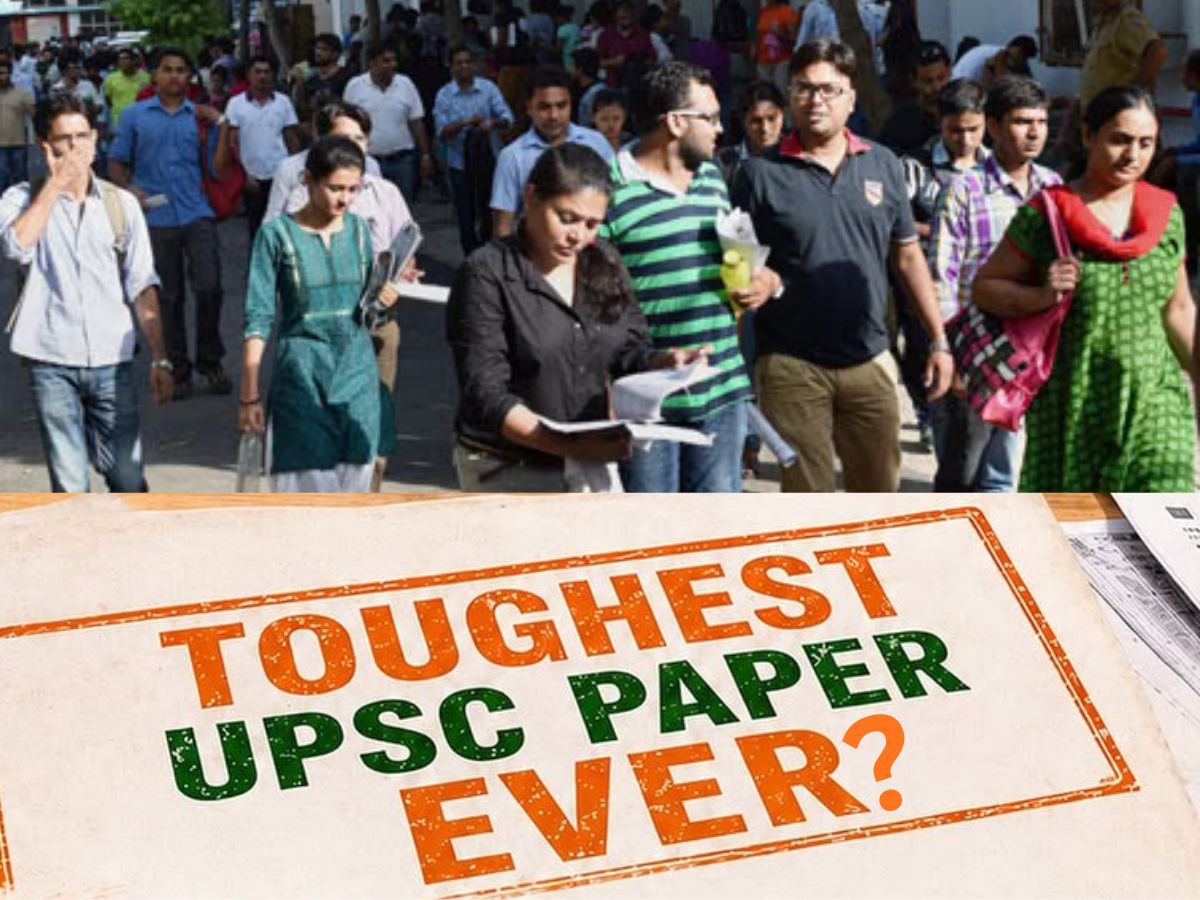
The UPSC Civil Services Prelims Exam 2026, conducted on May 24, has sparked intense debate across the country. With nearly 5.5 lakh candidates appearing for one of India’s most competitive examinations, discussions after the exam have centered not just on difficulty, but on what many students describe as a “complete shift” in the examination pattern.
In Delhi’s Mukherjee Nagar — the hub of UPSC preparation — ITV Reporter Arzu Seth went to the classroom to talk to the UPSC aspirants.
Many aspirants claimed that the paper moved away from the traditional UPSC trend and instead tested philosophical understanding, analytical thinking, and interdisciplinary connections between subjects.
“The Paper Was Not Difficult, It Was Different” Manu Chaurasia, an aspirant preparing for future attempts, said that after analyzing the paper he realized that UPSC had significantly altered its approach this year.
“This time the paper was based more on philosophy and perspective. The traditional style of asking questions from polity or standard subjects was missing,” he said.
Several students echoed the same sentiment, saying the exam focused less on factual recall and more on interpretation and conceptual linkage between subjects.
Lengthy Questions Increased Pressure
For first-time aspirants, the biggest challenge was not only the difficulty level but the sheer length of the paper.
“One question itself occupied an entire page,” said a candidate who appeared in the examination this year. “There were long paragraphs and interlinked questions connecting one subject with another.
Time management became extremely difficult.”
Students estimated that the number of pages in the question booklet was significantly higher than previous years, making it difficult to complete the paper within the allotted two hours.
“Earlier we used to read around 20–25 pages during the exam. This time it felt like reading nearly 60 pages under pressure,” another aspirant remarked.
Aspirants also expressed surprise over the nature of current affairs questions. Many had prepared extensively on topics such as the Election Commission, Supreme Court judgments, the G20 summit, and international developments, but found the actual questions moving in an entirely different direction.
“The current affairs portion was strange and unconventional,” said Salish, appearing for his second attempt. “We prepare based on previous year questions and trends, but this paper broke that pattern completely.”
Some students even argued that questions appeared to touch areas beyond the prescribed syllabus of UPSC.
A recurring concern among aspirants was unpredictability. Some students described the paper as a “luck-based examination” where even extensive preparation did not guarantee confidence.
“There was no clear boundary about where the questions could come from,” one aspirant observed. “UPSC wanted to test the overall perspective of a student rather than textbook knowledge.”
Meanwhile another first-time candidate. candidate said If someone had studied deeply and developed analytical thinking, the paper was manageable,”“It was tough, but not impossible.”
Cut-Off Likely to Drop
Most students agreed on one prediction — the cut-off for UPSC Prelims 2026 is expected to decline because of the paper’s unconventional nature and high difficulty level.
“No doubt the paper was tougher than last year,” a candidate said confidently. “Almost everyone faced problems because of the lengthy and unconventional format.”
However, despite disappointment and stress, several aspirants maintained a resilient attitude.
“We should not get demotivated,” one student said. “Previous year papers still guide us. We just need to adapt our preparation strategy according to the changing nature of UPSC.”
The reactions emerging from Mukherjee Nagar suggest that UPSC may be entering a new phase where static preparation alone may no longer suffice. Aspirants believe future preparation will require deeper conceptual understanding, interdisciplinary thinking, and the ability to analyze unfamiliar situations under severe time pressure.