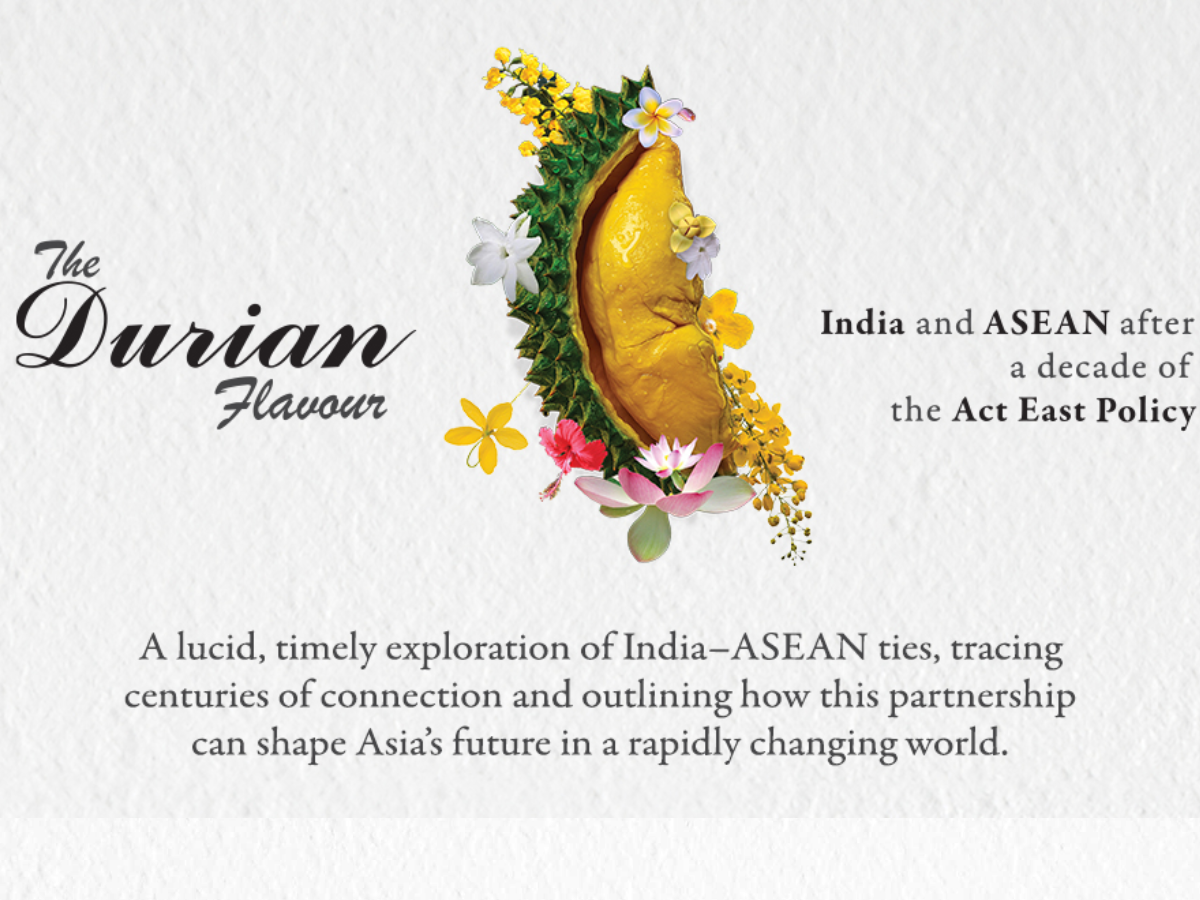
At a time when the global order is fraying and interdependence itself has become a source of vulnerability, Ambassador Gurjit Singh’s The Durian Flavour: India and ASEAN and the Act East Policy is both timely and strategically astute. For India and much of the Global South, the paradox is stark: those who invested most willingly in globalization, connectivity and resilient supply chains now find themselves most exposed to disruptions of their own making. In such a world, this book does not merely explain India-ASEAN relations; it argues, persuasively, why they matter more than ever and why both sides must invest more in it.
Drawing on his tenure as India’s Ambassador to Indonesia and ASEAN from 2012 to 2015, Gurjit Singh writes with the authority of experience, the discipline of reflection and his continuous engagement with and scholarship about the region. He was witness to a particularly consequential phase in the relationship: the 20th anniversary of India-ASEAN ties, the start of the RCEP negotiations, the consolidation of ASEAN’s three communities, and the launch of the Act East Policy in 2014. That vantage point gives the book both texture and credibility. It is not an abstract exercise in policy commentary, but an insider’s account of how the relationship evolved sharpened by Strategic Intelligence.
The title is ingenious. The durian, Southeast Asia’s iconic fruit — pungent, prickly and unforgettable — becomes a metaphor for ASEAN itself and for India’s engagement with it. It is not a relationship that yields its rewards to the casual or impatient observer. It requires adjustment, familiarity and the willingness to move beyond first impressions. I have known some South East Asians being addicted to it despite its somewhat sulphurous odor and carrying it like our beloved Alphonso mangoes across continents. Gurjit Singh handles this metaphor with considerable finesse.
For me, the book also evokes an early chapter in India’s strategic thinking and a new era of economic diplomacy, of what may be called plurilateral subregional and interregional engagements… I recall my own association with India’s pioneering Look East Policy in the 1990s and the strategic dialogue partnership with ASEAN that followed and I was involved in negotiating for nearly six years in MEA as head of Economic and Multilateral Economic Divisions. What a paradigm shift that was in our political, economic and strategic imagination. Twenty-five years on, and especially in the Modi era, that vision was recast into the more purposeful Act East Policy. The Durian Flavour focuses on this latter phase, but it also prompts the next and necessary question: how do we move from the necessary Acting East to genuinely harvesting its potential?
That, in many ways, is the central contribution of this book. Gurjit Singh situates India-ASEAN ties in a civilisational continuum rather than a narrowly transactional frame. His reflections on Indonesia and the wider Southeast Asian region remind us that these links are not recent diplomatic contrivances. They are older, deeper and embedded in memory, culture, cuisine, religion, maritime exchange and historical adaptation. Yet the book is not content with civilisational comfort. It asks the harder question: if so much of India is visible across Southeast Asia, why has contemporary India still not realised the full strategic and economic promise of this proximity? Of this kinship from ancient times to now through empires and migration of Indians to these countries — some 6 million. Why can’t these Indian origin communities play a more dynamic role in fostering a new age, mutually beneficial partnership?
The author addresses these questions through a careful examination of ASEAN’s Political-Security, Economic and Socio-Cultural Communities. These have evolved over time; some have strengthened but some have weakened. He assesses what India has attempted, how ASEAN has responded, and why a persistent sense of underachievement remains despite the proliferation of plans, forums and institutional mechanisms, and the multiple tracks of interaction. He is particularly persuasive in arguing that the relationship cannot deepen through governments alone. Businesses, CEOs, universities, think tanks and private foundations must become more active participants. Without that wider ecosystem, India-ASEAN ties risk being diplomatically busy but economically and socially underpowered.
The trade, investment and tourism dimension is among the book’s most important contributions. Why, despite so much rhetoric, are India and ASEAN still not growing together at the scale they should? Bilateral trade is at USD 130 billion or so — a big jump from the early 2000s. But it is skewed against India with a huge and persistent deficit. The composition of trade is such that we are impacting what we should be Making in India. We are not being able to be part of regional and global supply chains that they drive or are part of? There is not enough cross fertilisation of FDI and technological collaboration happening among Indian and ASEAN entities.
Part of the problem lies in the limited depth of business engagement. But part of it also stems from a deeper structural problem: the persistent perception that instead of functioning along a complementary competitiveness continuum, India and ASEAN often find themselves competing in the same sectors, for the same investors, the same markets and the same manufacturing or commodity opportunities. And then there is the invisible — and now increasingly visible — China factor. This is the elephant in the room. Controversies over rules of origin and the possibility of ASEAN-linked trade routes becoming conduits for what are, in effect, Chinese goods entering Indian markets cannot be brushed aside. Strategic partnership cannot be built on the polite avoidance of hard economic truths.
Equally valuable is the way the book broadens the canvas beyond ASEAN in a narrow institutional sense. Its treatment of the Indo-Pacific, regional integration and connectivity naturally leads into the wider maritime domain — SAGAR, the blue economy, the Indian Ocean Rim Association, and the India-ASEAN relationship across adjusting seas. India’s engagement with ASEAN is not just about trade agreements or overland corridors. It must also be understood through maritime geography, oceanic resilience and the strategic logic of the Indian Ocean and Indo-Pacific. In that respect, the book speaks to an important evolution in Indian thinking from ASEAN centrality to Indo-Pacific synergy.
The concluding chapters are constructive rather than merely diagnostic. Gurjit Singh points towards green growth, green skilling, impact investing, youth dividends and development partnerships as ways of building a more practical, future oriented and less politically burdened partnerships that look at and deal with each other directly not through a great power prism to work out more productive relationships with the ASEAN as a collective and with individual countries bilaterally. This a particularly valuable insight. Equally important are his suggestions about how trilateral ASEAN-India and regional developed country partnerships could be game changers in particular with Japan and Australia. India now has a web of FTAs with the Asia Pacific countries from ASEAN to Australia and New Zealand which can be leveraged to pursue trilateral partnerships. He suggests that India and ASEAN can build cooperation not only in reaction to geopolitical anxieties, but around shared opportunity and respective comparative advantages. The Durian Flavour is an erudite, clear-eyed and strategically significant book. It is part memoir, part policy reflection, part roadmap for the future. Above all, it reminds us that India and ASEAN are not merely celebrating old affinities or invoking the spirit of Bandung. They are being called upon to build a strong, multifaceted partnership resilient enough to survive but also shape a disordered and conflict ridden world. Gurjit Singh’s book shows that the next step is not just to Act East, but to think deeper, engage wider and finally reap the fruits of the East of our extended neighbourhood!