
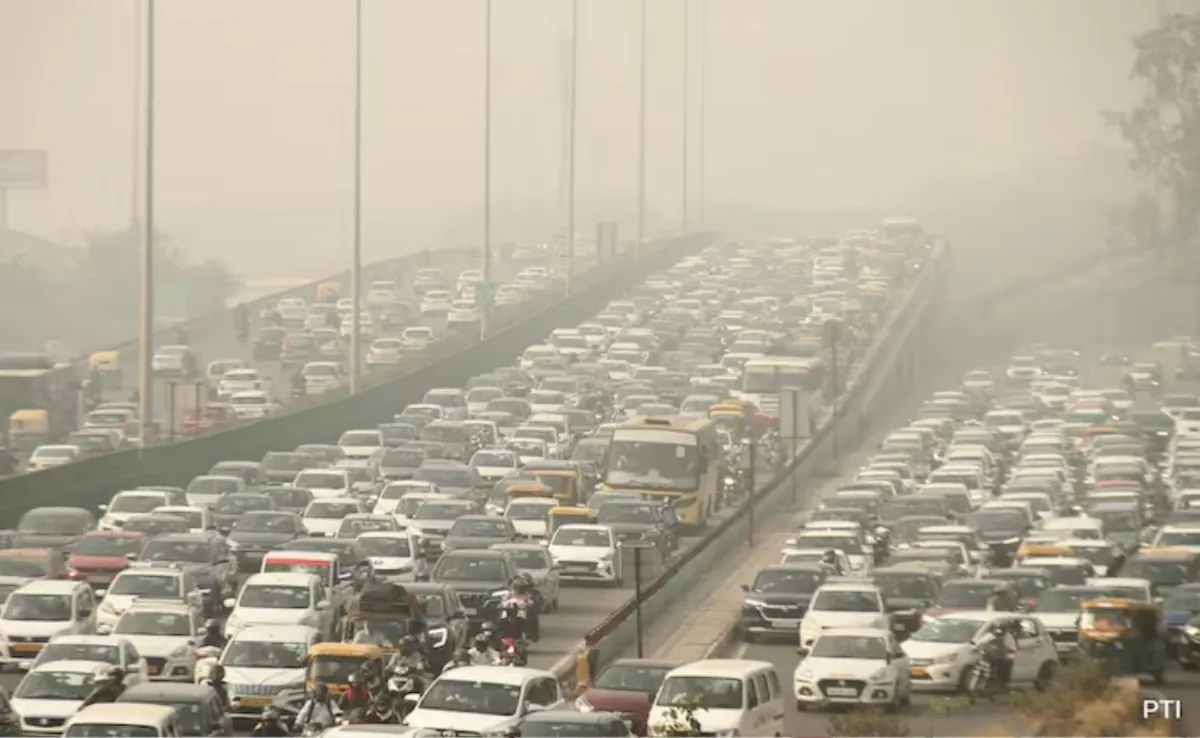
NEW DELHI: The Commission for Air Quality Management (CAQM) told the Supreme Court on Wednesday that vehicular pollution is the highest contributor to air pollution in Delhi-NCR and recommended 15 long-term measures to improve the worsening Air Quality Index (AQI).
Appearing for CAQM, Additional Solicitor General Aishwarya Bhati told a bench comprising Chief Justice of India Surya Kant and Justices Joymalya Bagchi and Vipul M Pancholi that a meta-analysis of studies from 2015 to 2025 attributes PM2.5 in Delhi to a mix of primary emissions and secondary particulate formation from sources within the National Capital Region (NCR).
The CAQM recommended the following measures to be introduced in a phased manner:
- Time bound phasing out of polluted vehicles from Delhi-NCR based on emission potential.
- Strengthening of PUC 2.0 and monitoring of on-road vehicles with remote sensing devices.
- Augmenting Regional Rail Transport and Metro Rail network with more lines and stations in Delhi and NCR.
- Developing Multi-Modal Transport hubs connecting Metro, Regional Rapid Transit System.
- Ensuring last-mile connectivity along with a real-time passenger information system with location-based tracking of public transport.
- Developing a plan for CNG/LNG fuelling network in NCR and on highways to shift long-haul trucking and other commercial vehicles to cleaner fuels.
- Reviewing and revising respective electric vehicle policies to accelerate the transition of all vehicles to zero tailpipe emission vehicles in Delhi-NCR.
- Expanding EV charging infrastructure including swappable battery stations expeditiously commensurate with vehicle growth.
- Permitting retrofitting of vehicles to EV certification by ARAI/ICAT.
- Giving higher incentives to owners for scrapping their old vehicles.
- Augmenting city public bus service through E-buses/CNG according to model yardsticks and service level benchmark of Ministry of Housing and Urban Administration (MoHUA) based on population.
- Installing ANPR cameras and automated RFID ensuring Multi-Lane Free Flow enabled Toll/Cess collection at all border entry points of Delhi.
- Deploying integrated traffic management system in Delhi and other major urban agglomerates, particularly Noida, Greater Noida, Ghaziabad, Meerut, Gurugram, Faridabad and Sonipat for smooth and improved traffic movement.
- Implementing parking area management plans in Delhi and NCR.
- Imposing higher environmental protection charges and intensifying enforcement through technology-based solutions such as automatic number plate recognition, radio frequency identification, remote sensing techniques, AI-driven surveillance etc.