
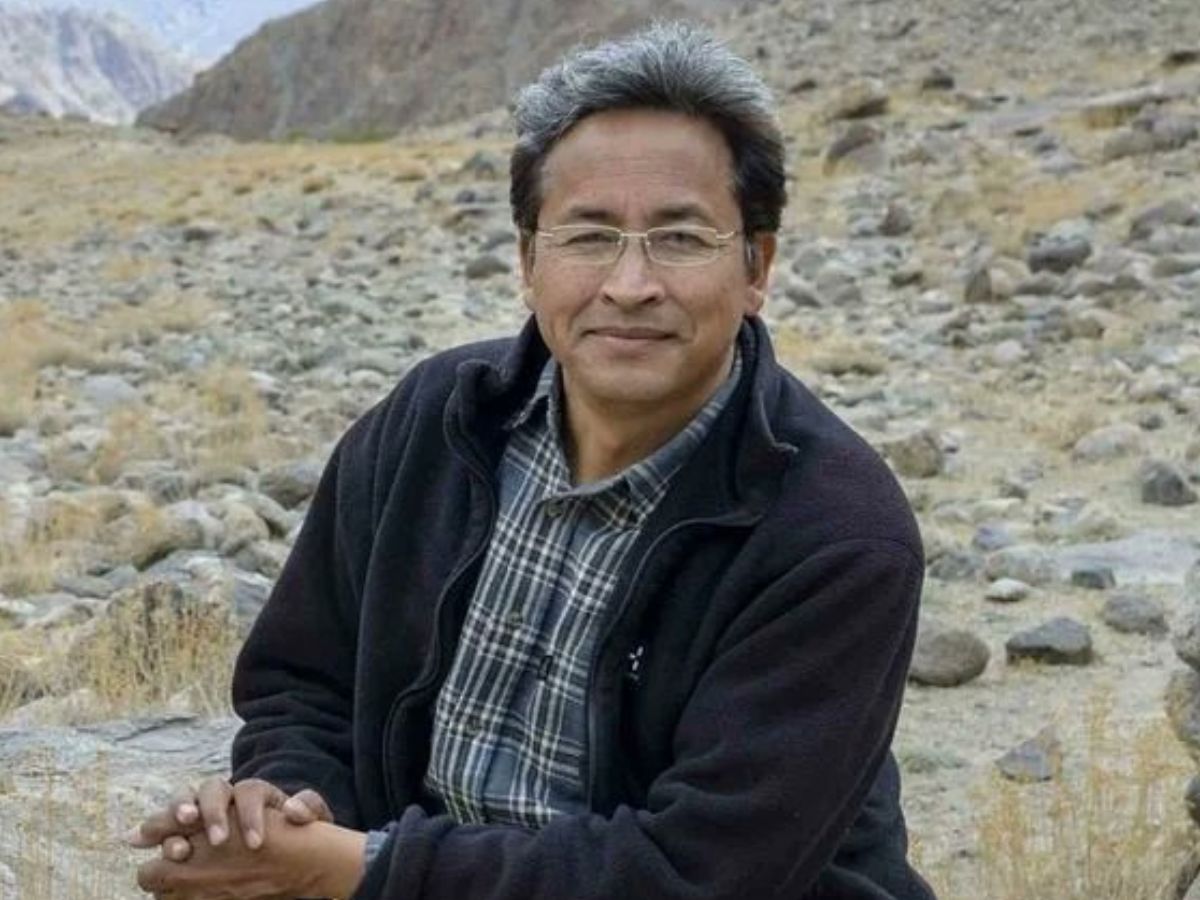
NEW DELHI: The Supreme Court on Wednesday urged the Centre to reconsider the preventive detention of climate activist Sonam Wangchuk under the National Security Act (NSA), noting that his health condition was “certainly not very good” after nearly five months in custody.
A Bench of Justices Arvind Kumar and PB Varale, hearing a petition filed by Wangchuk’s wife Gitanjali J Angmo, asked the Union government to take a “relook” at the detention order passed on September 26, 2025.
“Just give a thought to it, as an officer of the Court,” the Bench told Additional Solicitor General (ASG) KM Nataraj, appearing for the Centre. “Considering the health condition of the detainee… the report we saw earlier shows that his health is not that good. Is there a possibility for the government to rethink and review the detention?”
Nataraj responded that he would convey the Court’s suggestion to the authorities.
Wangchuk was detained under the NSA following protests in Leh in September 2025, which demanded sixth schedule status for the Union Territory of Ladakh.
Angmo’s counsel argued that Wangchuk was exercising his democratic right to protest and criticise the government, and that such actions did not amount to a threat to public order or national security warranting preventive detention.
The Centre and the Leh administration, however, have alleged that Wangchuk played a key role in instigating unrest and violence during the protests.
Earlier this week, the Union government claimed that Wangchuk sought to push Ladakh towards agitation and violence similar to events witnessed in Nepal and Bangladesh.
The government alleged that Wangchuk referred to the Central government as “them”, which, according to its submission, reflected secessionist tendencies, and that he had instigated Gen Z protesters to move towards a civil war-like situation.
“He refers to the Central government as ‘them’. This ‘us’ and ‘them’ is enough for NSA detention. There is no us and them. We are all Indians,” the Centre submitted.
On Tuesday, the government also asserted that all procedural safeguards were followed while issuing the detention order.
Continuing arguments on Wednesday, ASG Nataraj told the Court that Wangchuk was responsible for last year’s violence in Leh.
A Bench of Justices Arvind Kumar and PB Varale, hearing a petition filed by Wangchuk’s wife Gitanjali J Angmo, asked the Union government to take a “relook” at the detention order passed on September 26, 2025.
“Four people died and 161 were injured. His provocative speech, instigation and influence were enough. A person need not actively participate—his propensity to influence a group is sufficient for preventive detention,” Nataraj argued.
He further contended that the petition only challenged the original detention order, not the subsequent approval and confirmation orders passed by the state government.
“The detention order was approved on October 3, 2025. There is no challenge to the approval or confirmation. Only the detention order is under challenge,” he said, adding that an Advisory Board had upheld Wangchuk’s detention after hearing him in person.
The Bench, however, questioned whether a detention order could be sustained if its very foundation was legally flawed, even if later approvals were not challenged.
“If the detention order itself suffers from non-application of mind or jurisdictional errors, can it not be set aside? If the foundation goes, everything built on it goes,” the Court observed.
The judges noted that the petitioner’s challenge went to the root of the detention order, rather than merely procedural lapses.
Defending the NSA, Nataraj argued that it was a preventive law, not a penal one, aimed at stopping acts prejudicial to public order or state security.
“It is not punitive detention. It is purely preventive and discretionary, based on the satisfaction of the detaining authority,” he said.
The Court responded that discretion under the NSA must still operate within the bounds of law.
“If somebody says ‘I see him as a potential threat and therefore I detain him!’, that alone would not be sufficient,” the Bench said.
Addressing allegations that the detention order was a copy-paste exercise, Nataraj denied any mechanical application of mind and said the detaining authority had examined all relevant material.
“The order is only a reflection of the file. The law mandates supplying relied-upon documents, not referred documents,” he said, adding that the Centre would place the entire original file before the Court.
The Centre also invoked Section 5 of the NSA, arguing that even if one ground failed, other independent grounds could sustain the detention. The Court countered that if the grounds were closely linked, the principle of severability would not apply.
The Supreme Court has not passed any interim order but has urged the Centre to reconsider Wangchuk’s detention in light of his health condition. The matter will continue to be heard. The Centre and the Ladakh administration were represented by Solicitor General Tushar Mehta, along with Additional Advocate General of Rajasthan Shiv Mangal Sharma and advocates Arkaj Kumar, Astha Singh and Aman Mehta.