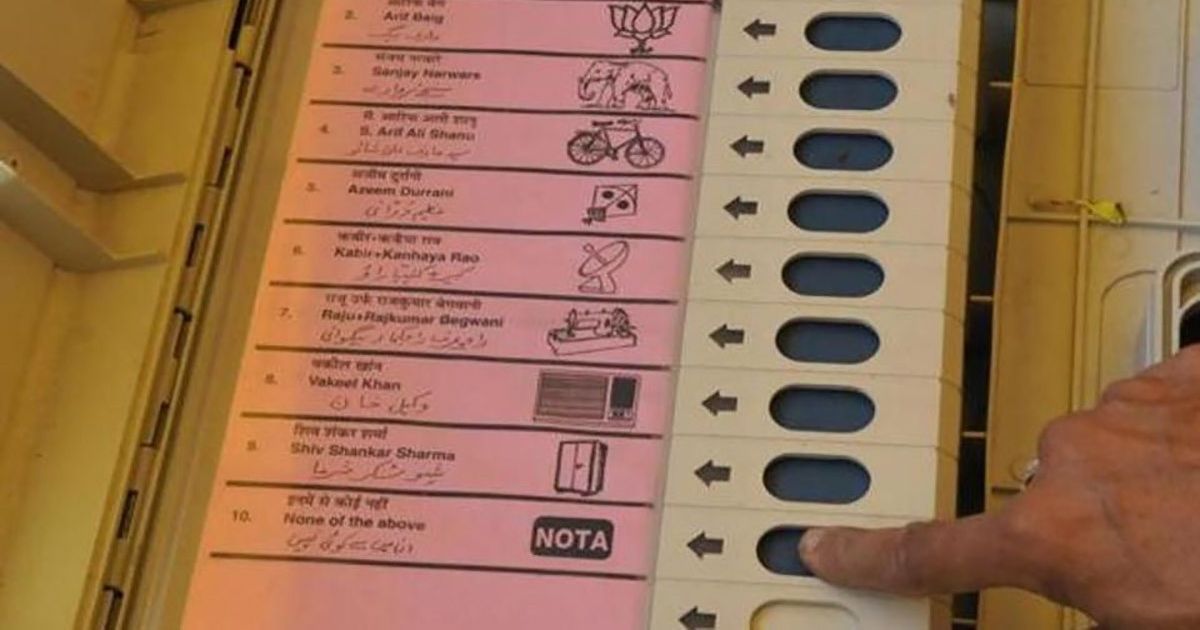
NEW DELHI: The Supreme Court on Tuesday asked whether the provision of NOTA option in the assembly and general elections have improved the “quality of elected leaders”, saying that it cannot fill up a seat.
A bench comprising Chief Justice Surya Kant and Justice Joymalya Bagchi was hearing a PIL challenging a provision of the Representation of the People Act, 1951 on the ground that it prevented voters from choosing the NOTA option in case of a lone candidate.
The plea sought to make NOTA option compulsory in all elections, including those with a single candidate.
NOTA (None of the Above) was introduced in 2013 in view of the direction issued in a landmark judgment in the case of People’s Union for Civil Liberties vs Union of India.
The top court had directed the Election Commission to provide a NOTA option on electronic voting machines.
During the brief hearing on Tuesday, Justice Bagchi asked, “Has the quality of the leaders elected improved with NOTA.”
The judge said NOTA cannot become an entity because it cannot fill up a seat despite getting the maximum number of votes.
The bench also said that there should be an endeavour to make voting compulsory in elections to ensure that good candidates win.
Attorney General R Venkataramani opposed the plea and said, “We are entering into too many hypothetical laws. Law cannot be tested like this. The right to vote is a constitutional right.”
The top court has now fixed the plea for hearing on March 17.
On October 21, 2024, the apex court agreed to examine the plea and issued notice to the Centre and the EC.
The PIL filed by legal think-tank, Vidhi Centre for Legal Policy, challenged validity of the Section 53(2) of the Representation of the People Act, which deals with the procedure in contested and uncontested elections.
Section 53(2) says if the number of contesting candidates is equal to the number of seats to be filled, the returning officer shall forthwith declare all such candidates to be duly elected to fill those seats.
The plea further sought that Rule 11 read with Forms 21 and 21B of the Conduct of Election Rules, 1961, be struck down.
Rule 11 of the 1961 Election Rules deals with the publication of a list of contesting candidates and declaration of results in uncontested elections.
“In direct elections (elections to the House of the people and state legislative assemblies) which are uncontested, the impugned sub-section (2) prevents voters from being able to cast a ‘negative vote’ by choosing the ‘none of the above’ option if there is only one candidate,” the plea argued.
It said since 1952, over 82 lakh voters were deprived of the opportunity to exercise their franchise in elections to the House of the people owing to the operation of the sub-section.
The plea referred to another top court verdict clarifying the right extended only to direct elections which were constituency-based and not to indirect elections, which were based on proportional representation.