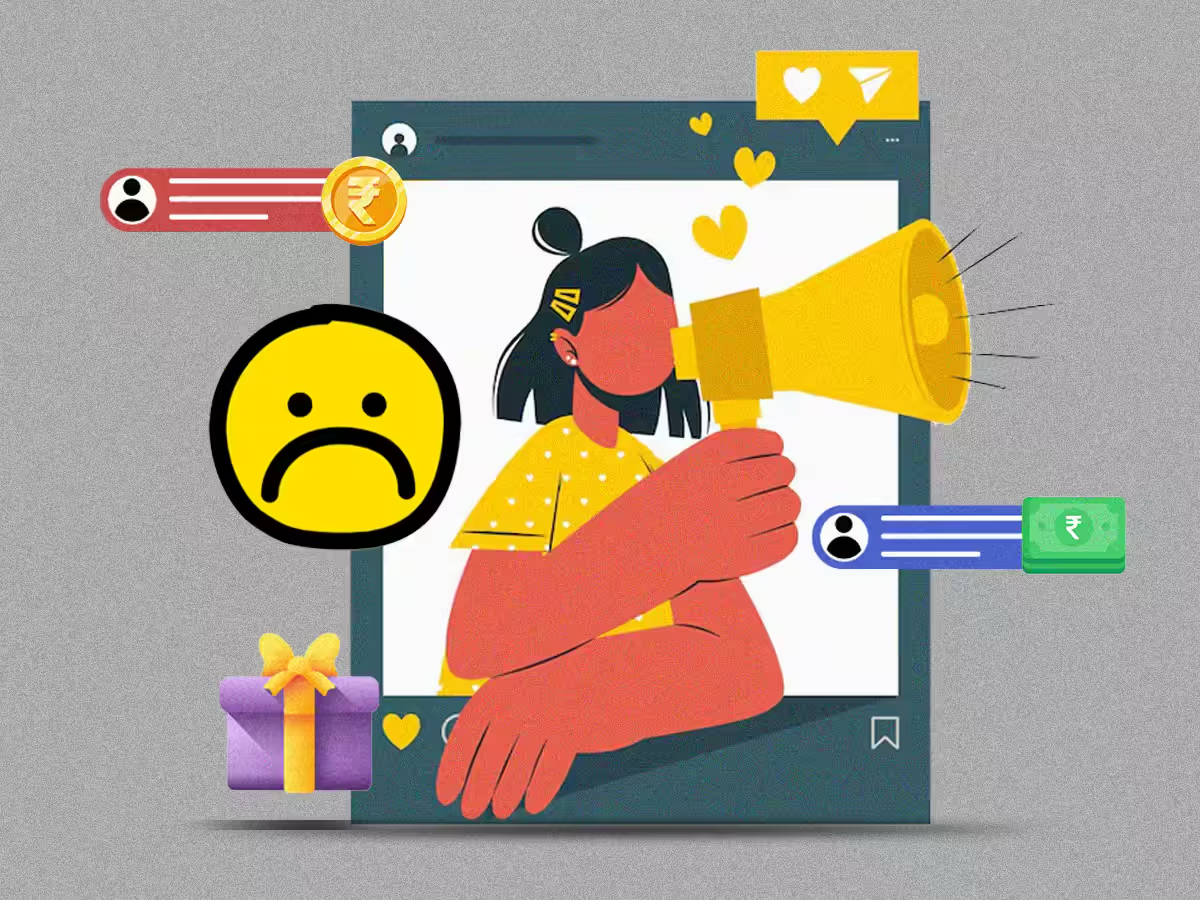
NEW DELHI: Shaping taste, opinion and consumption on social media is no longer a casual side hustle. For millions of creators, influencing is full-time work and a primary source of income. Brands pour money into influencer marketing, platforms monetise creator-led engagement through advertising, and audiences increasingly rely on influencers for information, entertainment and advice. Yet the systems that determine how this income is generated, disrupted or withdrawn remain largely opaque and weakly regulated.
This regulatory gap was recently highlighted by Member of Parliament Raghav Chadha, who drew attention to the precarious economic position of digital creators. While his intervention addressed creators broadly, it raised a sharp policy concern: livelihoods dependent on private digital platforms can be destabilised overnight by algorithmic changes, content demonetisation or takedowns, often without clear reasons, timelines or effective remedies.
At the heart of the issue lies a growing structural tension. Social media platforms are private entities, but they exercise power that increasingly resembles regulatory authority. Decisions about visibility, monetisation or account continuity directly affect incomes, yet are governed by internal policies that are automated, non-negotiable and shielded from public scrutiny. A minor algorithmic tweak, a copyright flag or a policy reinterpretations can wipe out earnings instantly, leaving creators with little explanation and even less recourse.
Chadha’s argument underscores the concentration of economic power in platform governance. When platforms unilaterally set and enforce rules that determine income, without the constraints of labour law, due process or constitutional safeguards, an accountability gap emerges. Creators are economically dependent, but legally vulnerable.
Indian law has yet to meaningfully respond to this shift. Influencers are not employees and therefore fall outside traditional labour protections. At the same time, contract law offers limited relief because platform terms of service are standard-form agreements with no scope for negotiation. Legal frameworks such as the Copyright Act, 1957 were drafted for a pre-digital economy and struggle to accommodate contemporary practices like transformative or incidental use. Automated copyright enforcement, in particular, can lead to disproportionate takedowns or demonetisation, directly impacting income.
This legal vacuum allows platforms to impose what are effectively economic sanctions without statutory safeguards. Income can be lost without clear reasoning, decisions may remain under review indefinitely, and appeal mechanisms are often inaccessible or ineffective. The result is not just individual hardship, but systemic insecurity across the digital creator economy.
The case for regulation, as Chadha frames it, is not about wage control or micromanaging content. It is about establishing minimum standards of fairness, transparency and predictability. One plausible approach is to impose due process obligations on platforms before actions that significantly affect creator income. This could include advance notice, reasoned explanations for demonetisation or takedowns, defined timelines for review and accessible avenues of appeal. Such procedural safeguards are familiar to administrative law and can be adapted to the digital economy without undermining platform autonomy.
Proportionality is another crucial principle. Minor or disputed violations should not trigger complete loss of monetisation. Enforcement measures must reflect the severity of harm, not operate as blunt instruments. Without this balance, platforms risk using economic penalties in ways that are excessive and arbitrary.
Critics argue that regulation could stifle innovation or burden platforms. Yet the absence of regulation also has costs. Economic uncertainty discourages sustained investment in content creation and entrenches platform dominance. Clear rules, by contrast, can reduce disputes, increase trust and stabilise the ecosystem. In this sense, regulation functions less as a constraint and more as an enabler of long-term growth.
Chadha’s intervention marks an important recognition: influencer income is no longer a purely private arrangement between creators and platforms. It has become a public policy issue involving livelihoods, economic rights and the regulation of concentrated corporate power.