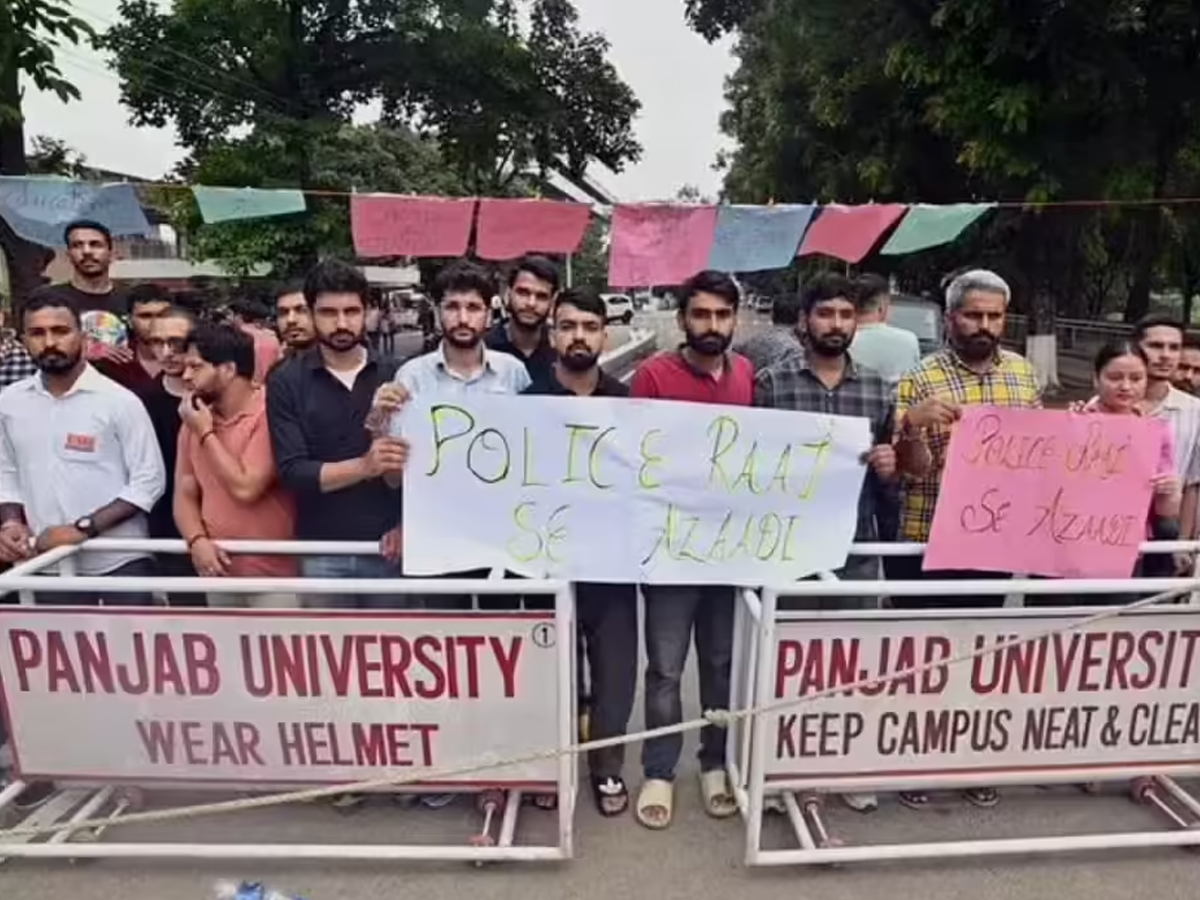
Tension gripped the Panjab University campus in Chandigarh on Monday, November 10, after protests demanding senate elections turned violent. Clashes broke out between protesters and the UT police at the main gates of the university as demonstrators tried to enter the campus.
The agitation, which began peacefully, soon drew large crowds of students, teachers, Sikh organisations, and farmer unions. They are demanding the immediate announcement of the Panjab University senate elections — which have been pending since last year — and the protection of the university’s autonomy.
Panjab University Protest: How the Clash Started
The situation escalated in the morning when groups of protesters tried to push through the university’s gates despite heavy police presence. Police used canes to stop them, but the demonstrators outnumbered the force.
Chandigarh’s Senior Superintendent of Police (SSP) Kanwardeep Kaur was seen trying to calm the situation. “Police said they were trying to prevent outsiders from entering the campus,” an officer said.
What Happened Inside the Punjab University Campus?
Once inside, nearly 500 protesters gathered near the Vice-Chancellor’s office. A temporary stage was set up, and the protest began with an ardaas (Sikh prayer).
Several student leaders and former senators addressed the gathering. Among the main speakers were PUCSC vice-president Ashmeet Singh, former senator Ravinder Singh Dhaliwal, student leader Rimaljot Singh, and Students for Society president Sandeep.
The university administration had already declared November 10 and 11 as holidays, leaving the campus mostly empty except for the protesters. The speakers demanded that Panjab University’s democratic structure and autonomy must remain untouched.
Police Deployment Across Chandigarh
Authorities deployed nearly 2,000 police personnel across Chandigarh to prevent escalation. They also set up 12 checkpoints on major roads, leading to long traffic jams — especially on the Zirakpur-Chandigarh highway.
Traffic movement slowed down near the Mohali and Mullanpur borders as police stopped protesters coming in from Punjab. The UT administration said the measures were to maintain peace and prevent outsiders from disrupting order.
Why the Protest Began in Punjab University?
The current agitation is the result of months of delay in holding Senate elections. The term of the previous senate ended in October 2024. The Centre’s recent attempt to change the structure of the university’s governing bodies further angered the academic community.
On October 28, the Union government issued a notification to amend the Panjab University Act, 1947. The proposed changes would have reduced the senate from 97 to 31 members and replaced elections for the syndicate — the executive body — with nominations.
The move would have also ended elections for PU graduates, a constituency that historically participated in shaping university governance.
The Centre’s action was widely criticised as an attack on the university’s autonomy and Punjab’s stake in it. Critics saw it as an effort to centralise control and undermine the state’s role.
Centre Withdraws the Notification
After strong opposition from teachers, students, and political groups, the Centre withdrew the notification on November 7. The decision came after days of protests and negotiations.
However, the Panjab University Bachao Morcha refused to end the agitation. It said the protest would continue until the government formally announced the schedule for the Senate elections.
Why the Issue Goes Beyond the University?
The dispute over Panjab University’s governance is deeply tied to Punjab’s political and cultural identity.
Established in 1882 in Lahore as the University of the Punjab, the institution shifted to India after Partition and became Panjab University in 1947. Its headquarters moved several times — from Shimla to Jalandhar — before settling in Chandigarh.
After the reorganisation of Punjab in 1966, Chandigarh became a Union Territory and a shared capital for Punjab and Haryana. Panjab University became an “inter-state body corporate” under the Punjab Reorganisation Act, 1966.
Even today, the Centre funds about 85% of the university’s budget, while Punjab contributes the rest. Yet, all 200-plus colleges affiliated with PU are located in Punjab and Chandigarh.
This arrangement has long been seen by many in Punjab as unfair. The state argues that both Chandigarh and PU historically belong to Punjab, not Haryana.
That sentiment fuels today’s protests — turning a university governance issue into a matter of state identity and federal rights.
Reform Push and Different Opinions
The call for reforming the PU governing structure is not new. In 2021, then Vice President M. Venkaiah Naidu, who was also the university’s chancellor, formed an 11-member committee to suggest changes in line with the National Education Policy (NEP) 2020.
The panel had recommended a smaller senate and syndicate to make administration more efficient. Former NAAC chairman and committee member VS Chauhan said, “We had recommended replacing elections for 15 registered graduates with nominations of eminent alumni by the chancellor and giving preference to university and college academicians — both of which the government accepted.”
Panjab University officials have also argued that the large-scale elections for graduates were “complex and cost-intensive.” An official said, “The earlier Senate was highly politicised. Its election process, involving over three lakh registered graduates, was time-consuming, expensive, and often diverted attention from academic priorities.”
Under the proposed structure, the Senate would have had 31 members — 24 nominated and 7 ex officio — instead of the earlier 90. The representation of Punjab was to remain the same, with the state’s chief minister, education minister, and the chief justice of the Punjab and Haryana High Court as ex officio members.