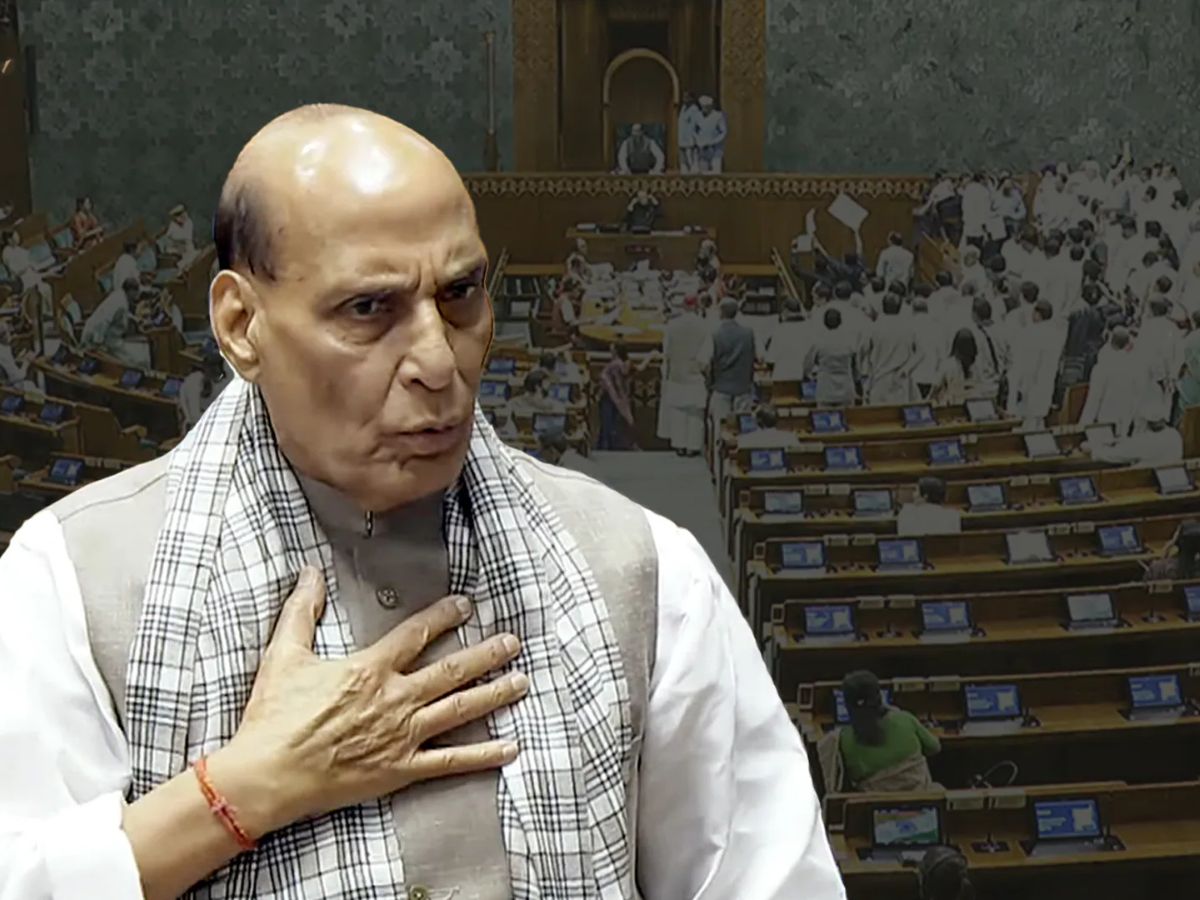
In a powerful intervention during the Operation Sindoor debate, Defence Minister Rajnath Singh reminded the Lok Sabha of the Congress-led UPA’s decision not to launch a military retaliation after the 26/11 Mumbai attacks.
Quoting from former External Affairs Minister Pranab Mukherjee’s memoir The Coalition Years, Singh said Mukherjee had admitted to rejecting the call for military action despite clear evidence that the terrorists had come from Karachi. Singh recalled Mukherjee’s reaction in a key post-attack meeting where, instead of backing a proposed cruise missile strike on Lashkar-e-Taiba’s Muridke headquarters, he simply cleaned his glasses and thanked everyone before ending the meeting.
Singh’s subtext was clear that the then government chose restraint at a time when firm action could have sent a strategic message to Pakistan.
‘A Message to Pakistan’: Purpose of Operation Sindoor
Turning to present events, Singh justified Operation Sindoor, launched after the deadly Pahalgam terror strike, which killed 26 civilians, as a calibrated, high-impact military response aimed at dismantling terror infrastructures across the border. “The operation was not about capturing land. It was to destroy terror nurseries run by Pakistan,” he said.
Revealing the strategic goals, Singh added that the armed forces were given complete freedom in target selection. “The goal was justice for the victims. And the result? Not a single Indian soldier was harmed, and the masterminds were eliminated,” he declared.
Opposition’s Questions Called Misguided
In a pointed rebuke, Singh lashed out at Opposition leaders for asking, “How many planes did India lose?” instead of celebrating the operation’s success. “The right question would have been: Did we eliminate those responsible for Pahalgam? Yes, we did,” he asserted.
#WATCH | Delhi | In the Lok Sabha, Defence Minister Rajnath Singh says, “… Few members of the Opposition have been asking how many of our aircraft were shot down? I feel their question does not adequately represent our national sentiments. They have not asked us how many enemy… pic.twitter.com/QlzKWr7BRj
— ANI (@ANI) July 28, 2025
This seemed to be a veiled response to Rahul Gandhi, who had posted a video clip accusing the government of informing Pakistan about the operation beforehand. Singh refrained from naming him, but his remarks hinted at mounting frustration within the government over the political narrative being built by the Congress.
Diplomatic Wins: From BRICS Silence to Global Condemnation
Singh also drew a contrast between diplomatic responses under UPA and NDA. He noted that the 2008 BRICS Summit failed to even mention the Mumbai terror attack, despite its magnitude. By contrast, he said, after the Pahalgam attack, India ensured that a joint statement condemning terrorism in Jammu and Kashmir was included in the BRICS declaration—even in the presence of China.
“In Brazil, the world saw India’s stand prevail. This was the first time a terror incident in J&K was condemned in a BRICS declaration,” he noted.
He added that during the SCO meet in China, India had refused to sign a joint statement that diluted its anti-terror position—a signal of the Modi government’s new diplomatic assertiveness.
Summing up his stance, Singh clarified that the intention was never to start a war. “This was not a war-footing exercise. It was an operation with limited military and political objectives—to punish Pakistan-sponsored terror,” he explained.