
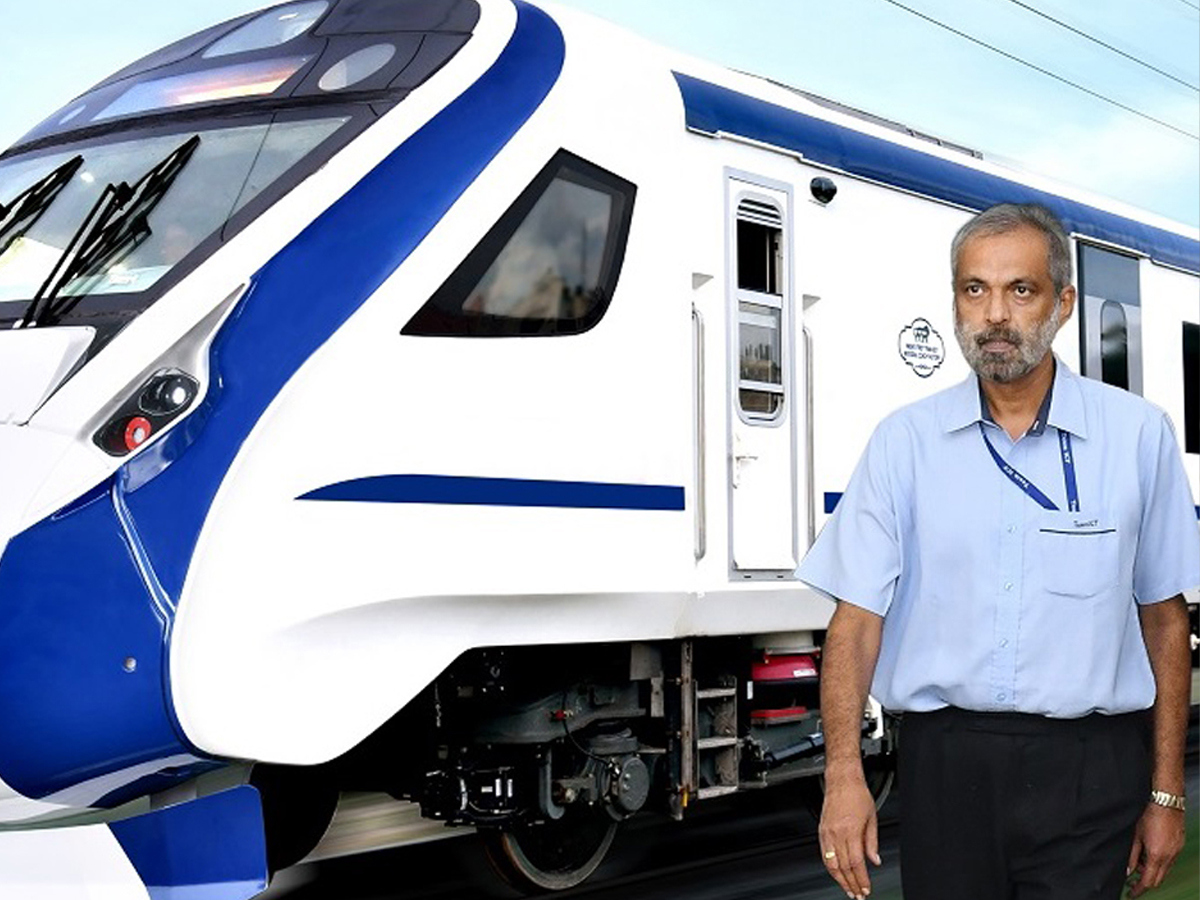
The Vande Bharat Express emerged as a game-changer for Indian Railways, a sleek semi-high-speed train built entirely in India. With modern amenities, swift acceleration, and a self-propelled design, it promised to deliver speed, comfort, and homegrown technology. What began as “Train 18” evolved into Vande Bharat, a symbol of India’s growing rail ambitions. Behind this dream stood a seasoned engineer whose vision changed how India travels by rail.
Who Is Sudhanshu Mani, the Father of Vande Bharat Express?
Sudhanshu Mani spent nearly four decades in the Indian Railways. By 2016, when the Railway Board planned to import a semi-high-speed train, Mani was serving as General Manager at the Integral Coach Factory (ICF), Chennai. He proposed a bold idea: why import, when India could build its own semi-high speed train — faster, cheaper, and indigenously?
Many were skeptical. Imported trains had proven reliability and existing infrastructure. But Mani believed in homegrown ingenuity. He argued that an Indian-built train could match performance standards while cutting costs significantly.
Vande Bharat Express: The 18-Month Race
Building Vande Bharat was not easy. The biggest challenge came in designing the self-propelled bogies, the base frame under the train that houses the propulsion system. Mani located a capable manufacturer in Kanpur to build the frame. Then, a team at ICF Chennai, 50 railway engineers and 500 factory workers, worked without pause.
In just 18 months, the prototype of Vande Bharat was ready. The design included placing the propulsion engine under the bogies for faster acceleration. With this, the train could achieve speeds up to 180 km/h, a remarkable feat for a fully Indian design.
Vande Bharat Express: Trials and Speed Feats
Vande Bharat didn’t just meet expectations, but also exceeded them. During trial runs between Gandhinagar and Mumbai, the train reportedly outpaced even high-speed rail benchmarks, showcasing smooth acceleration and efficient performance.
Sudhanshu Mani’s dream had come to life: a self-propelled, high-speed train built indigenously, cost-effective, and performance-ready. The world could see what “Make in India” could do for rail travel.
Sudhanshu Mani: Father of Vande Bharat
Today, Mani is often referred to as the father of Vande Bharat trains in India. His contribution marks a turning point in Indian Railways — demonstrating that domestic engineering can deliver world-class rail solutions.
Through decades of service, Mani’s passion for innovation reshaped the future of rail travel in India.
Why This Profile Matters
Sudhanshu Mani’s story shows how vision, persistence, and local expertise can challenge established norms. At a time when importing looked easier, he chose self-reliance. At a time when most doubted, he persevered. The success of Vande Bharat can inspire other sectors — demonstrating that homegrown solutions, when backed by commitment, can match global standards.
India’s railways now run on a train that symbolizes national pride, speed, and innovation — thanks to a man who believed in what Indian engineers could build.