
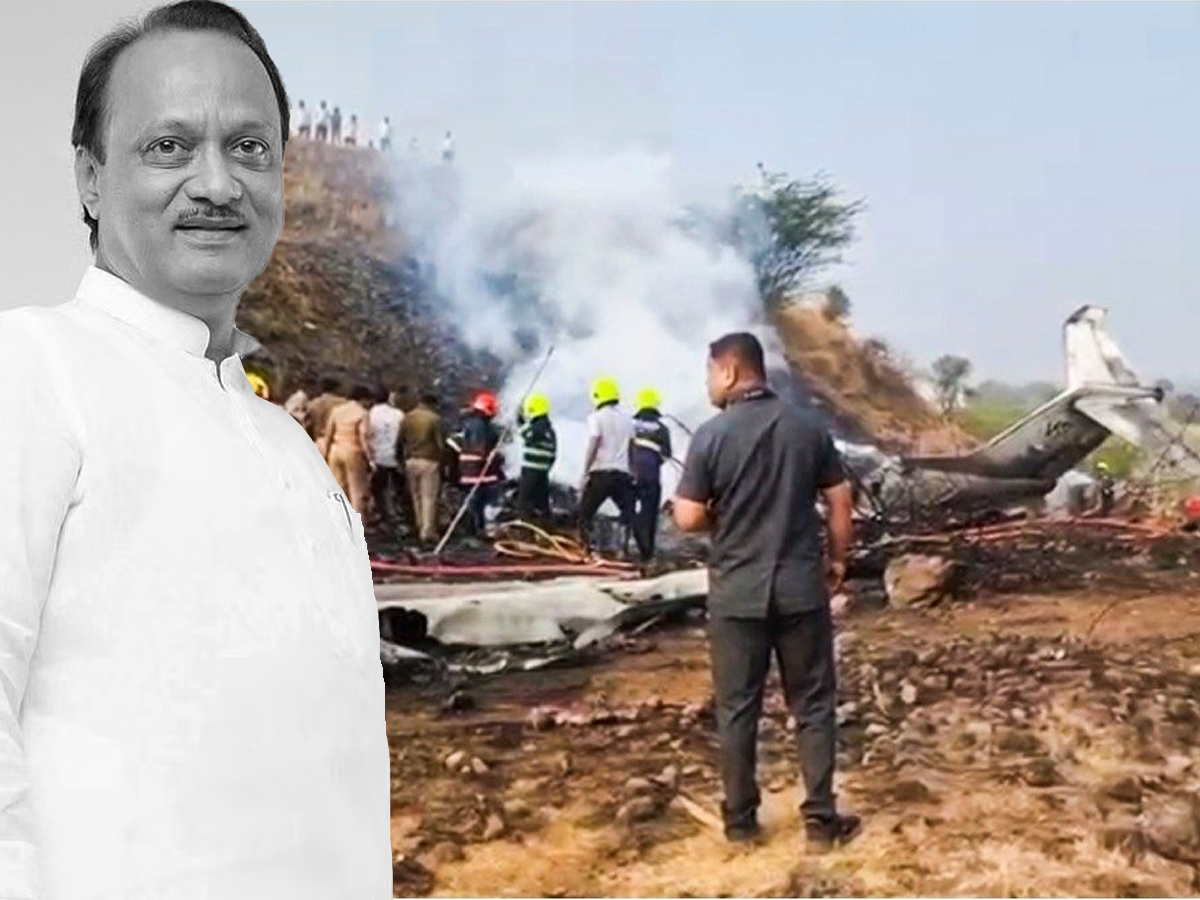
NEW DELHI: Indian politics has often been shaped not just by elections, defections, or ideological shifts, but by sudden, tragic absences. Among the most disruptive of these are deaths caused by air crashes — moments when the loss of a single leader altered party trajectories, redrew power equations, and plunged states into prolonged uncertainty. From Sanjay Gandhi in 1980 to Y.S. Rajasekhara Reddy in 2009, such tragedies have left behind legacies of unfinished agendas and political aftershocks that lasted years.
As Maharashtra once again grapples with uncertainty within the Nationalist Congress Party (NCP), these historical precedents offer critical insight into how Indian politics responds when a towering figure disappears overnight—and whether unity or fragmentation follows.
SANJAY GANDHI: THE ABRUPT END OF A POLITICAL HEIR APPARENT
On June 23, 1980, Sanjay Gandhi — the younger son of Prime Minister Indira Gandhi — died in a plane crash while performing aerobatic manoeuvres in a small aircraft over New Delhi. He was just 33 years old. At the time, Sanjay was not an elected representative, but his political influence far exceeded that of many senior Congress leaders.
During the Emergency (1975-77), Sanjay emerged as a decisive, if controversial, force within the Congress system. He exercised control over Youth Congress networks, influenced administrative appointments, and was widely perceived as Indira Gandhi’s political successor. His aggressive style and centralised control alienated many within the party, but also ensured discipline and loyalty.
Sanjay’s sudden death fundamentally altered the Congress party’s future. Indira Gandhi, left without her chosen heir, turned to her elder son Rajiv Gandhi — a reluctant politician at the time. Rajiv’s entry reshaped the Congress’s ideological direction, governance style, and eventually India’s political economy. In that sense, Sanjay Gandhi’s death did not merely end a career; it reoriented the trajectory of Indian national politics for over a decade.
MADHAVRAO SCINDIA: THE LOSS OF A MODERATE BRIDGE-BUILDER
On September 30, 2001, Madhavrao Scindia — a senior Congress leader and former Union Minister — was killed in a plane crash near Mainpuri in Uttar Pradesh. Scindia, a member of the erstwhile Gwalior royal family, was widely respected across party lines for his measured politics, administrative experience, and grassroots connect.
At the time of his death, Scindia was being seen as one of the Congress’s most credible national leaders — a rare figure capable of balancing regional influence with national stature. His loss weakened the Congress in Madhya Pradesh and Uttar Pradesh, regions where he had worked to rebuild the party after years of decline.
Politically, Scindia’s death triggered a generational shift. His son, Jyotiraditya Scindia, entered politics soon after and initially carried forward the Congress legacy. However, the absence of Madhavrao’s stabilizing influence and ideological anchor arguably contributed to Jyotiraditya’s eventual defection to the BJP in 2020 — a move that collapsed the Kamal Nath government in Madhya Pradesh and redrew the state’s political map.
OM PRAKASH JINDAL: INDUSTRIAL POWER AND POLITICAL SUCCESSION
In March 2005, Om Prakash Jindal — industrialist, politician, and Haryana’s Power Minister — died in a helicopter crash. Unlike mass leaders driven by ideological politics, Jindal represented a hybrid power centre: industrial capital fused with regional political influence.
His death marked a moment of transition rather than collapse. The Jindal family quickly regrouped, with his widow Savitri Jindal and later his sons stepping into political and corporate leadership roles. Yet the episode highlighted a recurring theme in Indian politics — where dynastic continuity often cushions the shock of sudden leadership loss, preventing immediate fragmentation but entrenching family-centric power structures.
Y.S. RAJASEKHARA REDDY: A STATE THROWN INTO TURMOIL
Few air crash deaths have had consequences as dramatic as that of Y.S. Rajasekhara Reddy, then Chief Minister of undivided Andhra Pradesh. On September 2, 2009, YSR died when his helicopter crashed in the Nallamala forest region during inclement weather.
YSR was not merely a Chief Minister; he was a mass leader with deep emotional connect among farmers, rural voters, and welfare beneficiaries. His death triggered spontaneous public grief, mass protests, and political instability. The Congress government struggled to maintain cohesion, while regional aspirations — particularly the Telangana movement — gained renewed momentum.
Within years, the Congress lost its dominance in the state. YSR’s son, Y.S. Jagan Mohan Reddy, broke away to form the YSR Congress Party, ultimately displacing the Congress as the principal political force. The state itself was bifurcated in 2014. In retrospect, YSR’s death accelerated processes that permanently altered Andhra Pradesh’s political landscape.
PATTERNS FROM THE PAST: TRAGEDY, TRANSITION, AND REALIGNMENT
These cases reveal a clear pattern. When a political leader dies suddenly in an air crash:
-
Immediate emotional unity often gives way to factional competition.
-
Organisational weaknesses within parties become exposed.
-
Succession struggles emerge, whether dynastic or ideological.
-
Rival parties exploit the vacuum to expand influence.
The outcome depends less on public sympathy and more on whether institutional mechanisms exist to manage leadership transition.
MAHARASHTRA AND THE NCP: A PARTY AT A CROSSROADS
Maharashtra today finds itself confronting a familiar dilemma — the absence of a dominant political strategist within the Nationalist Congress Party. Over the years, the NCP has relied heavily on a centralised leadership structure, where authority flowed downward rather than emerging organically from institutions.
This has left the party vulnerable whenever internal cohesion weakens. Unlike the Congress or BJP, the NCP lacks a clearly institutionalised second line of leadership that commands equal legitimacy across regions.
The consequences are not limited to party offices. Maharashtra’s coalition politics — already complex due to shifting alliances — is particularly sensitive to internal instability within key partners.
WILL NCP FACTIONS UNITE OR DRIFT FURTHER APART?
The question dominating Maharashtra’s political discourse is whether the NCP’s warring factions can find common ground. Historically, Indian parties faced with sudden leadership loss follow one of three paths:
-
Temporary unity under a caretaker consensus.
-
Formal split into rival factions.
-
Gradual erosion as leaders defect individually.
Given the NCP’s past trajectory, unity is possible — but fragile. Without a commanding figure to arbitrate disputes, personal ambition may override collective survival. Leaders with strong regional bases may prioritise negotiations with national parties over internal reconciliation.
At the same time, the emotional resonance of loss can act as a short-term adhesive, delaying open conflict. Whether this translates into lasting unity depends on how leadership roles are redistributed and whether the party reinvents its organisational structure.
MAHARASHTRA’S POWER VACUUM: BEYOND ONE PARTY
The implications extend beyond the NCP. Maharashtra is India’s financial engine and one of its most politically influential states. Any instability reverberates nationally.
A weakened NCP alters coalitional arithmetic, strengthening the bargaining position of larger national parties, and reshapes electoral strategies ahead of crucial polls. Governance may continue, but decision-making slows as political actors hedge their bets.
For voters, such uncertainty often results in cynicism and disengagement — fertile ground for alternative narratives, populist appeals, or consolidation around dominant players.