
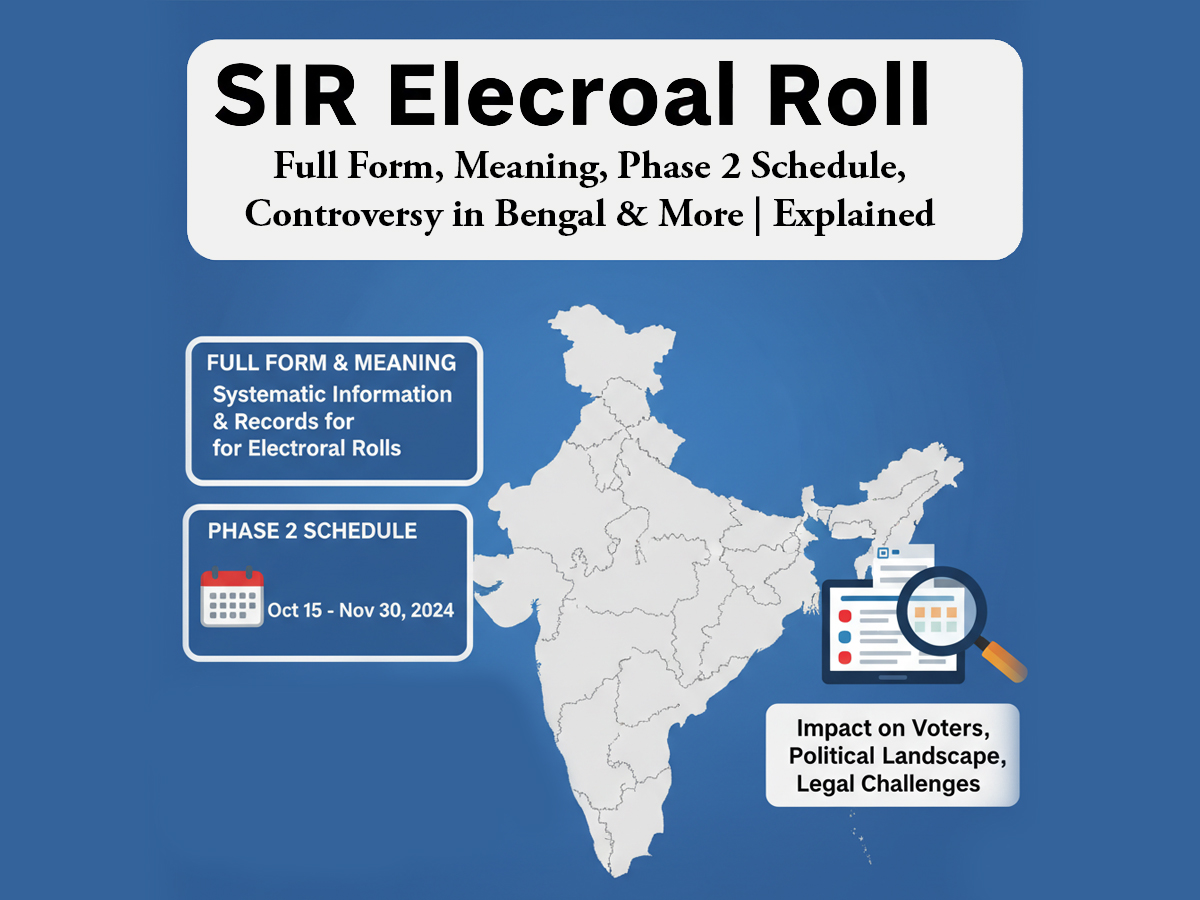
The Election Commission of India (ECI) is conducting a Special Intensive Revision (SIR) of the electoral rolls across several states to ensure clean and updated voter lists. The process aims to include all eligible voters and remove ineligible names. However, the exercise has sparked political debate, particularly in Bihar and West Bengal.
What is the Full Form of SIR?
SIR Stands for Special Intensive Revision.
What Is the SIR?
The Special Intensive Revision is an exercise to rebuild the voter list through house-to-house enumeration. Booth Level Officers (BLOs) visit each household to list all eligible voters as of a qualifying date. The process does not rely on existing rolls, ensuring a fresh and accurate register.
This comprehensive verification helps identify dead, permanently shifted, or duplicate voters. According to the Election Commission, “The effort is to ensure that no eligible citizen is left out while no ineligible person is included in the Electoral Roll.”
The SIR usually takes place before major elections or after constituency changes. In Bihar, the exercise started on July 1, with the final electoral roll expected on September 30, after claims and objections are reviewed.
What is the SIR Controversy with Bihar?
In Bihar, where assembly elections are approaching, the SIR process became a political flashpoint between the Congress and the BJP. Opposition parties alleged irregularities and questioned the timing of the revision, suggesting it could influence the electoral process. However, the ECI maintained that the revision is a routine administrative exercise aimed at improving voter accuracy.
The Election Commission clarified that Aadhaar numbers may be accepted voluntarily during the process for voter identification but are not mandatory.
What is the SIR Controversy with West Bengal?
West Bengal is among the 12 states participating in Phase 2 of the SIR. The state government has reportedly expressed concerns about the timing and coordination of the exercise.
Responding to this, Chief Election Commissioner Gyanesh Kumar said, “Under the Constitution, every Constitutional body has to fulfil their responsibility.” He reaffirmed the Commission’s commitment to carrying out the process fairly and transparently.
The EC will revise the voter lists in West Bengal through field visits, data verification, and inclusion of new voters, especially first-time electors.
SIR Phase 2 Full List
The second phase of the Special Intensive Revision (SIR) will take place in 12 states and union territories:
- Andaman and Nicobar Islands,
- Chhattisgarh,
- Goa,
- Gujarat,
- Kerala,
- Lakshadweep,
- Madhya Pradesh,
- Puducherry,
- Rajasthan,
- Tamil Nadu,
- Uttar Pradesh,
- West Bengal.
What is the Schedule of Phase 2?
The Election Commission of India (ECI) has announced the detailed schedule for the Phase 2 of the Special Intensive Revision (SIR) of Electoral Rolls.
- Printing and Training Activities: October 28 to November 3, 2025.
- House-to-House Enumeration Phase: November 4 to December 4, 2025.
- Publication of Draft Electoral Rolls: December 9, 2025.
- Claims and Objections Period: December 9, 2025 to January 8, 2026.
- Notice Phase (Hearings and Verifications): December 9, 2025 to January 31, 2026.
- Final Electoral Rolls will be published: February 7, 2026.
This structured timeline ensures that every eligible voter is accurately included and that the electoral database remains transparent and up to date.
Why SIR Is Important?
The SIR is essential to maintaining a fair electoral system. It ensures that every eligible citizen can vote and that no fraudulent or duplicate entries exist in the voter lists. A transparent electoral roll builds trust in the democratic process and strengthens public confidence ahead of elections.