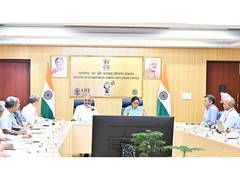
New Delhi [India], May 27 (ANI): Union Minister for Environment, Forest and Climate Change, Bhupender Yadav, on Tuesday held a comprehensive review meeting with the Chief Minister of NCT Delhi, Rekha Gupta, and senior officials of the Delhi Government, who will assess the progress of ongoing measures aimed at improving air quality in the National Capital.
According to the Ministry of Environment, Forest and Climate Change, during the meeting, the Minister emphasised the need for accelerated implementation, stronger inter-agency coordination and strict enforcement to ensure a substantial reduction in pollution levels before the onset of the winter season. Other dignitaries present in the meeting included Pravesh Sahib Singh, Minister for Public Works Department, and Sardar Manjinder Singh Sirsa, Minister for Environment, Forest and Wildlife, GNCTD.
Yadav underlined that air pollution mitigation requires sustained and coordinated action by all stakeholders. He appreciated the efforts being undertaken by the Delhi Government while stressing that identified implementation gaps must be addressed in a mission-mode manner.
He said, “The coming months are crucial for Delhi’s air quality management. Timely completion of planned interventions, strict enforcement and coordinated action on the ground are essential to protect public health and improve the quality of life for citizens.”
Reviewing the issue of road dust mitigation, the Minister noted the need for a more focused approach to meet annual targets for road redevelopment and address delays in planning, tendering, issuance of work orders and supply-chain disruptions. He urged the Delhi Government to expedite execution as per a targeted action plan, so that all pending redevelopment works are completed by October 2026.
Yadav also called for extensive greening activities alongside roads by identifying open patches to minimise dust pollution. He further highlighted that the pending Memorandum of Agreement (MoA) with the Central Road Research Institute (CRRI) and the School of Planning and Architecture (SPA) may be finalised by the end of May 2026, to ensure adherence to prescribed road development standards.
The Minister also reviewed the deployment of Mechanised Road Sweeping Machines (MRSMs) and observed the need for a significant increase in their current numbers. He requested the Delhi Government to intensify road-cleaning operations and ensure deployment of 78 large and medium MRSMs, along with 1,000 litter pickers, by September 2026, as proposed earlier. He said that intensive and deep road cleaning and dust suppression remain among the most effective interventions for reducing particulate pollution in urban areas.
On public transport and electric mobility, Yadav emphasised the need for procurement of more electric buses and urged the Delhi Government to bridge the gap through a phase-wise action plan by October 2026. He also emphasised the need for rapid augmentation of EV public charging infrastructure across the city. Stressing the importance of regional coordination, the Minister said that EV adoption across the wider NCR region must also be incentivised.
The Minister stressed the need for strengthening Delhi’s metro network and improving multi-modal last-mile connectivity to bridge the demand-supply gap, hence encourage greater public transport usage and reduce vehicular emissions. He urged that last-mile connectivity initiatives should be fully integrated with the broader city transport plan to ensure seamless and convenient mobility for commuters.
Reviewing measures related to End-of-Life (EoL) vehicles, Yadav asked authorities to expedite the issuance of No Objection Certificates (NOC) for the transfer of EoL vehicles outside the NCR region. He also requested that Automatic Number Plate Recognition (ANPR) cameras be installed at all border entry points by September 2026 to strengthen monitoring and enforcement. Yadav also laid stress on augmenting the capacity for testing the fitness of commercial vehicles in Delhi.
The Minister further urged that 15 stretches in Delhi be identified and developed as signal-free corridors by September 2026, in order to reduce congestion and vehicular idling emissions. He also asked concerned agencies to identify major pollution hotspots and undertake targeted interventions for decongestion and pollution abatement.
During the review of public parking infrastructure, Yadav called for an increased push to develop new parking facilities to meet planned targets. He urged the Delhi Government to take focused action and ensure the creation of adequate parking facilities by December 2026, as per the approved plan.
On industrial pollution, the Minister stressed that regular calibration and proper functioning of Online Continuous Emission Monitoring Systems (OCEMS) and Air Pollution Control Devices (APCDs) be ensured across industrial units, and adequacy of APCDs be ensured with reference to the new norms for industrial emissions issued by CAQM. He emphasised that inspections must be conducted regularly and GNCTD must ensure that data from these OCEMS devices continuously flow to the CPCB server for monitoring. He further urged that non-compliant units should face strict enforcement action, including sealing where necessary.
Yadav also called for intensified inspections of industries operating in non-conforming areas and directed authorities to take appropriate action for relocation, regularisation, and closure of such units in accordance with environmental norms by involving the District Administration. He further instructed that enforcement drives against non-compliant diesel generator sets be intensified across the city.
Reviewing construction and demolition (C&D) waste management, the Minister highlighted the existing gap of nearly 1,000 tonnes per day in processing capacity and requested that additional processing facilities be augmented by December 2026. He also urged the Municipal Corporation of Delhi to ensure geotagging of all C&D waste transport vehicles by July 2026. Stressing the need for strict monitoring, Yadav requested DPCC, MCD and NDMC to intensify inspections at construction sites and ensure that every active construction site is inspected at least once every month. He further called for strict enforcement action against non-compliant sites and urged government agencies to set clear targets for utilisation and offtake of processed C&D waste.
On municipal solid waste management, the Minister requested the Delhi Government to ensure achievement of legacy waste liquidation targets within committed timelines. He also stressed the need for the augmentation of fresh municipal solid waste processing facilities by September 2026 and called for firm timelines for the commissioning of Waste-to-Energy plants.
Expressing concern over incidents of waste burning during the winter months, Yadav reiterated the need for a zero-tolerance policy against open waste burning. He called on the authorities to deploy adequate enforcement teams to prevent violations and advised Resident Welfare Associations (RWAs) to provide heating facilities to workers during winter so that open burning practices are discouraged.
The Minister also emphasised the importance of Information, Education and Communication (IEC) activities for effective waste management and directed that all stakeholders be sensitised in accordance with the CAQM IEC framework. He further requested that green crematorium facilities be ensured at all 36 identified locations in Delhi.
Highlighting the importance of public participation and coordinated institutional action, Yadav suggested that intensive greening and deep-cleaning campaigns may be launched immediately, as well as be organised once monsoons are over. It would help in addressing the issue of legacy dust that gets accumulated on roads/drains/railtracks after rains and becomes a major cause of air pollution. These campaigns, Yadav added, may follow a ‘Whole of Government’ and ‘Whole of Society’ approach, with concerted efforts from the Union and the Delhi Governments, by encouraging public participation.
The Minister said, “Air pollution control requires collective responsibility and continuous action at every level. The Centre remains committed to working closely with the Delhi Government and all stakeholders to ensure cleaner air for the people of Delhi.” He further advised that the Delhi Government may create task forces composed of political and official representatives to tackle air pollution hotspots in the National Capital. The teams may coordinate with respective agencies and conduct monthly reviews to closely monitor implementation and ensure accountability on committed timelines, he concluded. (ANI)
The article has been published through a syndicated feed. Except for the headline, the content has been published verbatim. Liability lies with original publisher.