
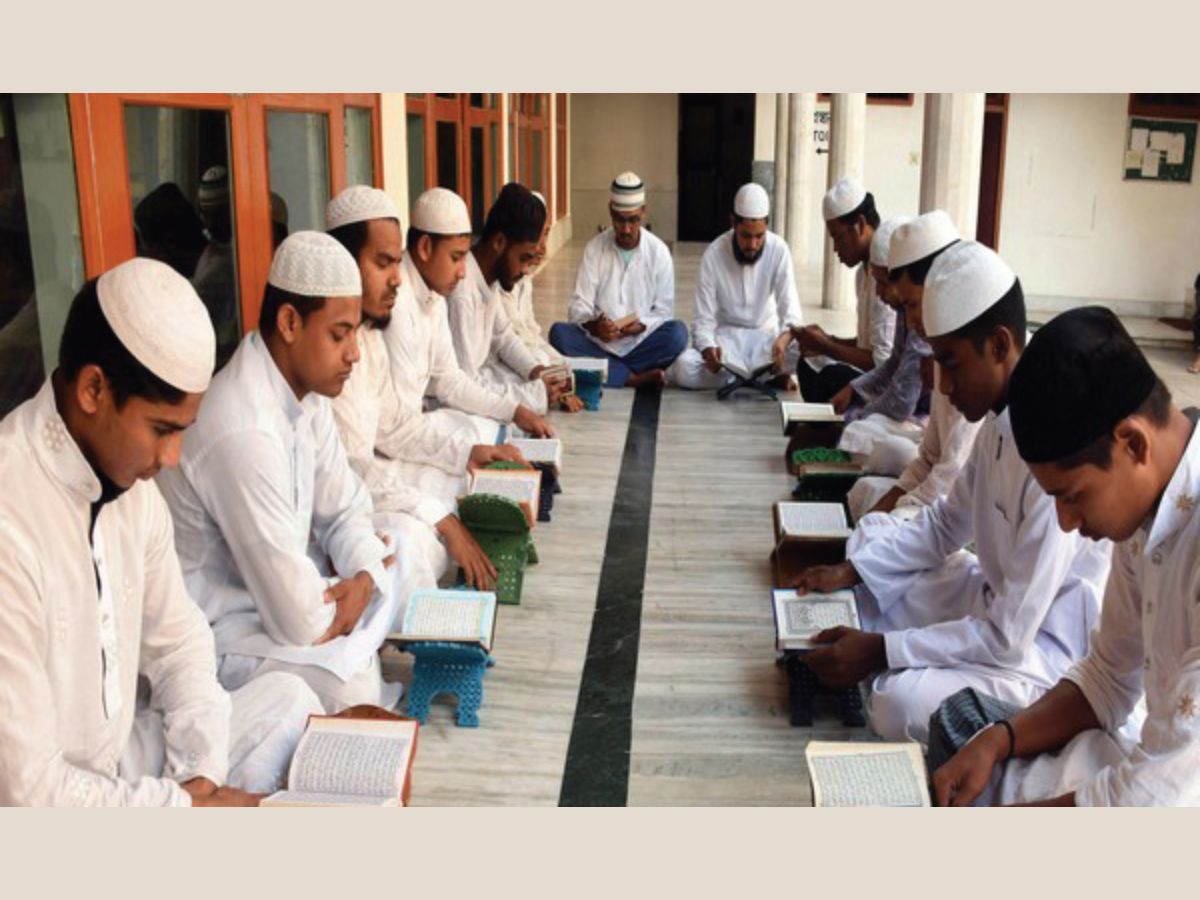
The Uttarakhand government’s move to scrap the madrasa board and replace it with the Uttarakhand State Minority Education Authority (USMEA) has attracted sharp criticism from Muslim bodies and scholars across India with several of them terming the move as unconstitutional while some have demanded that the move be withdrawn.
While some Muslim groups have moved the Uttarakhand High Court against the government’s move, Muslim leaders, including the Uttarakhand Muslim Seva Sangathan, have condemned the action, calling it a direct assault on minority rights to education.
“The way the madrasa board has been finished in Uttarakhand. It is regrettable and I criticise it on behalf of the All India Shia Personal Law Board (AISPLB) as madrasas are completely being targeted. On one hand, Modi ji (PM) is saying that in madrasas, there should be laptop in one hand of a student and Quran in the other….the PM is talking about sabka saath, sabka vikas (togetherness and development of all). And on the other hand, the way the Uttarakhand government has acted against the Madaris-e-Arabiya and the way it has ended the madrasa board…. this is absolutely incorrect,” said the AISPLB spokesperson Maulana Yasoob Abbas.
Abbas further said that in the past, madrasas have produced IAS, IPS, ministers, engineers and people on top posts and Madaris-e-Arabiya has given significant contribution in the country’s freedom struggle. “I object to this decision of Uttarakhand government and would like to tell the UP government that it would be better if they also strengthen the madrasa board as much as possible,” he said.
Maulana Rashid Firangi Mahal, an executive member of the All India Muslim Personal Law Board (AIMPLB) and the chairman of the Islamic Centre of India said in a statement that the move is against law and the Constitution even as he demanded that the move be withdrawn by the Uttarakhand government.
Speaking to TDG, SQR Ilyas, spokesperson for the All India Muslim Personal Law Board (AIMPLB) said that while some groups have moved the Uttarakhand High Court against the decision of the government to scrap the madrasa board, the move is anti-minority rights guaranteed in articles 29 and 30 of the Constitution of India. “The move has already been challenged in the High Court and hopefully, it will be scrapped,” he said.
With the Uttarakhand government rendering the board obsolete, the USMEA will now determine the syllabus and nature of education to be provided to children from the minority community as all minority institutions will now have to be affiliated with the Uttarakhand Board of School Education.
The government has cited functioning of a large number of madrasas illegally which it has claimed functioned as “centres of radicalisation” as a reason to disband the board. Uttarakhand CM Pushkar Singh Dhami said that the madrasas were not imparting conventional education to the children of the minority community.
The first USMEA constituted by the Dhami government will be an 11-member body with Professor Surjeet Singh Gandhi as its chairman. Besides Gandhi, USMEA will include eight government-nominated academicians and two ex officio-members, namely, the director general of school education and the director of the State Educational Research and Training Council.