More than two weeks after a deadly ambush in Manipur’s Kangpokpi district triggered a fresh cycle of violence and retaliatory abductions, around 20 civilians from the Naga and Kuki-Zo communities remain missing or allegedly held hostage, deepening fears of another prolonged ethnic flashpoint in the troubled hill state.
The crisis, centred mainly in Kangpokpi and Senapati districts, has led to mass protests, economic blockades, emergency negotiations and growing public anger. While security forces continue search operations and community leaders appeal for calm, the situation remains tense, with mistrust running deep between the two tribal groups.
The immediate trigger came on May 13 when armed attackers ambushed two vehicles carrying Kuki Baptist Church leaders in Kangpokpi district. Reverend Vumthang Sitlhou, Reverend Kaigoulun, Pastor Paogoulen and their driver were killed in the attack.
Soon after the killings, both sides accused each other of involvement. Kuki organisations blamed Naga militants, while Naga bodies denied the allegations and accused the other side of using the incident to fuel tensions.
Within hours, retaliatory abductions began across parts of Kangpokpi and Senapati. Initial estimates suggested that between 38 and 50 people, including women, students, minors and pastors, were taken hostage by armed groups and village defence volunteers linked to both communities.
On May 15, after negotiations involving church leaders, civil society organisations and security forces, 14 people from each side were released in a mutual exchange. Additional humanitarian releases later followed, including elderly persons, women and two Salesian brothers.
However, the deadlock has still not been resolved.
Kuki groups claim that 14 villagers from Taphou Kuki Village and nearby areas continue to remain in the custody of Naga groups or village guards in Senapati district. On the other side, Naga organisations say six Naga men, believed to be civilians from the Konsakhul area and nearby villages, remain missing and are feared to be held by Kuki-Zo armed groups linked to the Leilon Vaiphei area.
The continuing uncertainty has now spilled onto the streets.
On May 25, thousands of people from Naga and Meitei communities held a joint protest rally in Imphal and nearby Kanglatongbi-Namdilong areas. The rally, organised mainly by the Naga People’s Union Imphal and supported by several Naga bodies, also saw participation from Meitei groups and some members of the Gorkha community.
The protesters marched from Tribal Market and submitted memorandums to the state government demanding immediate rescue of the six missing Naga men. Protesters also raised slogans against armed groups operating under Suspension of Operations (SoO) agreements and demanded stronger action from the government and security agencies.
The joint participation of Nagas and Meiteis was seen as politically significant in a state where relations between communities have often remained strained.
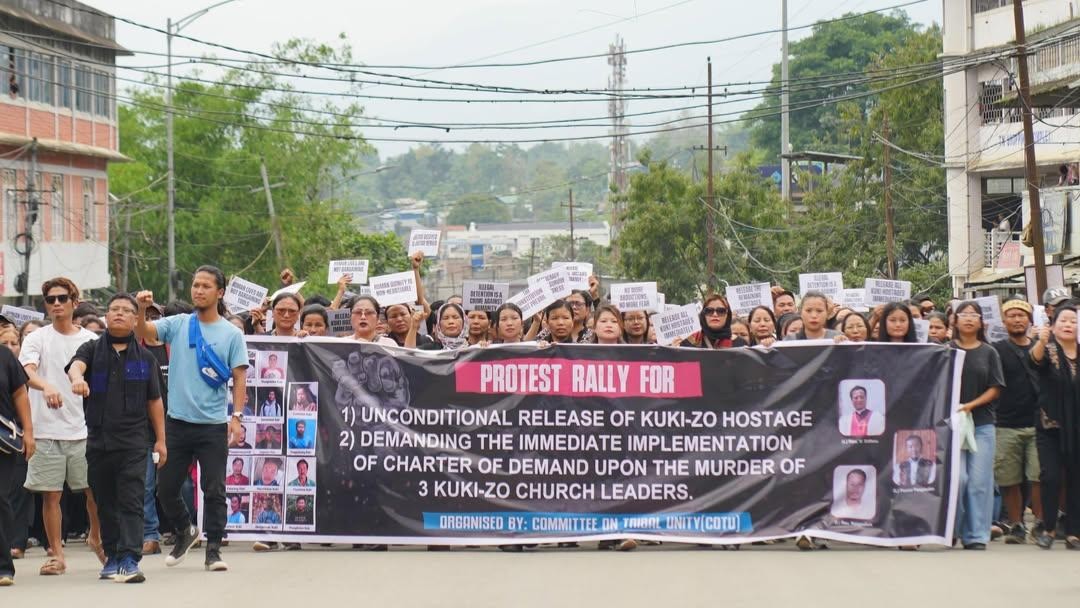
At the same time, Kuki villagers in Taphou staged peaceful sit-in protests demanding the unconditional release of their missing villagers. Many demonstrators wore white clothes as a symbol of peace and mourning. Women, elderly people and children held placards appealing for humanitarian intervention and safe return of the captives.
Similar demonstrations have also been organised in recent days by Kuki-Zo civil society groups, including Kuki Inpi and the Committee on Tribal Unity.
The unrest has disrupted daily life in several hill districts. The United Naga Council imposed economic blockades on key highways in Naga-dominated areas, affecting movement of goods and supplies. Kuki organisations have also enforced shutdowns and protests in several areas.
The political pressure on the new state government has continued to grow.
Chief Minister Yumnam Khemchand Singh, who took office earlier this year after the end of President’s Rule, has assured action and appealed for peace. After meeting a delegation of the United Naga Council on May 23, the Chief Minister announced that the National Investigation Agency (NIA) would investigate both the killing of the church leaders and the abduction of the missing Naga men.
He also said search-and-rescue operations were continuing in affected districts with support from central and state security forces. The Chief Minister appealed to all community leaders to cooperate in securing the release of those still missing.
State Home Minister Govindas Konthoujam earlier confirmed that more than 38 people were initially held hostage following the May 13 violence and said negotiations involving civil society groups were underway.
The Centre has also been monitoring developments closely. Union Home Minister Amit Shah has reportedly been briefed on the situation, while central security agencies continue operations in the affected hill districts.
At the same time, opposition parties and rights groups have criticised both the state and central governments for failing to fully stabilise Manipur even after three years of ethnic conflict.
The latest crisis has also revived memories of older Naga-Kuki clashes from the 1990s, when disputes over land, influence and territorial control led to large-scale violence and displacement in the hill districts.
The ongoing Meitei-Kuki conflict, which began in 2023 over issues including Scheduled Tribe status demands, land disputes and allegations of illegal immigration, has already left more than 250 people dead and displaced thousands across the state.
While Nagas had largely remained outside the direct Meitei-Kuki confrontation, the present hostage crisis has raised fears that old tribal rivalries may once again deepen instability in the hills.
For now, negotiations continue through churches, civil society groups and local leaders. Community organisations from both sides have appealed for peace and urged immediate release of all remaining captives.
But with nearly 20 people still unaccounted for, mistrust remains high and tensions continue to simmer across Manipur’s fragile hill districts.