
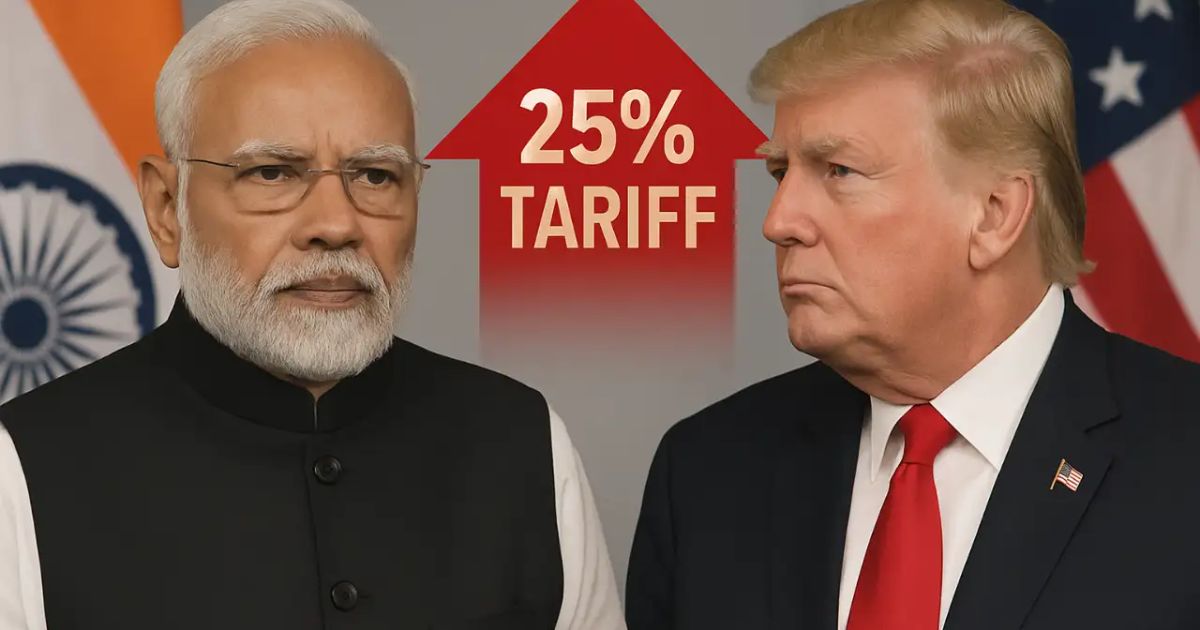
India is back in Washington’s crosshairs. On July 30, US President Donald Trump declared a sweeping 25% tariff on a broad array of Indian exports. He defended the action by blaming India for “obnoxious” trade practices and increasing alignment with Russia.
But while Trump renews the old “Tariff King” moniker for India, new data indicates the US quietly imposes some of the world’s highest tariff ceilings, particularly in agriculture.
The new obligations affect Indian products in industries ranging from auto components, electronics, and jewellery to textiles and processed foods. They are accompanied by an unspecified secondary penalty tied to India’s continued energy and defence relationships with Moscow. The tariffs apply from Aug. 1.
Low in Industry, High in Agriculture
Though the US has low average tariffs on manufactures, its agricultural trade policy is different. Based on the World Trade Organization’s 2024 Tariff Profiles and substantiated by filings from the United States Trade Representative:
The US legally imposes as high as 350% duties on some tobacco products. More than 200% on certain dairy products, such as milk powders and cheeses. Over 130% on a variety of fruits, vegetables, cereals, and processed items.
These upper limits aren’t used in normal trade. But they are invoked when import quotas are overstepped or when products originate from nations that are not part of US trade preference agreements. For Indian exporters, such ceilings are actual impediments.
India’s Exports at Risk, Growth Could Dip
Indian exporters now have new woes to contend with. The new US tariffs will impact industries already under strain—namely, gems, jewellery, and textiles. These are labour-intensive sectors that operate on thin margins.
NCAER and ICRIER economists put the impact at 0.2 to 0.5 percentage points for India’s GDP over the coming fiscal year, should the new tariffs stick. That’s a huge hit when India is attempting to position itself as a trusted alternative in supply chains around the world.
America’s Own Trade Barriers Are Often Overlooked
The “Tariff King” nickname headlines, but the figures don’t lie. India’s applied MFN average tariff is 15.9%, which is much higher than the US’s average of 3.4%. But that doesn’t even begin to reveal the extremely high peaks to which the US can legally raise tariffs in sectors critical to developing countries.
India, as a leading producer of dairy products, pulses, and fruits, is effectively shut out of the US agricultural market. The tariff barriers in America, particularly agricultural, are high and barbed. This belies the notion that India alone is responsible for stifling fair trade.
Bilateral Trade Still Booming
In 2024, the US received $87.4 billion in goods imports from India and sent out only $41.7 billion, as per US Census Bureau statistics. The resulting $45.7 billion trade deficit has now become a Washington political talking point.
But for India, the surplus is a natural evolution—its incorporation into global supply chains of manufacturing, services, and pharma. When it comes to agriculture, however, it’s still a stagnant and uneven one-way trade.
US Preaches Free Trade
Trump’s tariff action might mobilize his home base, but it could alienate a crucial strategic ally. More significantly, it invites contradictions in US trade policy.
While Washington preaches to others about free trade, it has tariff weapons held in abeyance—particularly in politically charged industries. India is not blameless, but the “Tariff King” crown might well rest elsewhere.