
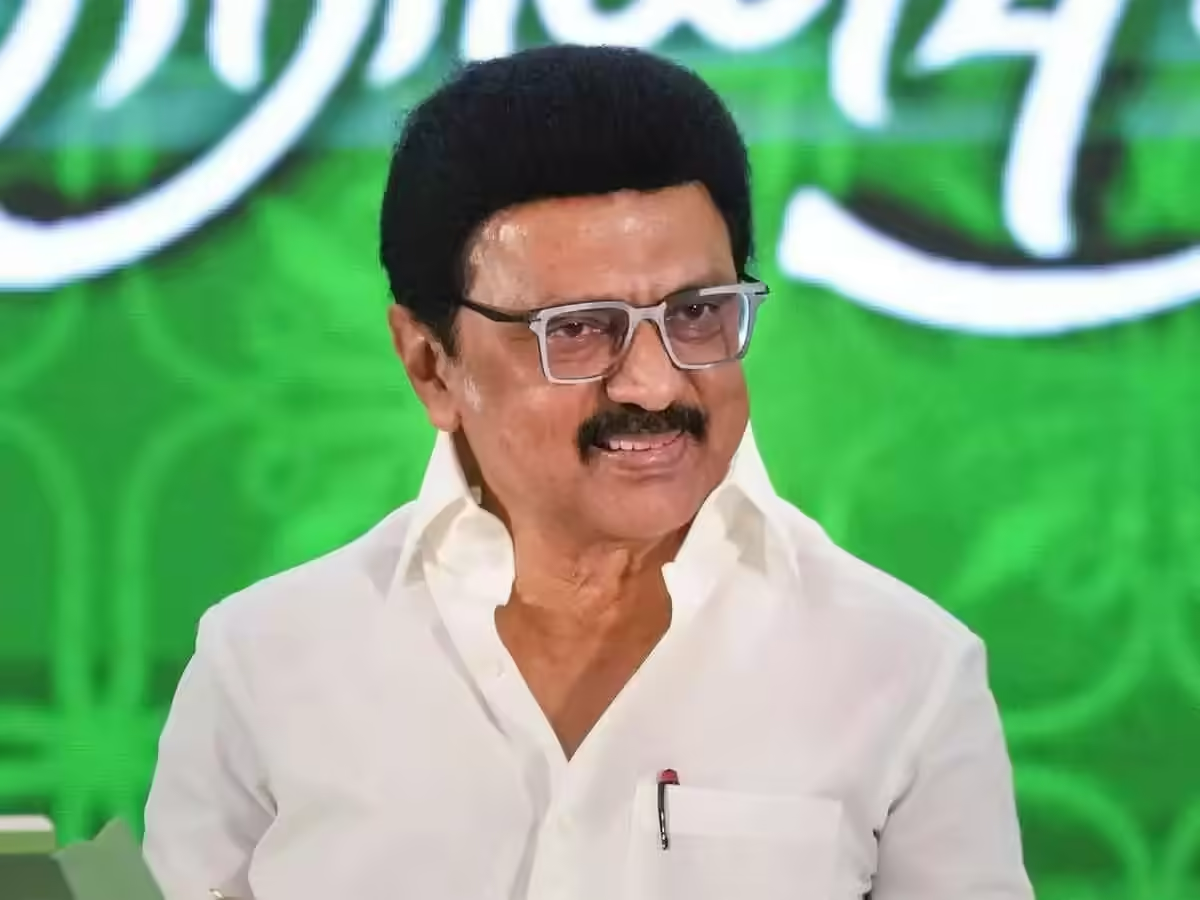
New Delhi: The Tamil Nadu government-constituted high-level committee on Union-State relations, which submitted Part I of its report to Chief Minister M K Stalin earlier this month, met in New Delhi on Sunday to deliberate on Part II of its report.
Justice Kurian Joseph, the committee’s Chairperson and former Judge of the Supreme Court and its members M. Naganathan, former Vice-Chairman of the State Planning Commission, and K. Ashok Vardhan Shetty, retired IAS officer, discussed various topics to be included in Part II of its Report, covering 10 chapters, an official release said.
According to a statement, the committee discussed various topics to be included in the Part-II of its Report covering 10 chapters.
The Part I of the Report of the High-Level Committee on Union-State Relations – in Tamil and English – was tabled in the Tamil Nadu Legislative Assembly on February 16.
It stated that Part-I of the report covers ten key topics ranging from language policy to the Governor, education, health, delimitation, elections, GST, among others.
A notable feature is that the Tamil version of the report has been made “open access” so that anyone can publish it, either as a whole or in part, provided that the source is duly acknowledged and no changes of any kind are made, it said.
This is to ensure that the ideas and recommendations of the Committee are disseminated widely, it said.
“The Government of Tamil Nadu also proposes to bring out translations of Part I of the Report in ten major Indian languages such as Hindi, Bengali, Marathi, Telugu, Kannada, Malayalam, Odiya, Gujarati, Punjabi, and Assamese, and to make these language versions also “open access”,” it added.
The High Level Committee was constituted by the Tamil Nadu government in April 2025 as a non-partisan exercise.
The committee started its work on June 1, 2025, the Committee brought out Part I of the Report in just eight months.
Meanwhile, Chief Minister Stalin in the assembly while presenting the report said that the the principle of state autonomy was written by the great scholar Anna as his final will and testament for all of us.
“Following his demise, the leader of the Tamil people, Kalaignar, formulated the iconic slogan: “Autonomy for the State, Federalism at the Centre” as one of the five core tenets of our movement,” he said.
“The Dravida Munnetra Kazhagam (DMK) government, which has embraced this as its primary policy, is initiating a monumental step that will guide not just Tamil Nadu, but all states in India and the Indian Union itself. As a younger brother to Perarignar Anna and like a sibling to Kalaignar, I stand here to table the first part of the highlevel committee report on Union-State relations before this august House,” Stalin saud.
He asserted that as a state, “we do not possess the powers required to fully realize the dreams of our people”.
“This is because a union government that grants state rights has not yet been established. Even with our limited powers, we are progressing in social justice, education, health, economy, and infrastructure. However, we still face a situation where we must struggle intensely for many demands, including financial rights. Therefore, today marks the day we begin legal initiatives to amend the Constitution to transform state governments into entities possessed of full authority.
“The union Ggvernment, which holds all powers in its hands, exercises them with an authoritarian mindset and fails to respect state governments. States are left waiting for the Union’s mercy for everything. How much longer must we remain in a position where they give and we receive? This status quo must change,” he said.
He said that the answer to our quest for a solution to these problems is this report.
“To put it simply, we have ‘belled the cat’. Our policy that all states should be autonomous and the Union should function as a federal government run collectively by all states is the silent yearning in the hearts of other states, which they struggle to voice openly,” he said.
The DMK chief said that the rights of states were echoed by Anna in Parliament in 1963 and emphasized in the DMK election manifesto of 1967.
And to examine Union-State relations, Kalaignar established a high-level committee in 1969 comprising Retired Justice P.V. Rajamannar, Dr. A. Lakshmanaswami Mudaliar, and P. Chandra Reddy, he said, adding that the entire nation took notice.
“That committee conducted an extensive study and submitted its report in 1971, the key recommendations of which were passed as a resolution in this House by Kalaignar. Subsequently, while the Sarkaria Commission (1983), the Venkatachaliah Commission (2000), and the Punchhi Commission (2004) were established by the Union and submitted thousands of pages of reports, disappointment continues without any real progress,” he said.
Stalin also pointed out that furthermore, the current central government was rapidly shifting crucial powers from the state list to the concurrent list.
“We are in a dire situation where state rights are being snatched away one by one, and we must fight even for the basic rights of our people. In this critical context, the Tamil Nadu government decided to form a high-level committee to evaluate the provisions of the Constitution, existing laws, and orders to suggest measures to improve Union-State relations.
“This committee submitted its report to me on February 16. I say this to the members of this House, the people of Tamil Nadu, the various states of India, and the Union Government: ‘We want State Autonomy; Federalism must bloom at the Union’.”
“This is not the demand of a single political party; it is a vital demand for the livelihood and growth of the people of India. In the 1994 S.R. Bommai case, the Supreme Court ruled that “Federalism is part of the basic structure of the Constitution.” We must incorporate this federal principle into the very culture of the Constitution. This requires constitutional amendment and reform,” the Chief Minister demanded.
He also pointed out that in the last 76 years, the Indian Constitution has been amended 106 times.
“Therefore, if we strive, we can amend it again. Efforts to transform India into a mature federal nation must begin. Power and opportunities must not be concentrated in one place; they must be decentralized. This report provides us with the legal pathways to achieve that. It clarifies that making the Constitution truly federal will not weaken the Indian Union,” Stalin added.