
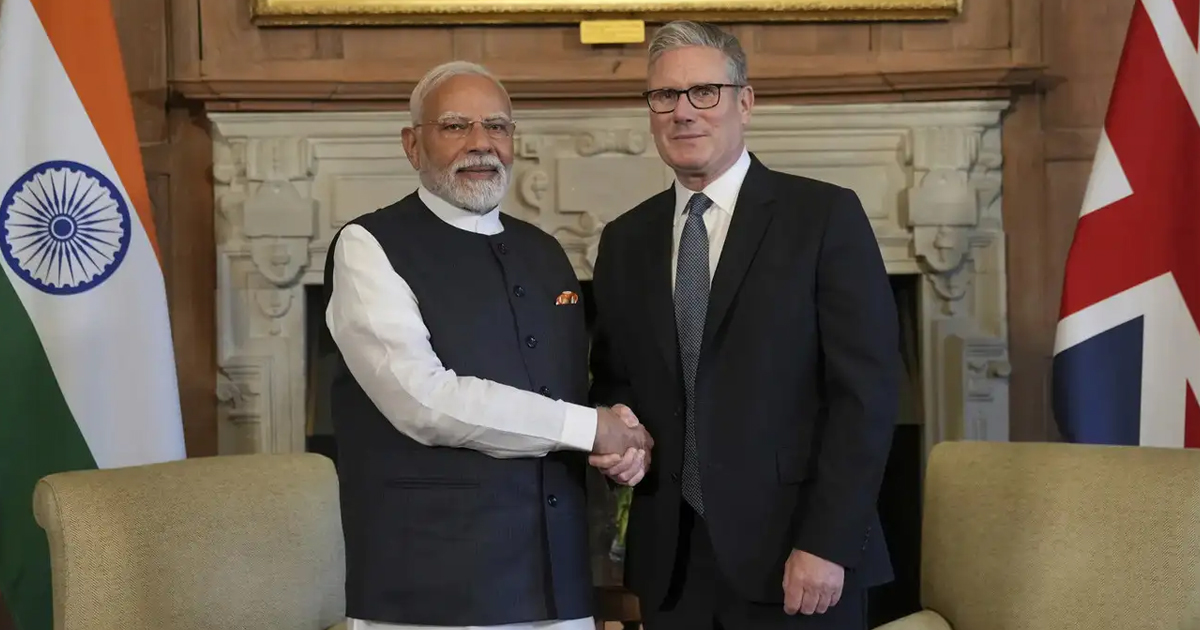
During the recent visit of Prime Minister Narendra Modi to the UK, he firmly urged its authorities to take stern measures against various extremists using democratic freedoms to further Khalistani separatist agendas. The request came while the two governments were in the process of signing the landmark India-UK Free Trade Agreement, thus illustrating the fused nature of economic statecraft and security concerns. Modi remarked that while societies such as the UK value freedom, these freedoms must not be abused to destabilize a country or foster separatism.
In a direct letter to his counterpart in the UK, Prime Minister Keir Starmer, Prime Minister Narendra Modi called on him to act against “extremist ideology” that “misuse democratic freedoms to undermine democracy” today. The statement coincides with pro-Khalistani sentiment becoming more powerful in Britain.
PM Modi thanked PM Starmer and his government for vehemently denouncing the Pahalgam terror attack at a speech in London following the signing of the free trade agreement. In the fight against terrorism, we all believe that dual paramter has no place.
His remarks were, in fact, a pointed signal to UK PM Keir Starmer to intensify action against Khalistani groups operating out of Britain. These groups have been engaged for many years in what Indian officials have described as threatening activities: from protests to public celebrations of banned militants to vandalism of Indian diplomatic missions, all raising fears for the safety of the Indian diaspora as well as for India’s sovereignty. India has, time and again, requested the UK government to act against these extremist elements through strict enforcement and intelligence sharing, legal actions and possible extradition of those involved in violent activities.
The Khalistani extremism issue has now become pivotal within the matrix of India-UK bilateral relations, as both the countries seek to invigorate their ties through trade and security collaboration. For the UK, finding the balance between protecting democratic freedoms and curbing separatist violence presents a diplomatic challenge.
Thus Modi’s public admonition serves not just to activate a call, but also to signal that heightened cooperation in the economic sphere will accompany heightened expectations for adherence to counterterrorism. Observers believe that India’s insistence to raise the Khalistan threat will continue to remain paramount and shape the course of the ongoing diplomatic exchanges between the two for years to come.
The report drew criticism from India over clubbing of the two in the same category. “Reports on this subject have surfaced. The threat posed by separatists and extremists from the UK is well acknowledged. MEA had stated that it should not be accepted or equated.
In essence, Modi’s viewpoint emphasizes the conjuncture between national security and international partnerships, stressing that economic development cannot be achieved at the expense of sovereignty and law and order.