
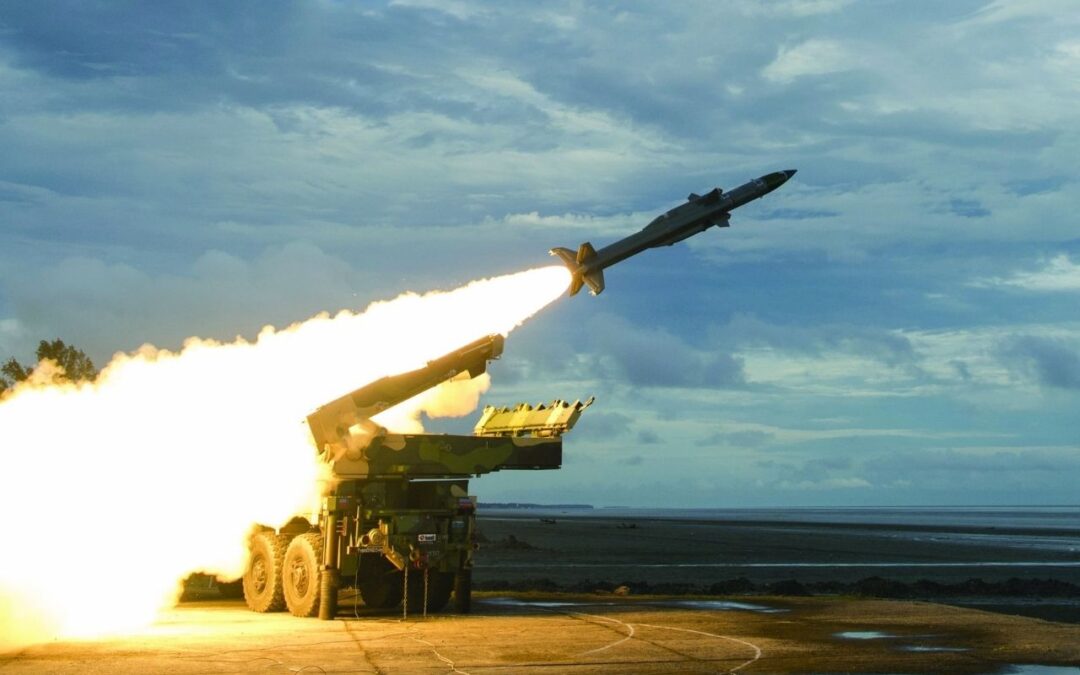
India is about to embark on a landmark expansion of its air-defence manufacturing, with plans to manufacture almost 2,000 state-of-the-art domestic surface-to-air missiles. The Ministry of Defense is ordering about 1,000 Quick Reaction Surface-to-Air Missiles (QRSAM) in a contract worth ₹11,000–12,000 crore with Bharat Dynamics Limited (BDL), industry sources said. Concurrently, the government is evaluating a parallel procurement of 1,000 Akash New Generation (Akash-NG) interceptors. Bharat Electronics Limited (BEL) has confirmed that developmental and integration work for the QRSAM is complete, leaving both mega-projects awaiting final approval from the Cabinet Committee on Security (CCS) before entering mass production.
Developed by the Defence Research and Development Organisation (DRDO), both weapon platforms offer state-of-the-art specifications tailored for distinct operational tiers. The QRSAM is an all-weather, mobile short-range system boasting a 30 km strike range, a single-stage solid propellant motor, and an indigenous active radar homing seeker capable of true fire-on-the-move tracking and engagement. In contrast, the Akash-NG operates as a medium-range area-defence system covering an interception radius of 70–80 km up to an altitude of 20 km. Powered by an advanced dual-pulse solid rocket motor, the Akash-NG features a canisterised launcher, rapid reaction time, and an Active Electronically Scanned Array (AESA) seeker to neutralize low-radar-cross-section cruise missiles, fighter jets, and drone swarms.
This multi-billion-rupee manufacturing push will fundamentally modernize India’s frontline tactical air defence while permanently phasing out legacy Soviet-era hardware. The high-mobility QRSAM is slated to replace the Indian Army’s obsolete 9K33 Osa-AK and 2K12 Kub batteries, providing uninterrupted escort protection to advancing strike corps and armored columns in forward battle environments. Meanwhile, the Akash-NG delivers a generational upgrade over older ramjet-powered Akash units through reduced ground footprint, superior deployment agility, and enhanced hit probability. Beyond plugging tactical vulnerabilities across mountainous and desert frontiers, executing these 2,000-missile orders marks an unprecedented technological milestone, solidifying India’s self-reliance (Aatmanirbharta) and establishing large-scale serial production capacity for complex missile systems.