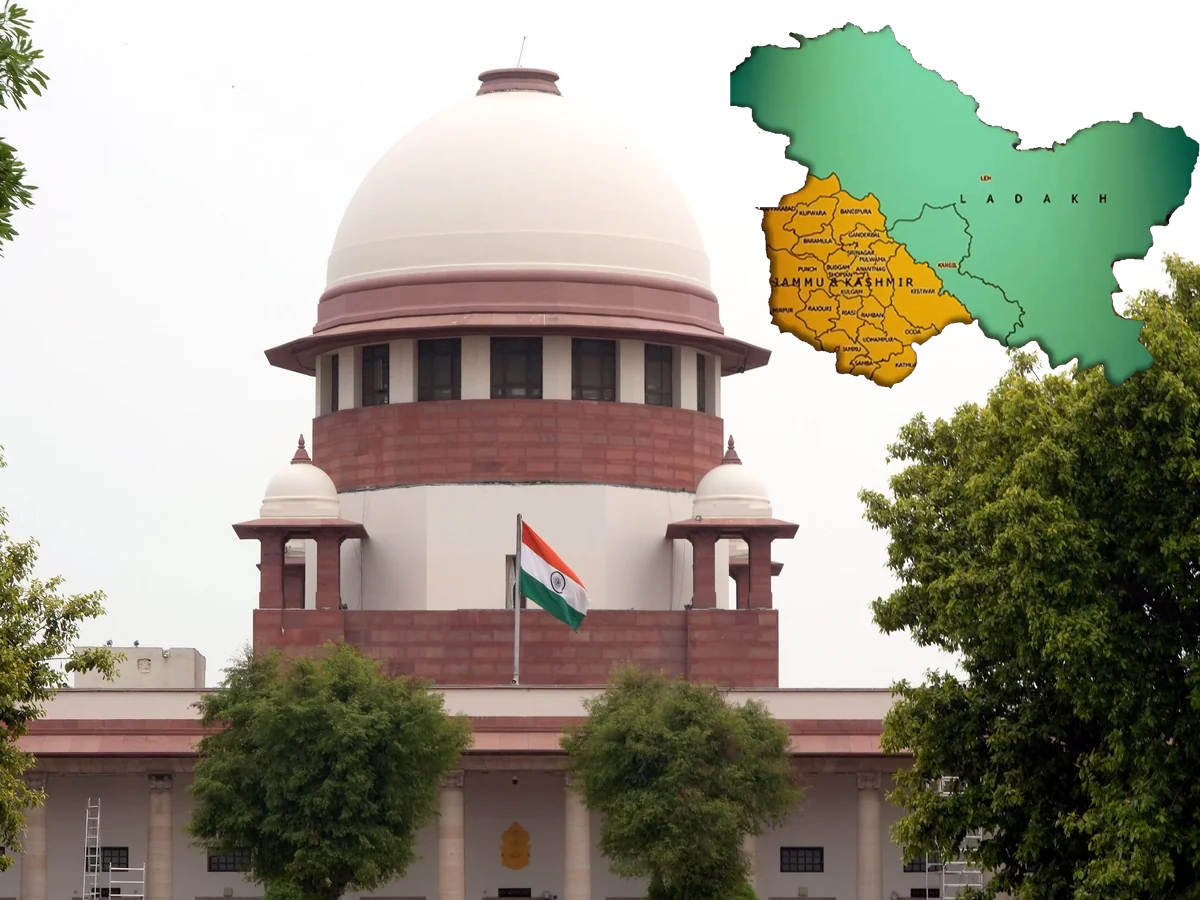
The Supreme Court of India will hear on August 8 a fresh application urging the Union Government to restore the statehood of Jammu and Kashmir, which has remained a Union Territory since the abrogation of Article 370 in 2019.
The matter was mentioned before the Chief Justice of India, DY Chandrachud, by Senior Advocate Gopal Sankaranarayanan, who requested that the application remain listed on the scheduled date. The CJI agreed to the request.
Filed on the Anniversary of Article 370 Abrogation
Significantly, the matter came up on August 5, which marks six years since the abrogation of J&K’s special status under Article 370. The current application is a Miscellaneous Application filed in the disposed-of case titled “In Re: Article 370 of the Constitution”, where the apex court had previously upheld the Centre’s decision to revoke the special status.
However, that judgment did not rule on the constitutionality of the Jammu and Kashmir Reorganisation Act, 2019, which bifurcated the state and turned it into a Union Territory. This was because the Solicitor General had assured the Court that statehood would be restored. Based on that, the Court only said, “Restoration of statehood shall take place at the earliest and as soon as possible,” but did not impose a timeline.
ALSO READ: Statehood or Status Quo? Centre’s Silence Fuels Speculation in Kashmir
Petitioners Say Centre Ignored Assurance
The new plea, filed by college teacher Zahoor Ahmed Bhat and activist Khurshaid Ahmad Malik, argues that the Union Government has not acted on its assurance, even eleven months after the judgment.
They contend that the delay violates the basic structure of the Constitution, particularly the principle of federalism. The application reads,
“The non-restoration of the status of Statehood of Jammu and Kashmir in a time-bound manner violates the idea of federalism, which forms a part of the basic structure of the Constitution of India.”
Filed through Advocate-on-Record Soayib Qureshi, the petition also stresses that there is no law-and-order excuse to withhold statehood, since the Assembly elections were held peacefully, showing that conditions are conducive.
ALSO READ: ‘Just a Gut Feeling’: Omar Abdullah Hints at Major Development in Jammu & Kashmir Tomorrow
“No Security Hurdles, Only Delay”
The applicants argue that the absence of violence or unrest removes any justification for continued Union Territory status.
“Therefore, there does not impede security concerns, violence, or any other disturbances which would hinder or prevent the grant/restoration of the status of Statehood to Jammu and Kashmir as had been assured by the Union of India in the present proceedings,” the application states.
A Constitutional Test on Federalism?
This development raises important questions about federalism, constitutional promises, and Centre–State dynamics. The petitioners are essentially asking the Court to hold the Union Government accountable for its assurance made during constitutional litigation.
With the Supreme Court agreeing to take up the matter on August 8, the focus now returns to whether the Centre will finally set a timeline for restoring full democratic status to Jammu and Kashmir, six years after one of the most dramatic political shifts in India’s recent history.