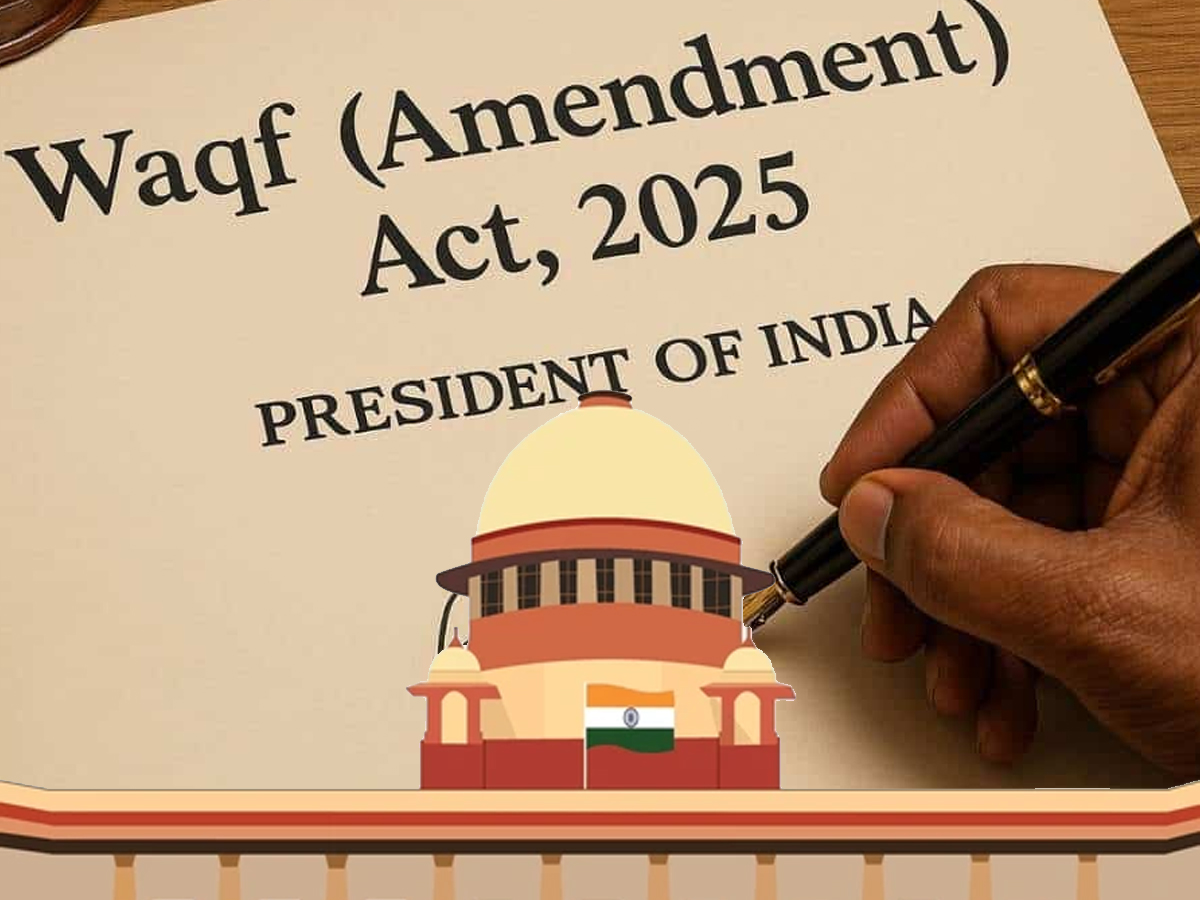
The Supreme Court on Monday declined to stay the entire Waqf (Amendment) Act, 2025, but suspended some controversial provisions. The court ruled that district collectors cannot take final decisions on whether a property claimed as waqf belongs to the government. It also put on hold the rule that only practising Muslims for five years can dedicate property as waqf.
Chief Justice of India (CJI) Bhushan R Gavai, along with Justice AG Masih, said this five-year requirement will apply only after states frame clear rules to decide a person’s adherence to Islam.
Digital Registration Stays Valid
The bench upheld the rule making registration of waqf properties on a centralised online portal mandatory. The judges said the registration process cannot be stopped. However, they clarified that any decision on ownership or property rights must remain open to challenge before waqf tribunals and high courts. No third-party rights can be created in disputed properties until the matter is decided.
ALSO READ: Acharya Devvrat sworn in as new governor of Maharashtra, succeeding CP Radhakrishnan
The court also directed that the Central Waqf Council should not have more than four non-Muslim members, while state waqf boards should not include more than three. It further suggested that board CEOs should preferably be Muslims.
CJI Cites Need for Safeguards
Delivering the judgment, CJI Gavai said laws are presumed constitutional. But he added that safeguards were necessary, which is why certain provisions were suspended.
The case comes after the August 22 hearing, when the court refused to stay a government order making it compulsory for all waqf properties to be registered on the UMEED (Unified Waqf Management, Empowerment, Efficiency, and Development) portal. The platform aims to create a transparent and centralised record of all waqf properties, including photos and geotagged locations.
Petitioners Call Law Discriminatory
Senior advocate Kapil Sibal argued that shifting the burden of registration to waqf custodians punishes the Muslim community for the state’s failure since 1954. He said, “It is the failure of the state to carry out its job from 1954 to 2025, and due to their failure, a community is being punished.”
Other petitioners, including senior lawyers Rajeev Dhavan and Abhishek Manu Singhvi, said the new law discriminates against Muslims and threatens the survival of traditional waqf practices. They argued that the requirement of being a practising Muslim for five years before creating a waqf is unfair, as similar conditions are not imposed on other religious endowments.
Centre Defends Law as Reform
Solicitor General Tushar Mehta defended the law, saying the 2013 amendment wrongly allowed non-Muslims to create a waqf. He argued that the 2025 law was designed to improve transparency and prevent misuse. He also said the restriction on creating a waqf on tribal land was necessary to protect vulnerable communities.