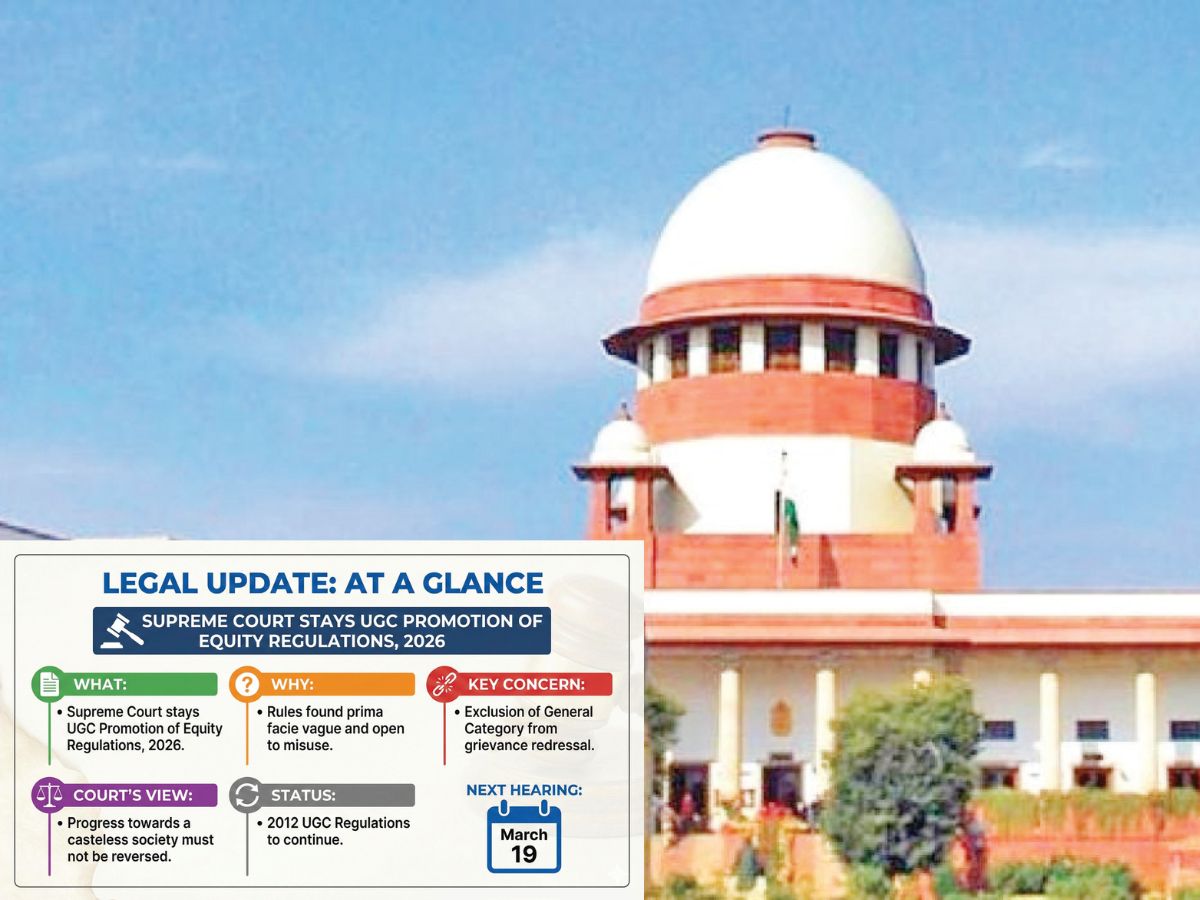
The Supreme Court on Thursday stayed the operation of the UGC Promotion of Equity Regulations, 2026, which address caste-based discrimination in educational institutions. A two-judge Bench comprising Chief Justice of India Surya Kant and Justice Joymalya Bagchi said the provisions are prima facie vague and capable of misuse, and directed the Union government to redraft the regulations.
Until then, the 2012 UGC Regulations will continue to operate while the Court examines the constitutionality of the new rules. The hearing was held on petitions challenging the validity of the recently notified UGC regulations.
The new rules seek to prevent caste-based discrimination on university and college campuses. However, the petitioners argued that the grievance redressal mechanism excludes students belonging to the General Category.
Senior Advocate Vishnu Jain, appearing for the petitioners, challenged Clause 3(c) of the regulations, submitting that caste-based discrimination has been defined only in relation to SC, ST and OBC communities. This, he argued, entirely excludes members of the General Category, rendering the provision discriminatory.
The Chief Justice clarified that the Court was, at this stage, undertaking only a prima facie examination of the validity and constitutionality of the provisions.
During the hearing, the CJI raised concerns about the scope of the regulations and questioned whether a complaint of ragging would be entertained under the new rules. In response, counsel submitted that ragging has not even been defined in the regulations.
The counsel further argued that the regulations focus solely on caste-related issues and are regressive in nature, institutionalising divisions between seniors and juniors in universities.
The CJI also questioned whether the regulations would address regional or cultural discrimination, such as instances where students from South India or the North-East face sarcastic or insulting remarks in North India.
The Court noted disparities within reserved communities as well. The CJI observed that even within such communities, certain groups are better placed than others, describing it as a matter of policy wisdom.
He also questioned whether there would be any remedy if a student belonging to one SC group uses insulting language against another community.
Remarking that progress made towards building a casteless society should not be reversed, the CJI described ragging as one of the worst problems in educational institutions and cautioned against suggestions such as creating separate hostels.
At the conclusion of the hearing, the Supreme Court stayed the UGC Promotion of Equity Regulations, 2026, keeping them in abeyance. The Court asked the Union government to rework the regulations, warning that they could otherwise have sweeping and dangerous consequences, and listed the matter for further hearing on March 19.