
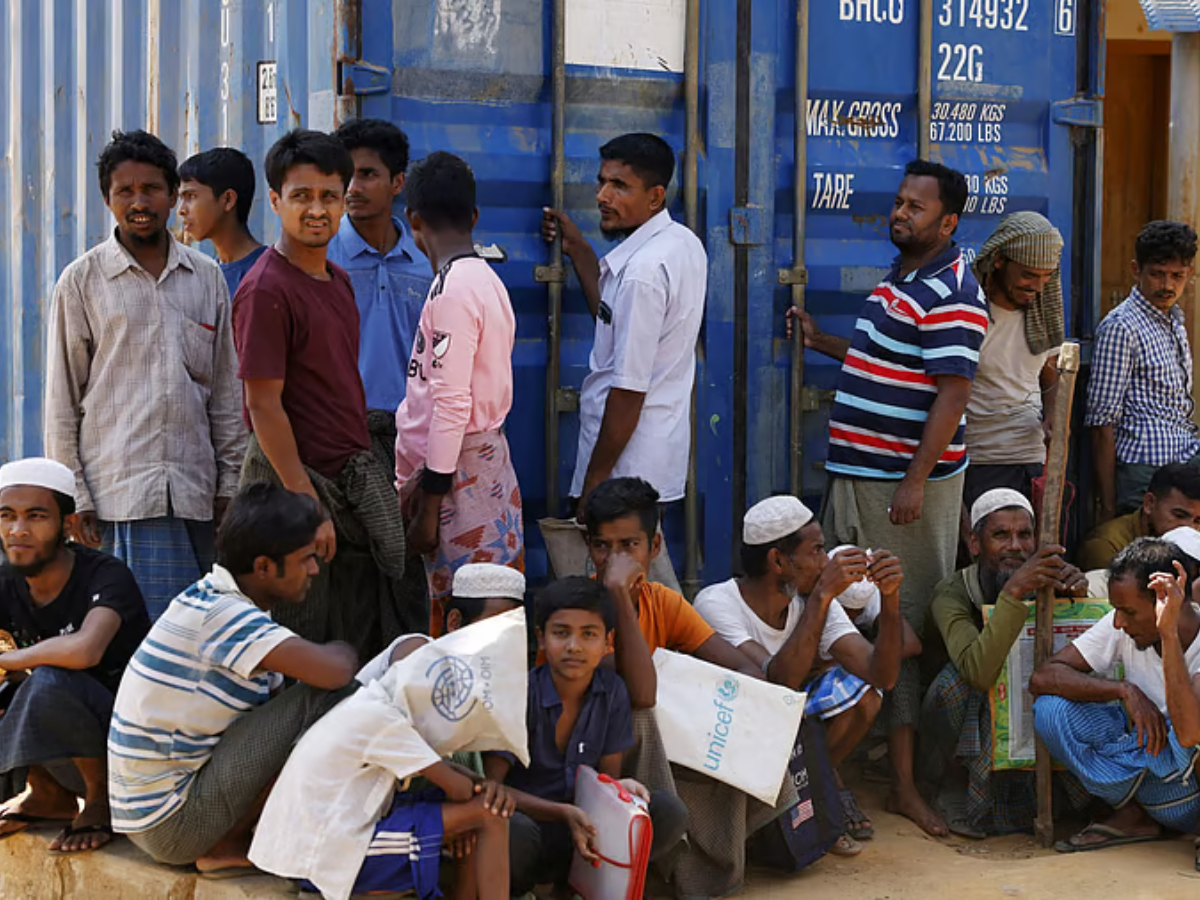
The Supreme Court on Thursday indicated it will consider whether Rohingyas residing here were refugees or illegal immigrants before proceeding with hearing a batch of petitions presented on their behalf asking for their deportation to be challenged and basic facilities for them during the course of their residence in refugee camps.
Key Legal Question: Refugees or Illegal Migrants
The first major issue is whether they are refugees or illegal migrants. Rest is consequential,” a bench of justices Surya Kant, Dipankar Datta and N Kotiswar Singh said.
“If they are refugees, they are entitled to certain protections under law. If not, they are illegal migrants and should be deported back to their country.”
There were two consequential issues also that were framed by the court. These were: “Even if Rohingya entrants are held to be illegal entrants, can they be detained indefinitely or they are entitled to be released on bail subject to conditions.” Lastly, it said, “Whether Rohingya entrants who are not detained but living in refugee camps have been provided with basic amenities like drinking water, sanitation, education, etc.”
Four Legal Questions Framed in the Rohingya Batch
The four questions framed by the court in the Rohingya batch of cases included, “whether Rohingya entrants are entitled to be declared as refugees and if so, what protection emanates from the rights they are entitled to; whether Rohingyas are illegal entrants and if government of India and states are obligated to deport them in accordance with law.”
The court had accepted 22 cases concerning the deportation of Rohingya people who were either in detention centers or claimed refugee status. Among these, the bench tried to isolate cases concerning Rohingya migrants as one batch. The remaining cases concerning other foreigners were instructed to be put into another batch to be disposed of differently.
Practical Challenge in Conducting a Unified Hearing
As the set of cases came on board collectively, the bench found it difficult practically to conduct the hearing because the petitions were discussing deportation of aliens in general, and then there were some specifically talking about the situation of aliens in detention camps.
Government counsel Kanu Agarwal, who appeared for the central government, produced a list of cases involving Rohingya individuals and requested the court to dispose of this set of cases first. The non-Rohingya cases, he further added, involve interpretation of the Foreigners Act.
The bench agreed, saying, “The issues that arise in the other batch of cases will be determined separately on another date.”
Petitions Originated in 2013: Advocate Prashant Bhushan
The pioneer Prashant Bhushan, who was himself seen in a number of petitions, stated that the origin of the cases started with the pleas filed by Rohingya citizens in 2013. He added that 15 out of the group of 22 cases were related to Rohingya refugees and the necessity to accord them facilities in their camps equal to refugees recognised under the UN Convention on Refugees. India is not a signatory to this convention and has not even thought of granting refugee status to them.
Senior counsel Ashwani Kumar and Colin Gonsalves, who appeared in other cases, observed that the Rohingya people who originated in Myanmar had run away to India on the basis of being persecuted within their own country. Gonsalves also mentioned a case brought by a foreigner’s wife who was facing detention in Assam which involved Rohingya and non-Rohingya foreigners. In that case, Gonsalves presented orders issued by the court to speed up the deportation process even though Myanmar did not want to accept these individuals back.
SC Calls for Collective Listing of All Related Cases
In May this year, during hearing of an application moved by Rohingya people in Delhi, the Supreme Court declined to take a piecemeal view of deciding individual cases and directed all pending cases on the issue to be listed collectively.
The Centre has been resisting the maintainability of these petitions, invoking the order made by the Supreme Court in April 2021. The order allows the Centre to initiate deportation actions as mandated under the law and ruled that although the right to life and liberty extends to even non-citizens, the right not to be deported is ancillary but concurrent to the right to live or settle in any region of India, which is ensured under Article 19(1)(e) only to citizens.