
Chandigarh: For thousands who walk into the Postgraduate Institute of Medical Education and Research each day with hope, fear and urgency, the last thing they expect is to feel exploited even before reaching a hospital ward. Yet, troubling allegations suggest that while families struggle with illness and rising medical expenses, some private parking operators inside the premier institute may be quietly turning distress into a steady stream of unaccounted cash.
PGIMER remains one of the country’s most sought after tertiary care centres, drawing patients not just from Punjab, Haryana and Himachal Pradesh but from across northern India. The institute is already battling overcrowding, stretched infrastructure and an overburdened doctor patient ratio. However, these systemic pressures do not justify what attendants describe as an organised pattern of overcharging within the hospital premises.
There are around eleven parking areas inside the campus. Some fall directly under the institute’s administration and are meant primarily for staff, while several others have been outsourced to private contractors. It is within these privately managed spaces that serious concerns are emerging.
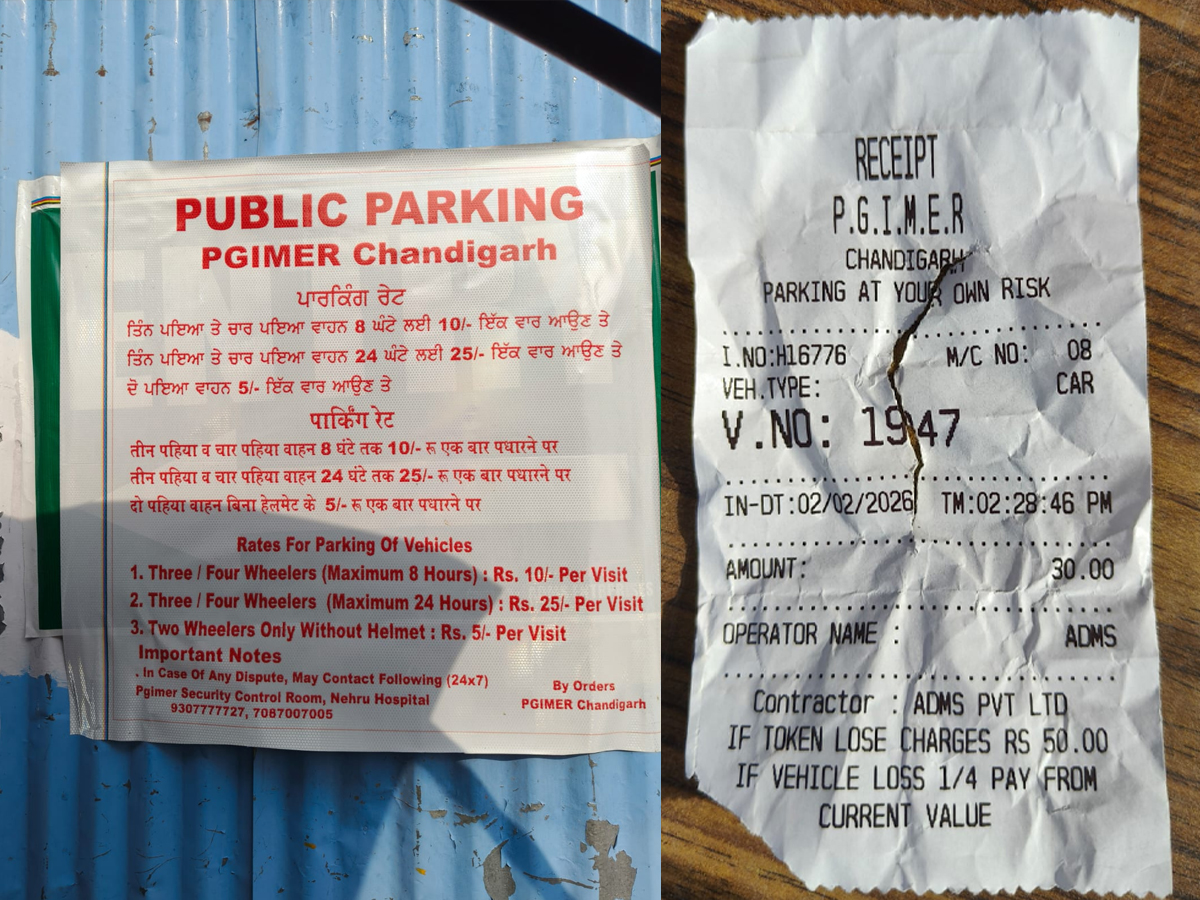
Visitors allege that contractors are not merely rounding off charges but are directly collecting Rs 30 per vehicle, despite commissioned parking rules clearly stating that the rate is Rs 10 for up to eight hours and Rs 25 for twenty four hours. The gap between approved tariffs and what is being charged on the ground has triggered sharp criticism from attendants who call it outright exploitation.
Take the parking near the Advanced Paediatric Centre as an example. The officially commissioned rate for a four wheeler for twenty four hours is Rs 25. Yet, visitors claim they are routinely charged Rs 30, without being informed about the approved slabs. At any given time, nearly 50 cars are parked at this location alone, making the extra collection far from negligible.
────────────────────────
The Math behind the Alleged Overcharging
Approved rate for 24 hours: Rs 25
Amount allegedly charged: Rs 30
Extra charged per vehicle: Rs 5
Average vehicles per hour: 50
Illegal earning per hour:
5 × 50 = Rs 250
Illegal earning per day:
250 × 24 = Rs 6,000
Illegal earning per month:
6,000 × 30 = Rs 1,80,000
Now consider 6 outsourced parkings operating on a similar pattern:
1,80,000 × 6 = Rs 10,80,000 per month
Estimated amount with zero visible accountability.
────────────────────────
And this is only a conservative estimate built on a modest difference of Rs 5 per vehicle. If the actual number of vehicles rises during peak hospital hours, the figure could be significantly higher.
The human cost behind these numbers is far more disturbing. TDG spoke to complainant Shikha Sehrawat from Jabalpur, whose father is currently admitted in the ICU after suffering a brain haemorrhage and undergoing surgery. Speaking emotionally, she said, “Who is going to check the rules and the rate card for parking when there is an issue of survival of our own kin? It is quite inhumane on their part. They are minting money out of despair.”
The larger question is not merely about five rupees. It is about a system that appears to allow small, repeated excess charges to snowball into lakhs every month. For families already coping with treatment costs, medicines, travel and accommodation, even minor financial strain adds to emotional trauma.
Visitors also point to another contentious issue: hefty fines, sometimes reaching Rs 500, imposed in the name of wrong parking. Many attendants allege that confusion over designated areas, combined with inadequate guidance, creates a situation where penalties become another source of revenue rather than a corrective measure.
No one disputes that the institute is under immense pressure. Corridors remain crowded, waiting areas overflow and doctors continue to work beyond capacity. But administrative challenges cannot become a shield for practices that resemble profiteering within a public healthcare institution.
What raises eyebrows further is the apparent absence of strict monitoring. If the parking rates are officially fixed, why is overcharging not being detected? Are receipts being audited? Is there a mechanism to verify whether contractors are adhering to approved tariffs?
Healthcare institutions are meant to inspire trust. When allegations of unchecked collections surface inside hospital walls, that trust begins to erode.
Patients arrive seeking relief from suffering, not an additional financial burden at the gate. The administration must now answer a difficult but necessary question: if this is happening in plain sight, who is watching the watchers?
While speaking to TDG, Deputy Director Administration Pankaj Rai said, “We will take strict action against all those involved and will also conduct a further investigation into the matter.”