Punjab has been reeling under one of the worst flood disasters in decades. Since 26 August, incessant rainfall and sudden release of water from dams have left large swathes of land inundated, displacing families and washing away crops and livestock. According to official figures, more than 16,000 people have been rescued across 1,018 affected villages, with the combined efforts of the Indian Army, National Disaster Response Force (NDRF), State Disaster Response Force (SDRF), and local administration.
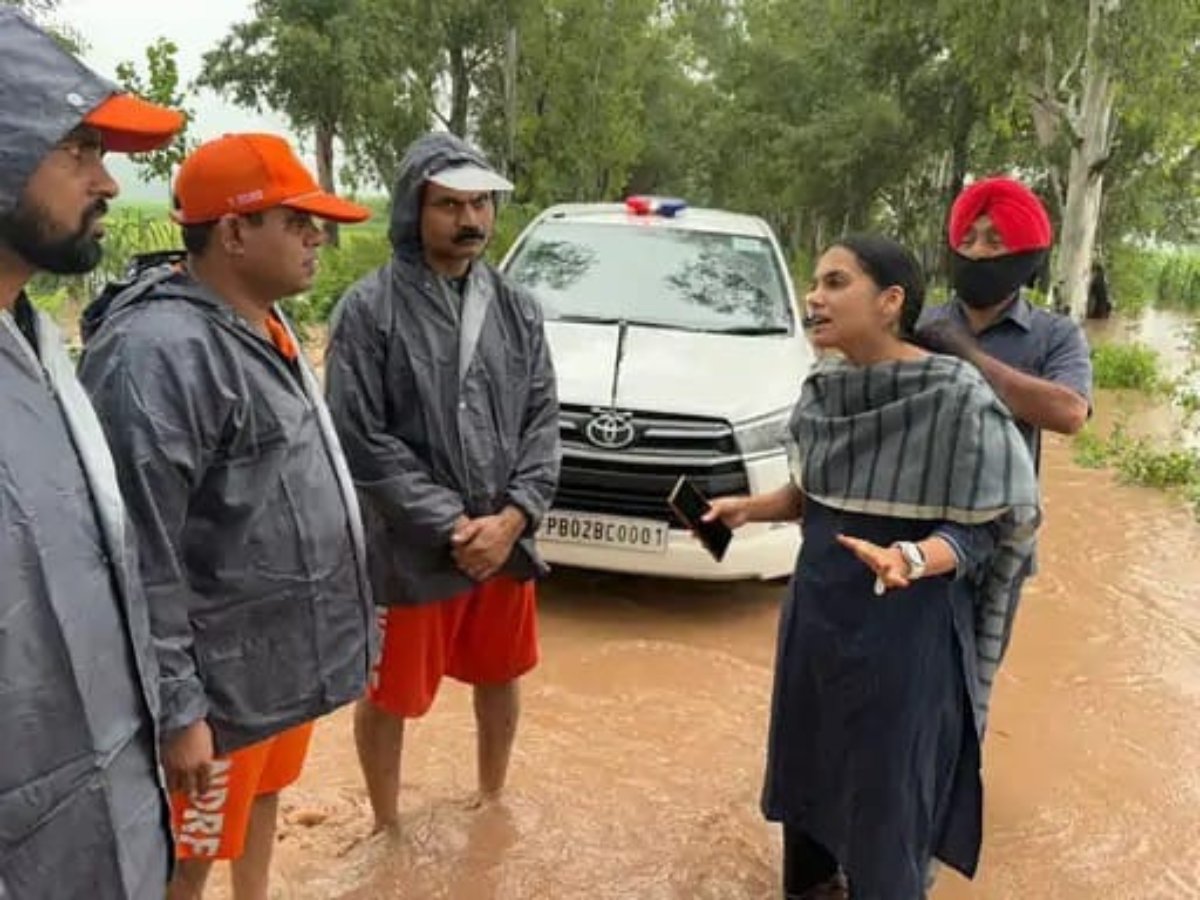
The situation has tested Punjab’s resilience, yet it has also displayed the state’s spirit of unity. On the ground, officials have been working relentlessly to ensure safety and rehabilitation of the affected. Among them, Amritsar Deputy Commissioner Sakshi Sawhney has emerged as a key face of the administration’s commitment. She has been present in the flooded belts of Ajnala and adjoining Amritsar villages since the first day waters entered homes. Videos and images of her coordinating rescues in waist-deep water have gone viral, symbolising responsive governance.
Sakshi Sawhney and ministers lead from the front
Unlike routine disaster reviews often restricted to offices, this time the response has been marked by direct intervention. Deputy Commissioner Amritsar Sakshi Sawhney was seen moving with boats, ensuring safe evacuation of stranded families, including the elderly and children. She supervised the shifting of patients from flooded homes to hospitals and personally inspected relief camps.
Her approach has been hands-on. “This is not the time for paperwork. We need to be with the people, hear them, and help them on the spot,” Sawhney told locals during a field visit.
Punjab ministers too have remained visible on the ground. Senior leaders visited affected belts daily, monitoring rescue operations, arranging medical teams, and ensuring supply of food and clean drinking water. Their presence not only boosted the morale of the rescue workers but also reassured the displaced families that they were not alone.
Numbers that Reflect the Ground Realities
The state government reports that 14,936 people had been evacuated by August 31, with 6,582 sheltered across 122 relief camps. The district-wise breakdown:
- Amritsar: 1,700 rescued
- Barnala: 25
- Fazilka: 1,599
- Ferozepur: 3,265
- Gurdaspur: 5,456
- Hoshiarpur: 1,052
- Kapurthala: 362
- Mansa: 163
- Moga: 115
- Pathankot: 1,139
- Tarn Taran: 60
Relief camps shelter:
- Amritsar: 170
- Barnala: 25
- Fazilka: 652
- Ferozepur: 3,987
- Gurdaspur: 411
- Hoshiarpur: 478
- Kapurthala: 110
- Mansa: 163
- Moga: 115
- Pathankot: 411
- Sangrur: 60
As of late August, floods impacted 1,312 villages statewide all districts included with Amritsar, Gurdaspur, Ferozepur, Kapurthala, and Fazilka among the most affected
Army, NDRF, SDRF win trust of locals, rescued 15 day old with Mom
The role of the armed forces has been exemplary. Kharga Corps Sappers, for instance, rescued a mother and her 15-day-old baby from an inundated building in Gurdaspur using improvised ladders. Such stories of courage have multiplied across flood-hit belts. Soldiers, braving heavy currents, ferried stranded villagers to safer zones.
NDRF teams conducted coordinated rescues using motorised boats, while SDRF personnel waded through narrow village lanes to pull people out of marooned houses. Together, these agencies have been instrumental in saving thousands of lives.
Locals have repeatedly acknowledged that without such quick intervention, the casualty count would have been far higher. The trust between villagers and the armed forces stood out as a strong pillar during these days of distress.
NGOs, gurdwaras, and locals turn saviours
Punjab’s culture of seva once again came alive during the crisis. NGOs, religious bodies, and common villagers turned into saviours for those in need. Gurdwaras in Amritsar, Gurdaspur, and Patiala opened their doors to shelter homeless families. Volunteers cooked and distributed hot meals to thousands, while youth groups ferried people to safety on tractors and trolleys.
Local NGOs partnered with the administration to distribute dry rations, medicines, and clothes. Doctors organised free medical camps in relief shelters, treating children for waterborne diseases. Students and IT professionals, many of whom were not trained rescuers, formed groups to provide information and logistics support.
These efforts demonstrated that floods may wash away houses, but not Punjab’s collective humanity.
Propaganda in disguise of relief
While the majority of society stood united, some elements attempted to poison the atmosphere. Certain social media accounts Rajinder Singh Talwandi, Anand Dullewala, and Salahpur Ranjit Singh were found spreading divisive propaganda during the peak of the disaster.
Instead of amplifying genuine relief work, these accounts circulated videos portraying slain militant Jarnail Singh Bhindranwale and glorifying the killers of former Punjab Chief Minister Beant Singh. Under the guise of helping flood victims, they attempted to revive Khalistani symbolism and stoke communal divisions.
In some posts, even the Indian Army, which has been tirelessly rescuing flood-affected families, was targeted with derogatory language, being mischaracterised as a “Hindu Indian Army.” Such content has been widely criticised as an insult to the soldiers risking their lives in floodwaters.
Hate campaigns rejected by people
The propaganda failed to gain ground on the ground. Flood-hit families, irrespective of religion, have largely rejected such attempts to communalise their suffering. In Ajnala, Sikh and Hindu families were seen eating from the same langar, waiting together in relief camps, and cooperating with each other in cleanup drives.
Villagers themselves countered hate messages online, posting videos thanking the Army and administration for saving their lives. “We don’t want politics or hatred. We want our homes rebuilt, our children safe, and our fields restored,” said a farmer in Gurdaspur.
Punjab’s social fabric, tested by natural disaster, once again showed its resilience by refusing to allow extremists to dictate the narrative.
Official condemnation of hate mongers
The Punjab Government has taken cognisance of such divisive campaigns. Officials made it clear that flood relief work must not be hijacked for political or separatist propaganda. “Any attempt to mislead vulnerable families in the garb of flood help will face strict action,” an officer in Amritsar stated.
Cyber cells are monitoring accounts that glorify separatist figures under the pretext of humanitarian aid. The administration is also encouraging citizens to report such attempts so that misinformation does not derail relief operations.
Madhopur Headworks Collapse on 27 August Adds to the Crisis
The flood crisis in Punjab, already severe, took a dramatic turn when the Madhopur headworks in Pathankot suffered a catastrophic failure on 27 August 2025. Three of the barrage’s floodgates were washed away under pressure far less than what they had been certified to withstand. Punjab’s Water Resources Minister, Barinder Kumar Goyal, confirmed that a private firm Level 9 Biz Pvt Ltd., commissioned in March 2024 and paid ₹22.72 lakh had certified the structure in December as being able to withstand flows of up to 6.25 lakh cusecs. Yet, it failed under less than 2 lakh cusecs
The breach flooded upstream villages and farmlands within hours, triggering emergency warnings and forcing thousands to flee once more. Authorities issued a strict show-cause notice to the firm and announced punitive action for this negligence, which not only endangered lives but also undermined departmental credibility
Ghaggar River Bursts Its Banks, Swallows Villages
At the same time, the Ghaggar River turned ferocious, particularly in Malwa districts—Patiala, Sangrur, Fatehgarh Sahib, and Mohali. On 29 August, water flow surged to nearly 70,000 cusecs, breaching embankments and engulfing entire settlements in the Dera Bassi region. Families living along the river were forced to flee with little warning, many abandoning homes fully submerged within hours. Fields and roads vanished underwater; boats became the only safe means to reach relief camps.
This inundation revived a long-understood fault line Ghaggar’s vulnerability due to silt buildup and weakened embankments. Experts have issued repeated warnings about the need for maintenance and desiltation, but this disaster underscores how inadequate infrastructure can turn rivers into agents of destruction.
Agriculture and Livestock Take a Major Hit
Punjab’s status as the country’s agricultural heartland rests on fertile paddy, cotton, and vegetable fields—many of which are now buried under mud and water. Affected districts are reporting complete crop losses. While floodwaters may recede, fields remain parched, layered with silt, and unfit for immediate replanting.
Livestock populations have also suffered. In many villages, buffaloes and cows were swept away or left to perish. With fodder stocks destroyed and veterinary access limited, remaining herds face disease and starvation. Economic losses are mounting quickly, with estimates reaching into thousands of crores. Although the government has pledged compensation following assessments, farmers say this disaster will leave a lasting scar on their livelihoods.
Infrastructure Erosion and Displacement Continue
The floods haven’t just drowned crops they’ve fractured infrastructure. Rural roads, bridges, and culverts have been washed away. In places like Gurdaspur and Ajnala, school buildings, power lines, and communication networks remain down. As a result, dozens of villages remain cut off, without electricity or reliable connectivity. Children’s education, in particular, is in limbo as schools wait till September 3 for water to recede.
The human toll is growing. Entire families are camping in makeshift shelters, schools converted to relief centers, and even temples and gurdwaras though safe from access. Women and children face dire conditions, struggling with poor sanitation, contaminated water, and the threat of disease outbreaks like cholera and dysentery.
Solidarity Amidst the Deluge
Despite the extent of destruction, Punjab’s spirit of unity remains intact. Gurdwaras in Patiala and Sangrur have thrown open their kitchens, feeding displaced families daily. NGOs and welfare societies have delivered ration kits, medical supplies, bedding, and clothes to relief camps. Technology-savvy youth from advantaged districts set up WhatsApp helplines to coordinate aid deliveries and monitor villages that remain inaccessible.