Punjab has thrown a major challenge to Pakistan-based smugglers with the deployment of Baaz Akh (Hawk Eye), an AI-powered anti-drone system designed to detect, track, and neutralise rogue unmanned aerial vehicles along the state’s international border. The move comes as Punjab’s border belt — stretching 553 km from Pathankot to Fazilka — continues to face relentless attempts by Pakistani handlers to push drugs, weapons, and explosives into the state using drones. With Baaz Akh now operational in key hotspots, security forces are aiming to turn the tide against a threat that has grown in scale and sophistication over the past six years.
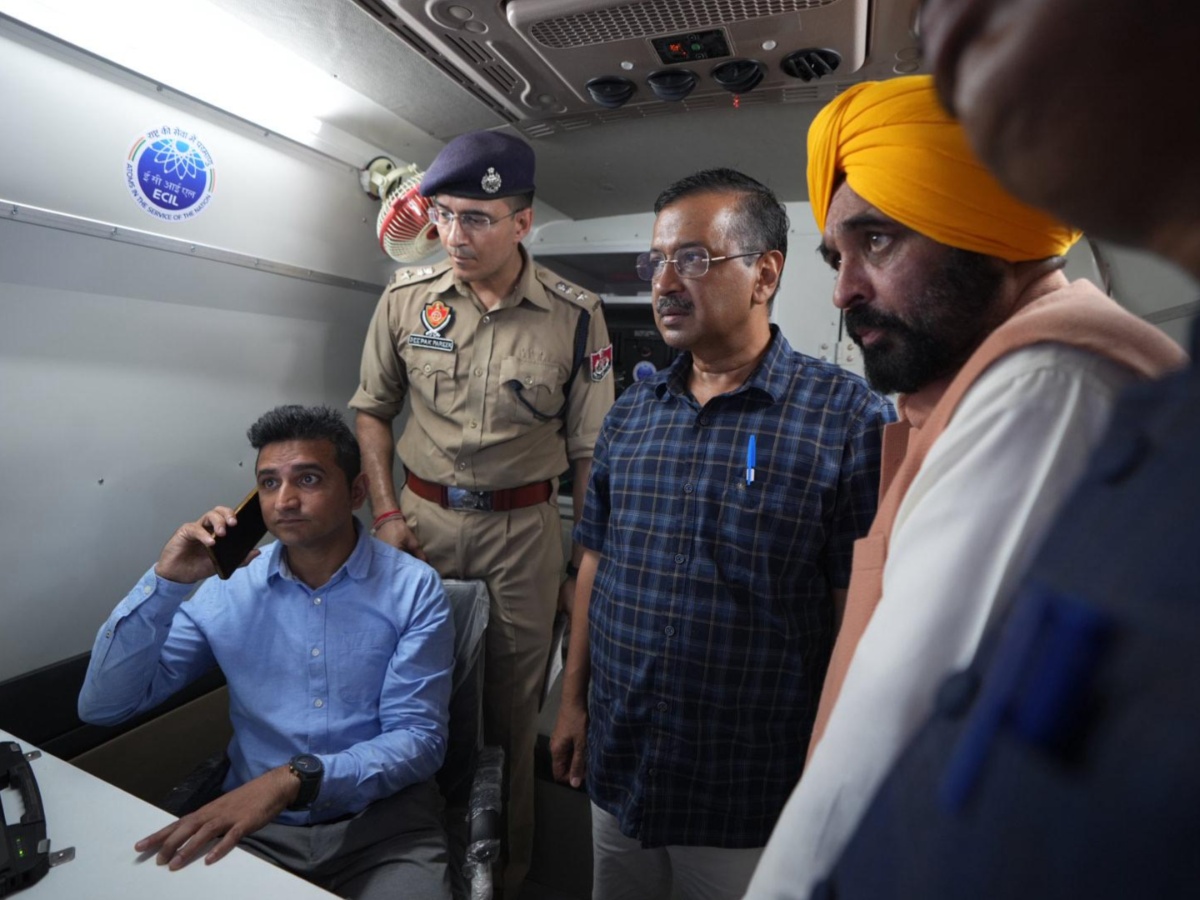
Chief Minister Bhagwant Mann, accompanied by Aam Aadmi Party national convener Arvind Kejriwal, formally launched the system in Tarn Taran on Saturday, calling it a “game-changer” in the fight against narcotics and arms trafficking.
A Menace growing in Scale and Sophistication
Punjab Police records show that the first documented interception of a cross-border drone delivery took place in September 2019 during a counter-intelligence operation against a Khalistan Zindabad Force (KZF) terror module. Since then, the threat has escalated sharply.
Between September 2019 and 15 July 2025, Punjab’s border districts reported 1,403 drone sightings and recovered 591 drones. The trendline reveals a clear and dangerous escalation:
2019 – 34 sightings, 2 recoveries
2020 – 49 sightings, 7 recoveries
2021 – 72 sightings, 1 recovery
2022 – 252 sightings, 28 recoveries
2023 – 325 sightings, 121 recoveries
2024 – 531 sightings, 294 recoveries
2025 (till July 15) – 140 sightings, 138 recoveries
The year 2024 alone saw a 173% rise in sightings compared to 2022, and a fifteen-fold increase compared to 2019. While the first half of 2025 has so far recorded fewer sightings, security officials caution that this may be due to altered smuggling tactics — with fewer but more targeted flights — rather than a decline in attempts.
The recoveries have exposed the scale of smuggling operations. Between 2019 and mid-2025, drones dropped 932.8 kg of heroin, 654.22 g of opium, 2.87 kg of methamphetamine (‘Ice’), 263 pistols/revolvers, 14 AK-47 rifles, 384 short-range magazines, 66 hand grenades, multiple improvised explosive devices, and 14.85 kg RDX.
The Border Hotspots
The drone menace is not evenly distributed along Punjab’s frontier. Intelligence and operational data point to five districts — Gurdaspur, Amritsar, Tarn Taran, Ferozepur, and Fazilka — as the primary targets. Within these, 25 “hotspots” have been identified where rogue drones are most likely to cross.
The most vulnerable points include Khalra and Khem Karan in Tarn Taran, Gharinda and Ajnala in Amritsar, and Dera Baba Nanak in Gurdaspur. These areas combine a mix of open farmland, close proximity to the international border, and well-established smuggling networks on both sides.
Village Vigilance as the Second Line of Defence
To counter the threat, Punjab Police has implemented a Drone Emergency Response System as the second line of defence behind the BSF’s border patrols. This community-integrated model relies on Village Information Systems, Village Defence Committees, and Village Police Officers.
596 border villages now host Village Defence Committees composed largely of ex-servicemen from the Army, Central Armed Police Forces, and Punjab Police.
Village Police Officers maintain detailed “beat books” with intelligence on known smugglers, couriers, and peddlers, and map vulnerable routes.
WhatsApp groups connect villages for rapid alert sharing, ensuring that sightings are quickly reported to security forces.
The system categorises hotspots into three tiers and notes even granular details such as pakka and kacha roads, enabling swift ground interception once a drone is spotted or heard.
Launch of Baaz Akh: The Technology Layer
The unveiling of Baaz Akh adds a crucial technology layer to this network. Developed by the Electronics Corporation of India Limited (ECIL), the AI-powered anti-drone units are designed to detect, track, jam, and neutralise rogue UAVs. They have an operational range of up to 8 km and use advanced algorithms to differentiate drones from birds, reducing false alarms.
The first three units have been mounted on vehicles and deployed in Amritsar, Tarn Taran, and Fazilka — districts with the highest recorded incidents of drone drops. From these bases, their coverage extends to key hotspots in Gurdaspur and Ferozepur, including Khalra, Khem Karan, Gharinda, Ajnala, and Dera Baba Nanak. This deployment ensures overlapping surveillance in the most vulnerable zones.
Six additional units are being procured, with the goal of establishing continuous AI-based monitoring from Pathankot to Fazilka. The ₹51.4 crore project is fully funded by the state government.
CM Mann and Kejriwal’s Remarks
Speaking at the launch, CM Bhagwant Mann said the Baaz Akh deployment was not just about hardware, but about safeguarding the next generation. “We are determined to cut the supply lines of drugs and arms. This AI-powered system will ensure smugglers no longer have the upper hand. Our youth deserve a drug-free Punjab, and this is one more step towards that goal.”
Arvind Kejriwal took a sharper political line, accusing past state governments of complicity with the drug mafia. “Earlier, these smugglers had political protection. Today, they have none. We are demolishing their properties, jailing their leaders, and breaking their networks. The days of political patronage to the drug trade are over.”
Recent BSF–Punjab Police Operations
The past year has seen multiple high-profile interceptions of Pakistani drones by joint BSF–Punjab Police teams:
July 24, 2025 – Six Pakistani drones were brought down near Amritsar, yielding three pistols and over 1 kg of heroin.
May 15, 2025 – A DJI Mavic 3 Classic drone was neutralised near Khem Karan in Tarn Taran.
May 14, 2025 – A coordinated operation in Amritsar, Gurdaspur, and Tarn Taran intercepted drones carrying pistols and heroin.
Early 2025 – Several drones were recovered from fields and trees in Tarn Taran and Ferozepur, some carrying small heroin packets wrapped in luminous adhesive tape for night visibility.
Late 2024 – Drone seizures exceeded 90 for the year, quadrupling the number in 2023.
BSF officials report that smugglers are constantly modifying drones to fly higher, carry heavier payloads, and evade detection, sometimes using GPS waypoints for automated drops deep into Indian territory.
Dogs Join the Fight at Attari–Wagah
In an innovative addition to its arsenal, the BSF has begun training dogs at the Attari–Wagah border to detect drones. These specially trained canines are taught to alert handlers at the first sign of a drone’s sound or movement — even before it is visible to the human eye. This biological early warning system is intended to work in tandem with technological measures like Baaz Akh, providing layered detection in varied weather and terrain conditions.
Officials say the dogs have already proven their worth in training exercises, reacting quickly to low-altitude drone flights and giving security teams extra seconds to respond — time that can be the difference between a successful interception and a lost consignment.
Collaboration Praised by BSF
The deployment has also drawn praise from senior BSF leadership. SS Chandel, DIG BSF Attari, lauded the Punjab Police’s anti-drone initiative, noting that its integration with BSF operations has already made an impact on the ground.
“Baaz Akh is a force multiplier. Working in close coordination with Punjab Police, we have been able to intercept multiple drones before they could drop their payloads. This synergy between state and central forces is essential to securing our skies and protecting our people,” Chandel said.
He added that the system’s ability to distinguish drones from birds and track them in real time has given troops a critical edge during night-time and low-visibility conditions, when most smuggling attempts occur.
Multi-Layered Strategy
Punjab’s current counter-drone architecture can be viewed as a three-tiered system:
Community Vigilance – through Village Defence Committees and Police Officers in all border villages.
Operational Coordination – with joint BSF–Punjab Police patrols and intelligence-led raids.
Technological Superiority – via Baaz Akh AI systems, supported by forensic analysis of every recovered drone.
Recovered drones are dismantled and examined for serial numbers, GPS logs, communication modules, and flight path data. These forensic leads have helped security agencies map smuggling routes, identify handlers in Pakistan, and build cases against local operatives.
The Stakes Ahead
For Punjab, the stakes are not just about border security, but about the health and safety of its people. The volume of heroin recovered from drones between 2019 and 2025 underscores the extent to which the drug trade depends on this delivery method. In 2022, 347.7 kg was seized; in 2023, 270 kg; and in 2024, 163.3 kg.
While 2025 has so far seen fewer incidents, police warn that traffickers may be switching to more covert, high-value flights rather than abandoning drones altogether. The introduction of Baaz Akh is expected to force further changes in smuggling tactics, potentially pushing traffickers towards riskier ground routes.
If Punjab’s integrated approach — combining village-based vigilance, inter-agency coordination, canine detection, and AI-powered interception — succeeds in reducing drone drops over the coming months, it could set a benchmark for other border states.
However, officials stress that the technology is only as effective as the human networks that feed it information. “A machine can bring down a drone, but it takes people on the ground to dismantle the smuggling syndicates behind them,” said a senior Punjab Police officer.
For now, with Baaz Akh scanning the skies over Amritsar, Tarn Taran, and Fazilka, and villagers, police, and BSF personnel on heightened alert, Punjab has sent a clear signal: the era of unchecked drone smuggling is coming to an end.