Chandigarh: Punjab is battling one of the worst flood disasters in decades, but the clash between the state and the Centre over disaster relief funding is deepening. The state government has accused the Union government of offering inadequate and unrealistic assistance under the existing disaster relief framework, saying that the gap between New Delhi’s claims and ground reality is “stark and widening by the day.”
Chief Minister Bhagwant Mann, who has been touring flood-hit villages, set the tone when he declared, “I am not the mukh mantri of Punjab, I am the dukh mantri. Dukh sanjha karan naal dukh adha reh janda hai.” His remark, meant to show solidarity with affected people, also underlined the frustration that despite Punjab’s repeated appeals for urgent help, the Centre has not met the state’s demands.
State’s own enhanced package
To fill the gap, Punjab has rolled out what Mann called the “highest-ever” compensation package in the state’s history. Farmers suffering crop loss will receive ₹20,000 per acre, nearly three times higher than the SDRF’s ₹6,800 norm. For houses, families whose dwellings have been fully destroyed will get ₹1.20 lakh, and those with partial damage ₹40,000, compared to the earlier ₹6,800.
Compensation for livestock has also been enhanced: ₹37,500 for a cow or buffalo, ₹20,000 for a calf or mule, ₹4,000 for a goat, and proportionate amounts for poultry. Ex gratia for deaths has been fixed at ₹8 lakh per family, double the Centre’s ₹4 lakh benchmark. So far, 55 deaths have been confirmed, with cheques already issued to 42 families.
“The state government will complete all compensation disbursal within 45 days. Officers from unaffected districts will be deputed in affected areas to speed up the special girdawri. Farmers will be allowed a week to file objections to ensure accuracy,” Mann said.
The state’s demand versus the Centre’s response
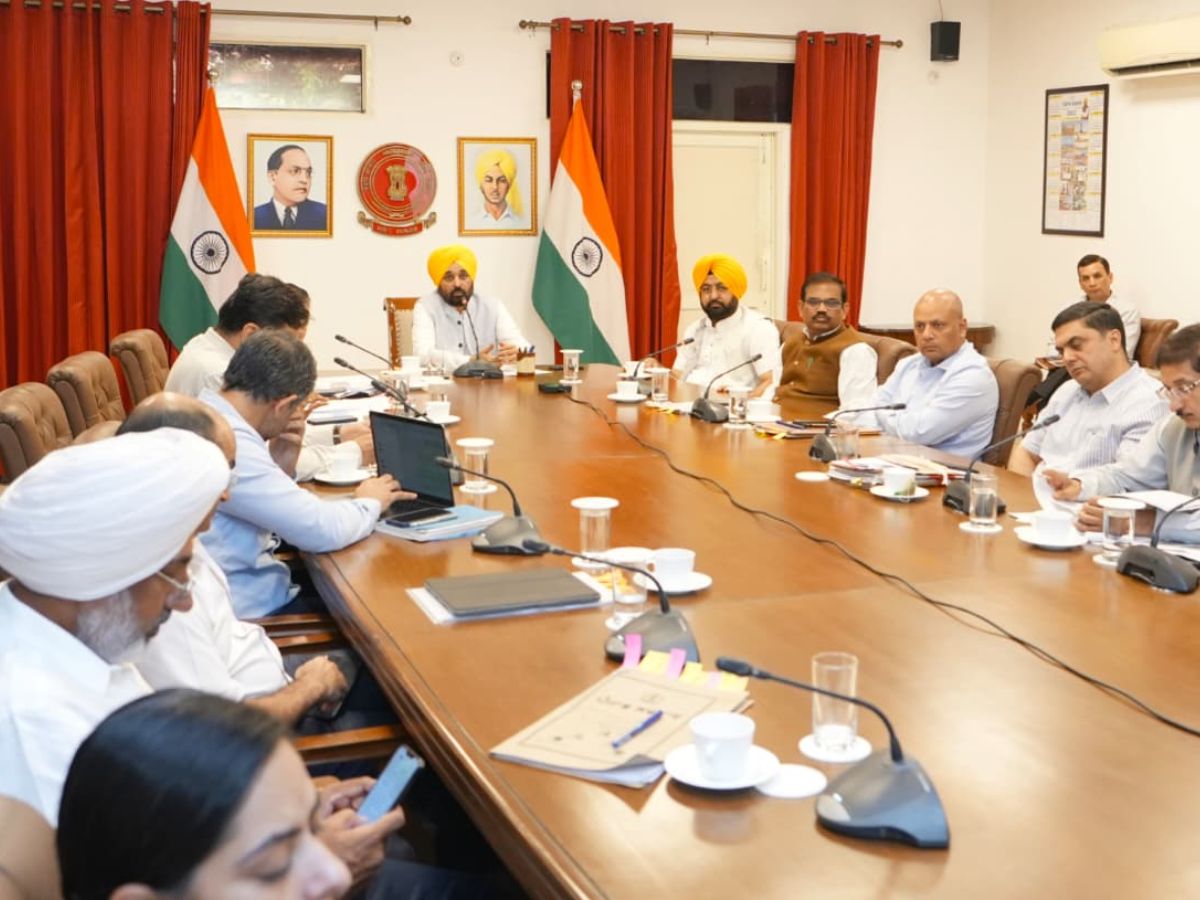
Mann, flanked by Revenue Minister Hardeep Singh Mundian and Chief Secretary KAP Sinha, said that since the AAP government had come to power in 2022, only Rs 1,582 crore had been released by the Centre as disaster relief fund. Sinha said that the amount of Rs 12,000 crore which the Centre claimed was in the SDRF was only entries in the accounts and had three components — Centre’s share, state share and interest.
“We only act as bankers and give the money as and when required. These are part of the state’s Public accounts,” he said.
The SDRF guidelines currently allow an input subsidy of ₹17,000 per hectare for farmers suffering more than 33 per cent crop loss. Translated into Punjab’s agricultural scale, this amounts to just ₹6,800 per acre. “Such a petty amount would be a cruel joke with the farmers,” Chief Minister Mann wrote in his letter to Prime Minister Narendra Modi on 31 August. The state government has already decided to supplement the Centre’s contribution by adding ₹8,200 per acre, raising compensation to ₹20,000 per acre. But Mann insists that this is still nowhere close to fair. “Since the crops were almost at the harvesting stage, at least ₹50,000 per acre should be paid to the farmers,” he argued, urging the Centre to revise its norms.
Chief Minister’s letter to the Prime Minister
In his detailed letter, Mann laid bare Punjab’s concerns. He reminded the Prime Minister that floods have affected nearly 1,000 villages across seven districts — Gurdaspur, Kapurthala, Amritsar, Pathankot, Ferozepur, Fazilka and Hoshiarpur. Close to three lakh acres of farmland remain waterlogged, and the loss of livestock has wrecked rural households dependent on dairying and animal husbandry.
The letter also catalogued Punjab’s larger financial grievances. It pointed out that the state has been left without any compensation for a revenue loss of nearly ₹49,727 crore arising from the transition to GST from the VAT regime. Added to this is the cumulative loss of over ₹8,000 crore due to cuts in RDF (Rural Development Fund) and MDF (Market Development Fund). Recently, the Centre scrapped PMGSY (Pradhan Mantri Gram Sadak Yojana) projects worth ₹828 crore in Punjab, which the state believes will seriously hamper rural connectivity in the long run.
“In total, nearly ₹60,000 crore of Punjab’s funds are stuck with the Government of India. At a time when our people are reeling under floods, withholding these dues is extremely unjust,” Mann wrote. He emphasised that while funds exist in the SDRF, the restrictive norms framed by the Ministry of Home Affairs make them almost unusable for meaningful rehabilitation.
Farmers’ plight in the fields
On the ground, the picture is grim. Paddy farmers have seen their nearly mature crops flattened by weeks of standing water. With harvesting season approaching, the loss is not only of grain but also of investment made in seeds, fertiliser, and labour through the year.
Livestock loss has added another layer of distress. Many households in Punjab maintain two or three cattle, whose milk sales form a crucial part of family income. With animals swept away in the floods, or dying due to disease outbreaks in waterlogged areas, the rural economy has taken a sharp hit. Here too, the Centre’s SDRF norms allow only a fraction of the actual market value of animals lost, leaving families struggling to replace them.
State machinery calls Centre’s stand unrealistic
Senior officials in Punjab have openly said that the Centre’s position is “far from reality.” KAP Sinha explained that the state cannot be expected to handle this magnitude of disaster with its limited resources, especially when much of its legitimate dues are already pending with the Government of India,” he noted.
Sinha further pointed out that SDRF norms were last updated years ago and fail to reflect current market costs. For instance, the input subsidy of ₹17,000 per hectare is unchanged despite the sharp rise in fertiliser, diesel, and seed prices. “It is like trying to fight today’s disaster with yesterday’s tools,” he remarked.
Political undertone and Centre-State relations
The Aam Aadmi Party government in Punjab has argued that the Centre should release at least part of the ₹60,000 crore pending with it, to enable meaningful rehabilitation. The opposition Congress has backed the demand for central aid, though it has simultaneously criticised the state government for not maintaining proper flood protection infrastructure. The BJP, meanwhile, has accused the Mann government of politicising the tragedy instead of working in coordination with the Centre.
Despite these exchanges, the ground situation remains unchanged — the Centre maintains that the state must use SDRF resources first, while Punjab insists that the fund is insufficient under the current norms.
The larger debate on disaster relief norms
The Punjab episode has reignited a wider debate about India’s disaster relief framework. Experts argue that SDRF and NDRF (National Disaster Response Fund) allocations are designed for routine calamities, not for large-scale floods that wipe out lakhs of acres. The flat-rate compensation system, they say, does not account for regional variations in cropping patterns, costs, and vulnerabilities.
Punjab officials point out that while states like Maharashtra or Gujarat may receive higher central assistance during droughts or cyclones, Punjab’s case often goes unnoticed because floods are seen as “seasonal occurrences” in the region. “But this year’s flood is not routine. It is among the worst in decades, and the relief must reflect that,” a senior official remarked.
In the absence of sufficient central assistance, the Mann government has rolled out its own relief measures. Apart from enhancing crop loss compensation to ₹20,000 per acre, it has promised ₹4 lakh to the families of those who lost their lives in the floods. Farmers whose cattle died will also receive assistance, though again the compensation levels are lower than replacement costs.
The state has further requested the Centre to allow flexibility in SDRF spending, so that it can design support packages suited to Punjab’s agricultural economy. Without such flexibility, officials warn, funds will remain unspent on paper while affected households continue to suffer.
As Punjab’s villages struggle with stagnant waters, ruined fields, and lost livelihoods, the confrontation over disaster relief is hardening. The Centre’s insistence on following SDRF guidelines and the state’s plea for realistic compensation have left farmers caught in the middle.
By the state’s own admission, unless the Union government recognises the scale of the calamity and revises its relief norms, rehabilitation will remain incomplete. “The gap between the Centre’s claim and Punjab’s reality has never been wider,” a senior official summed up.