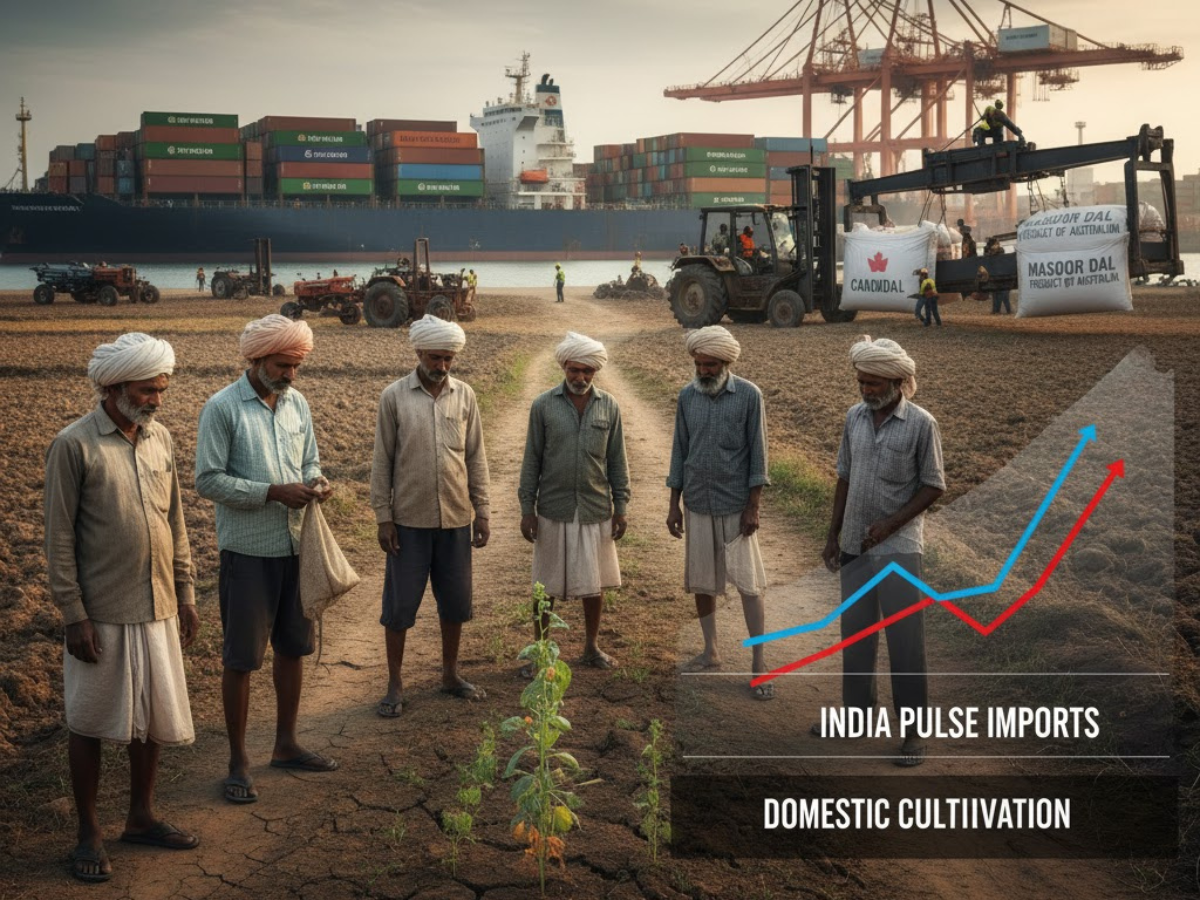
India’s determination for agricultural self-sufficiency keeps displaying grey areas as is revealed by pulse imports. In 2025, the country imported pulses at an all-time record of 7.7 million metric tonnes notably worse is the concurrent decrease in domestic pulse cultivation, where over 3 million hectares were lost in the last four years. The increasing separation of production and consumption raises serious concerns about policy priorities and farmer confidence.
What is the New Pulses Mission & Will It Work?
The government has launched the New Pulses Mission, an embodiment of its ambitious plan for self-reliance in pulses by 2030-31. The plan has Rs. 11,440 crores for bringing under cultivation the area from the present 27.5 million hectares to 31 million hectares and increasing production to 35 million tonnes across 416 districts in the country.
The real test lies in actual delivery on paper, all of that looks quite impressive with a mission is only as strong as the incentives it offered those expected to drive it-India’s farmers.
Can it Succeed Without Price Guarantees?
India already boasts the largest area of pulse cultivation almost 36% of the whole area but realized production is around 27% of world total, showing a large productivity gap. The Farmers lack the assurance of Minimum Support Price (MSP) and Expansion strategy will never be sustainable without price protection. Plans, policies and slogans will fail to make any dent in influencing a farmer to sow if signals from the market have been raising loss.
ALSO READ: Will Aliens Arrive on October 29? Scientists Decode 3I/ATLAS
Why Has Area Under Pulses Shrunk?
During the period 2021-22 to 2024-05, area under pulses decreased from 30.73 million hectares to 27.62 million hectares. The Low market prices bothering even minimum support prices that are consumer-friendly tend to get a lot of public clapping but in that, he is actually destroying the motivation of growers as their input costs are also rising Farmers are opting out of pulses, chasing crops that are more stable in returns.
How High Demand is Falling Prices?
The principle is that less supply and increased demand would logically mean higher prices for producers. The Indian pulse market has defied this principle. By October 1, 2025, the market prices of Tur, Moong and Urad were below MSP of Rs. 1,838, Rs. 2,250 and Rs. 2,063, respectively. This comes at a time when India is still unable to meet domestic demand. When even MSP cannot be relied upon, it is not surprising that pulse cultivation is in decline.
ALSO READ: What is the Scientific Name of Rice? Meaning, Origin & Importance
Heavy Imports: The Bigger Loss
India’s annual requirement for pulses is around 29 million tonnes whereas the local output is 25.24 million tonnes. Of this shortfall of 3.76 million tonnes instead of meeting it through imports, 7.65 million tonnes are being brought in-an overshoot of almost 1.9 million tonnes on its way to saturation of markets, plunging prices and farmer distress. The more the imports exceed actual demand gaps, the more difficult it is to avoid thinking that flaws-or deliberate omissions-in policy are hurting domestic producers.
Is India Really Going to be Import-Free by 2027?
In early 2024, Union Minister Amit Shah with utmost confidence, declared that all importation of pulses would cease by the end of 2027. The perspective looks gloomy with falling production, lesser area being cultivated and increased imports unless the government revises its pricing and procurement strategies at urgent pace, India’s self-reliance dream on pulses is likely to remain a far-off distant political sound byte far from ground realities.
ALSO READ: India or China: Which Country Leads the World in Rice Production in 2025
Disclaimer: Data and projections are based on government reports, ministry statements, and public sources available as of 2025; subject to change with policy updates.