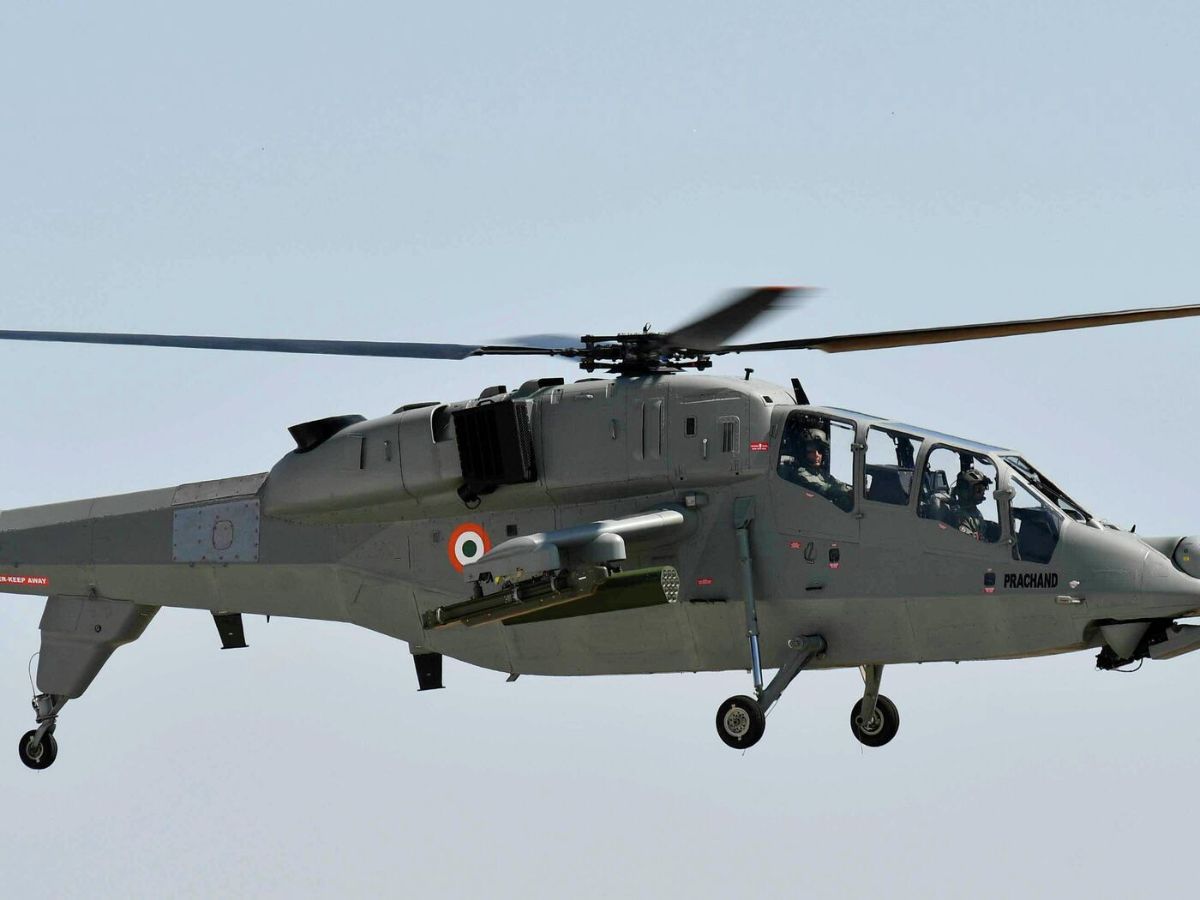
India’s indigenous Light Combat Helicopter (LCH) Prachand has already achieved a strategic victory that the iconic Apache AH-64E cannot match—operating effectively in the world’s highest battlefields. While the Apache recently arrived at Hindan Air Force Station after long delays, the Indian Air Force and Army have committed ₹62,700 crore to induct 156 more Prachands.
This isn’t a simple face-off between two helicopters—it’s a case of complementarity. But in the context of high-altitude warfare, especially amid rising tensions with China, Prachand outshines its American rival. More importantly, it signals a deep shift in India’s defense strategy—from reliance on imports to prioritising self-reliance and operational specificity.
High-Altitude Mastery: Prachand’s Himalayan Edge
Prachand has done what the Apache struggles to do—fly and fight at altitudes above 15,000 feet. Its demonstrated landings on the Siachen Glacier and operational ceiling of 6,500 meters give India a critical advantage in its most hostile and contested terrain.
In comparison, the Apache—despite its cutting-edge firepower—has a service ceiling of around 6,400 meters. At those heights, every kilogram counts, and every rotor spin slows. Physics makes thin air the ultimate test, and Prachand passes it with ease.
ALSO READ: Kolkata Police Issues Traffic Advisory for Independence Day Rehearsals: Check Routes
Complementary, Not Competitive
Defense headlines often pitch Prachand against Apache as rivals. But both helicopters serve different purposes. The Apache, with its Longbow radar and UAV integration, dominates in conventional low-altitude warzones, like deserts and urban environments.
Meanwhile, the Prachand is purpose-built for the Himalayas. It’s not about replacing the Apache—it’s about deploying the right platform for the right mission. India needs both. But only one can rule the mountains.
Strategic Autonomy: Beyond the Price Tag
At nearly half the cost—₹438 crore per Prachand versus ₹877 crore per Apache—India gets more firepower per rupee with the indigenous option. Yet, the true gain lies in independence.
Using foreign platforms can result in delayed deliveries, limited access to upgrades, and geopolitical ties. The 15-month delay in Apache delivery due to issues with the US supply chain shows the risk.
Production, maintenance, and any enhancements with Prachand are under India’s purview. It’s a shift from dependence to independence, from consumer to creator.
Political Signal Behind the Rotor Blades
Prachand is not only a military asset but also a diplomatic one. Its success shows that India is growing more confident in its capacity to set itself apart from conventional arms purchases. India’s reliance on domestic innovation demonstrates its sovereignty in a multipolar environment where international suppliers frequently have terms.
As Western defense firms angle for contracts, and China flexes along the LAC, India’s message is clear: it will not let foreign timelines or politics dictate military readiness. The Prachand is more than a weapon—it’s a statement of intent.
ALSO READ: India’s Fifth-Generation Fighter Conundrum: F-35, Su-57, or Wait for AMCA?
Rethinking Military Procurement Strategy
India’s experience offers a lesson to the world: don’t copy, adapt. The Prachand did not attempt to convert to Apache culture. It became a machine designed to meet the particular difficulties faced by India, something the Apache was unable to do.
Note to planners of the world’s defense. Platforms built for certain battlefields, not all-purpose powerhouses that falter when it counts most, are the platforms of the future.
Autonomy in the Air
The Apache is still one of the world’s most feared attack helicopters. But in the Himalayas, it’s Prachand that leads. India has quietly rewritten the rules of military acquisition.
The goal isn’t to own the most expensive machine—it’s to own the one that works when and where it’s needed most.