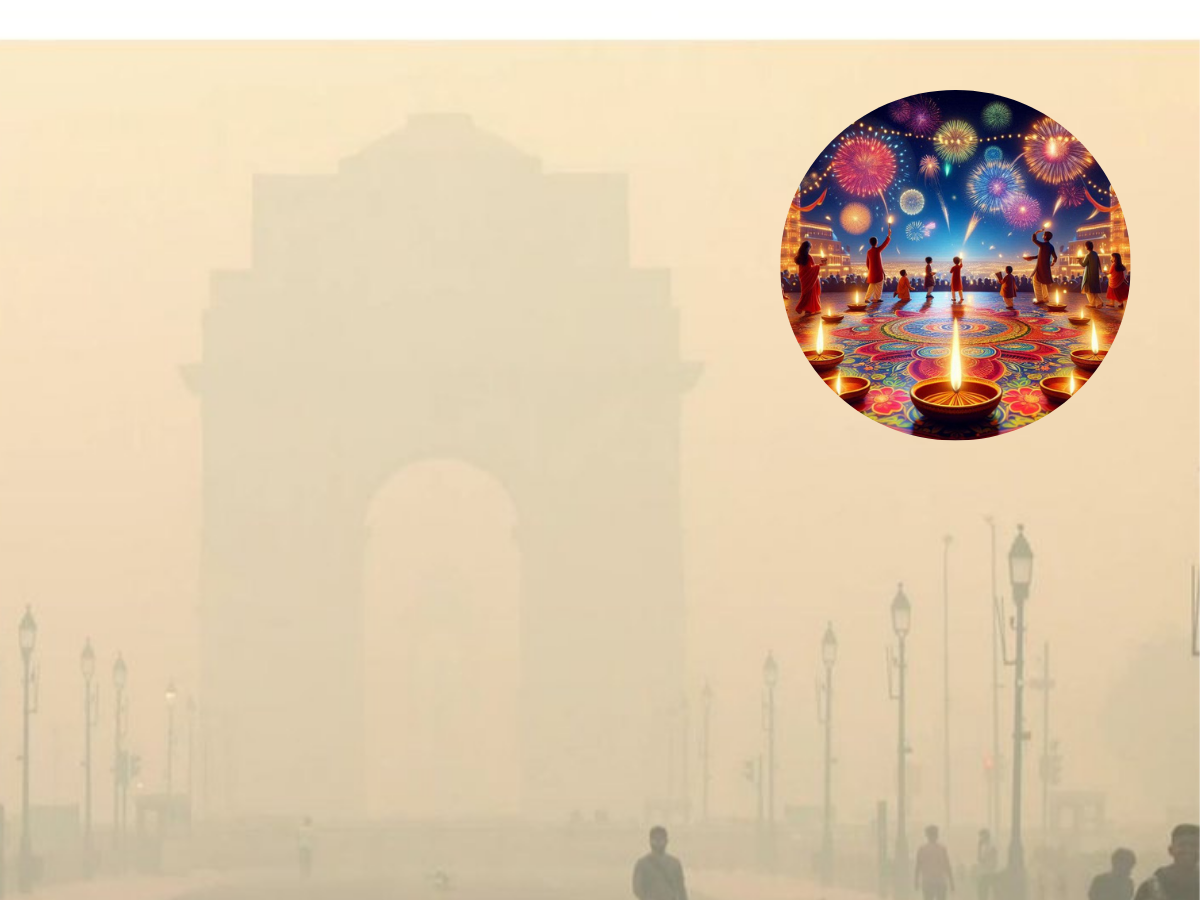
Dense smog and poisonous air are already choking Delhi woke up to even worse air this morning, just a day after Diwali. The air quality dipped to the ‘Very Poor’ category of the Air Quality Index, with the majority of the city’s monitoring stations measuring pollution levels in the ‘red zone.’
The overall AQI in Delhi stood at 350 as of 8 am on Tuesday, according to the Central Pollution Control Board (CPCB) data.
| Area | AQI | Category |
|---|---|---|
| Bawana | 427 | Severe |
| Wazirpur | 408 | Severe |
| Alipur | 408 | Severe |
| Jahangirpuri | 407 | Severe |
| Burari Crossing | 402 | Severe |
| Shadipur | 399 | Very Poor |
| Ashok Vihar | 391 | Very Poor |
| Punjabi Bagh | 376 | Very Poor |
Besides the above-mentioned figures, air quality also dipped in places such as JLN Stadium (AQI 318), ITO (347), Aya Nagar (AQI), Lodhi Road (AQI 327), Anand Vihar (AQI 360), Okhla Phase-2 (AQI 353), North Campus, Delhi University (363), and Dilshad Garden (357), among others.
Also Read: Delhi AQI Alert: National Capital Faces Rising Pollution as Winter Sets In
Apart from this, air quality in the vicinity of the Indira Gandhi International Airport also did not move out of the ‘very poor’ category this morning, with an AQI of 313.
Delhi Pollution Blues
As the days approached towards Diwali, Delhi’s air quality progressively deteriorated, with AQI levels becoming progressively more ominous day by day.
Even while Stage 2 of the Graded Action Response Plan (Grap 2) became effective on Sunday, the city saw AQI in the ‘severe’ level the following day, Diwali. The AQI at most of the stations was above 300, and that of Anand Vihar and Wazirpur was 400-plus.
Parallel but even grimmer readings were reported on Tuesday, a day after fireworks illuminated the city during Diwali. With winter, Delhi witnesses a sudden spike in poisonous air and pollution every year.
Supreme Court Nod to Green Crackers
On October 15, days prior to Dhanteras and Diwali, the Supreme Court permitted the use and sale of green firecrackers in the Delhi-NCR area from October 18 to 20.
But the nod was accompanied by some conditions crackers that were not sourced from outside the NCR were banned, and usage was limited to specific hours: 6–7 pm and 8–10 pm. The apex court called this a “balanced approach” that ensured festive fervor while protecting the environment.
On Diwali though, crackers were said to be burst outside the windows the top court established, and this in all probability became one of the causes of driving the hourly PM 2.5 levels in some areas of the city to approximately 29 times beyond permissible standards.