
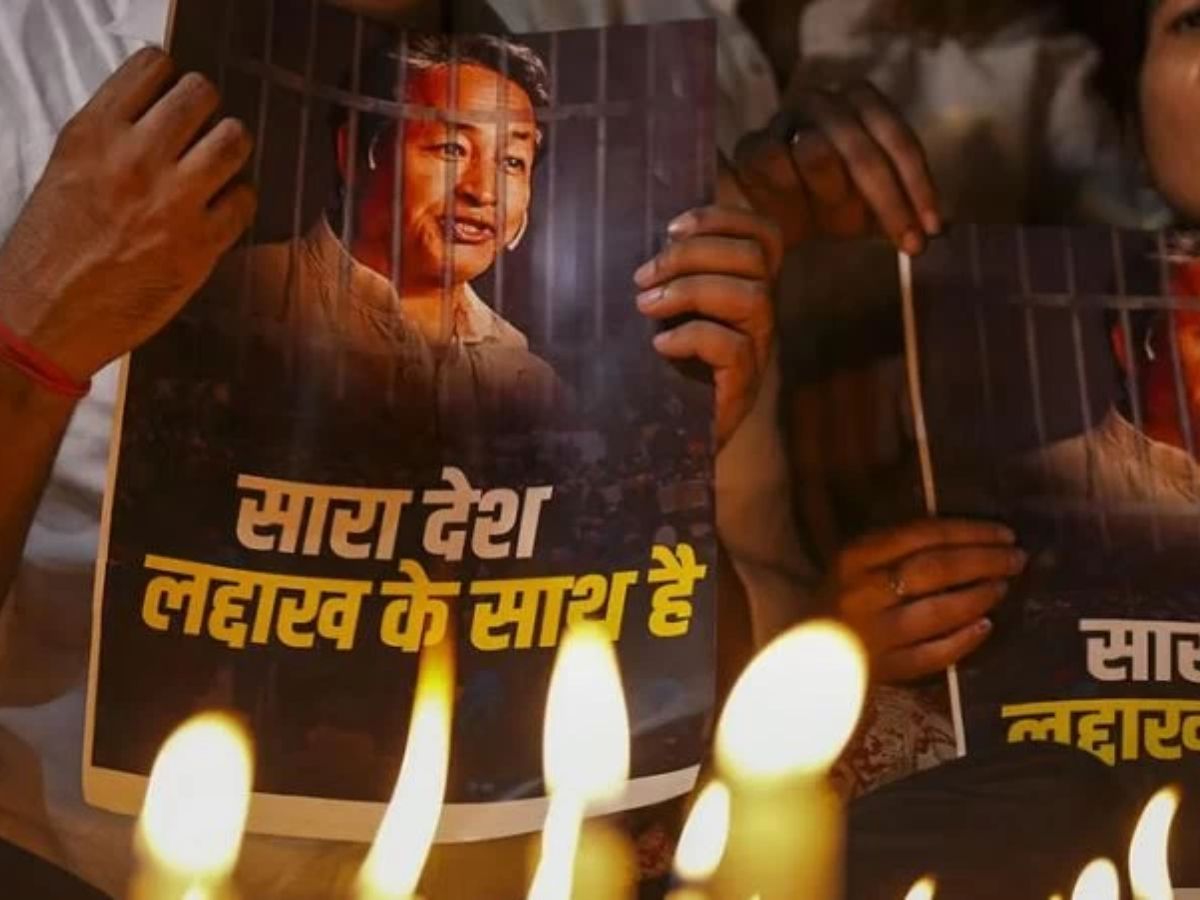
The Ladakh administration has broken its silence, dismissing allegations of victimisation against prominent activist Sonam Wangchuk and stating that his detention under the stringent National Security Act (NSA) was based on “credible inputs and documents.” Following violent clashes in Leh, tensions have been rising for weeks.
Who is Sonam Wangchuk and Why Was He Detained?
Known to many as the real-life ‘Phunsukh Wangdu’ from 3 Idiots, engineer and education reformer Sonam Wangchuk has emerged as a prominent leader in Ladakh’s fight for statehood and constitutional safeguards under the Sixth Schedule. Following this, Wangchuk was detained under the NSA, a law that allows for preventive detention for months.
What Are the Administration’s Specific Allegations?
In a detailed statement, the Union Territory administration laid out a series of serious allegations against the activist. They accused him of making “multiple provocative statements” from the protest venue, allegedly inciting the public, especially the youth, by giving references to political upheavals in Nepal, Sri Lanka, and Bangladesh.
The most severe accusation claims that Wangchuk, on his YouTube channel, suggested bringing an ‘Arab Spring’ type revolution in India to “overthrow” the government if their demands were not met. The administration’s statement further alleges that he put forth the idea of self-immolation, drawing parallels to protests in Tibet and the Arab world, to instigate agitation. Regarding the September 24 violence, the administration stated that while other leaders from the Leh Apex Body (LAB) tried to pacify the crowd, Wangchuk made no attempts to ensure peace.
What About the Action Against His NGO?
The administration also addressed the cancellation of the Foreign Contribution (Regulation) Act (FCRA) certification of Wangchuk’s NGO, the Students Educational and Cultural Movement of Ladakh (SECMOL). They stated the cancellation was not arbitrary but followed “clear evidence of multiple violations.” They also stated that the Himalayan Institute of Alternatives, Ladakh (HIAL), another group connected to Wangchuk, is being investigated for foreign exchange crimes.
How Has Wangchuk’s Family Responded?
The family of Wangchuk has strongly refuted the accusations. Gitanjali Angmo, his spouse, has denied the accusations and charged the Ladakh police with having a “agenda.” She claims that a “fabricated narrative” has been created to avoid implementing the Sixth Schedule and to make her husband a scapegoat. According to Angmo, Wangchuk only ever supported Ladakh’s peaceful inclusion in the Sixth Schedule of the Constitution, which she claims is essential to preserving the area’s democratic rights and ethnic identity.
What Does the Sixth Schedule Mean for Ladakh?
At the heart of this conflict is the demand for the Sixth Schedule. This section of the Indian Constitution relates to the administration of tribal areas, primarily in the northeastern states, and advocates for the creation of autonomous district councils with legislative, judicial, and administrative autonomy. Protesters in Ladakh argue that this level of autonomy is essential to protect the region’s unique ecology, tribal culture, and land rights from unchecked industrial and demographic change.
Also Read: Power Up Your Morning: A Vegetarian Breakfast with 30g of Protein, No Meat, No Supplements
A Battle of Narratives
The Ladakh administration’s statement concludes by urging that law enforcement agencies be allowed to continue their probe impartially, asserting “there is no question of witch-hunting or smoke screen.” This sets the stage for a protracted legal and political battle, pitting the state’s narrative of national security and lawful investigation against the protesters’ claims of democratic suppression and victimisation of a beloved public figure.