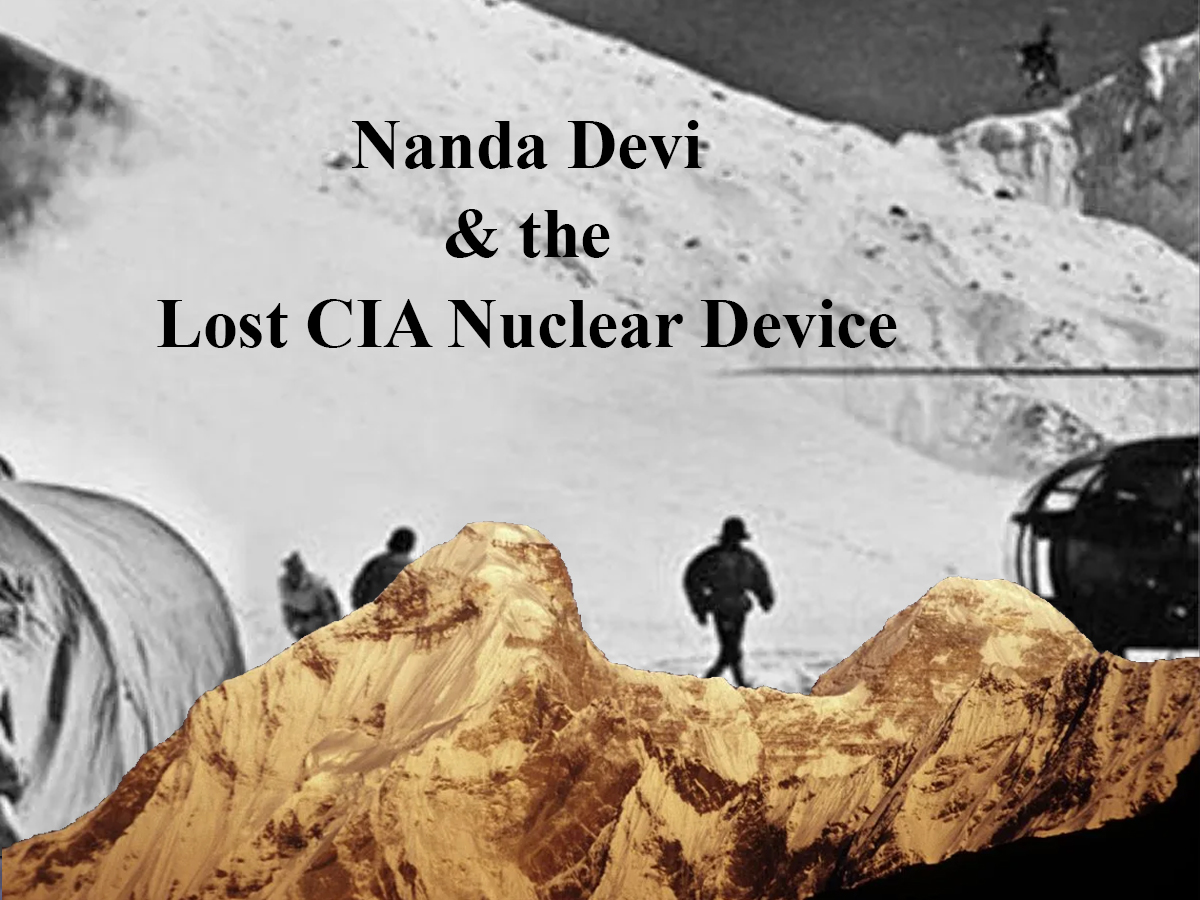
High above Uttarakhand, Nanda Devi stands quiet and remote, as it is India’s second-highest peak. It is also one of the most protected ecological zones in India. Yet decades after a secret Cold War mission, the mountain has returned to the national spotlight.
This time, it is not because of mountaineering or conservation. It is because of politics, radiation fears, and a forgotten intelligence operation that still raises questions about India’s environment and national security.
A claim by BJP MP Nishikant Dubey has reopened an old chapter that many believed was closed. The allegation links past governments, a missing nuclear-powered device, and long-term environmental risks tied to the Ganga basin, and now the issue goes far beyond history.
What Did Nishikant Dubey Claim?
On Monday, BJP MP Nishikant Dubey accused former Prime Ministers Jawaharlal Nehru and Indira Gandhi of allowing the US Central Intelligence Agency to install nuclear-powered surveillance equipment on Nanda Devi during the 1960s.
In a post on X, he said, “India’s first Prime Minister, Nehru Ji, in 1964, and former Prime Minister Indira Ji, in 1967 and 1969, collaborated with America’s CIA to install nuclear espionage equipment for China on Nanda Devi in the Himalayas. All the equipment was left there as the Americans fled. Isn’t this the reason why cancer rates are rising among people living along the banks of the Ganga from Uttarakhand to Bengal? Is this the cause of glaciers melting in the Himalayan regions, cloudbursts, and cracks appearing in houses? In the Lok Sabha in 1978, then Prime Minister Morarji Desai acknowledged this. Recently, the famous American newspaper The New York Times has prominently published this news. It is time to save our children.”
भारत के पहले प्रधानमंत्री नेहरु जी ने 1964 में तथा पूर्व प्रधानमंत्री इंदिरा जी ने 1967,1969 में अमेरिका के CIA से मिलकर न्यूक्लियर जासूसी उपकरण चीन के लिए हिमालयन नंदा देवी में स्थापित करवाया ।सभी उपकरण वहीं छोड़कर अमेरिकी भाग गए ।आज गंगा किनारे रहने वाले लोगों को उत्तराखंड से… pic.twitter.com/lGZxIGTQaS
— Dr Nishikant Dubey (@nishikant_dubey) December 15, 2025
The statement triggered sharp political reactions and renewed public concern.
Cold War Mission on Nanda Devi
During the 1960s, China was testing nuclear weapons, and the US wanted intelligence signals from across the border. India was recovering from the 1962 war with China and cooperated.
A joint operation between the CIA and India’s Intelligence Bureau planned to place a listening device on Nanda Devi. The device ran on a Radioisotope Thermoelectric Generator, or RTG. It used plutonium to generate power.
In 1965, bad weather forced the team to abandon the equipment, and when climbers returned the next year, the device had vanished. Avalanches likely buried it deep under ice and rock. The mission failed, and the questions never did.
What Is an RTG and Why Does It Matter?
An RTG, or Radioisotope Thermoelectric Generator, is a power source that produces electricity from radioactive heat. It does not rely on batteries, fuel refills, or sunlight, but instead, it uses the natural decay of radioactive material, usually plutonium-238, to generate continuous heat.
This heat converts into electricity through thermocouples. The process has no moving parts, and that makes RTGs extremely reliable. They can work for decades without maintenance, and because of this, space agencies use RTGs in satellites, deep-space probes, and remote scientific stations where solar power fails.
The RTG placed on Nanda Devi was designed for the same reason. The location was remote, the weather was extreme, and no other power source could survive those conditions. The device needed to operate silently for years while collecting signals from across the border.
Is RTG a Nuclear Bomb?
An RTG is not a nuclear bomb, and it cannot explode or trigger a nuclear reaction. That distinction is important. However, the danger lies in radiation exposure if the protective casing breaks.
The plutonium inside an RTG is sealed in heavy shielding, and under stable conditions, it poses minimal risk. But mountains are not stable environments. Avalanches, ice movement, earthquakes, and glacial melt can damage containment over time.
If the casing cracks, radioactive particles can slowly leach into surrounding ice, soil, or water. This process may not cause immediate harm, but over the years or decades, radioactive material can enter river systems through glacial melt.
Where Could the Lost Device Be Today?
No one knows.
Search missions by Indian and American teams failed. Some believe the device was quietly recovered. Others think it remains trapped in ice.
In 1978, India’s Atomic Energy Commission said it found no plutonium contamination in rivers. However, it also failed to locate the device.
The uncertainty fuels fear.
Why the Ganga Basin Is Central to the Concern
Nanda Devi’s glaciers feed the Rishi Ganga and Dhauliganga. These rivers join the Alaknanda and Bhagirathi to form the Ganga.
Hundreds of millions depend on this water.
Experts say a sealed RTG poses little immediate danger. But if its casing cracks due to warming or glacial shifts, radioactive material could enter meltwater.
That risk may be small. Its impact would be massive.
Politics, Blame, and the Nehru-Gandhi Debate
Dubey has linked the issue to the Congress party and the Nehru-Gandhi family. He questioned whether national interest was compromised.
He also raised links between the lost device and disasters like the Kedarnath floods, the Teesta flooding, glacier retreat, and structural damage in Himalayan towns.
Scientists have not confirmed any such link. But politics rarely waits for scientific consensus.
Why Nanda Devi Was Closed to the World
Before the CIA-linked operation, Nanda Devi attracted elite climbers from across the world. The inner sanctuary was open. Expeditions were permitted under regulated conditions.
Search missions by Indian and American teams failed. Some believe the device was quietly recovered. Others think it remains trapped in ice.
Indian authorities realised that the mountain was no longer just a natural site. It had become a strategic and environmental liability. The possibility that radioactive material lay buried beneath ice forced a rethink.
Foreign access became sensitive, intelligence concerns grew, and environmental risks became harder to assess. Slowly, permits stopped coming.
In 1978, India’s Atomic Energy Commission said it found no plutonium contamination in rivers. However, it also failed to locate the device.
Nanda Devi Crisis: The Mountain Still Holds Its Secret
Nanda Devi has stood untouched for decades, as it has seen empires rise and fall. It has absorbed a Cold War secret into its ice.
Whether the lost device still lies there may never be known, but as glaciers melt and politics heats up, the mountain is no longer silent.