The Nagaland government has decided to convene a special session of the Nagaland Legislative Assembly to enact legislation for the proposed Frontier Nagaland Territorial Authority (FNTA), marking a major step toward addressing long-standing demands for greater autonomy and development in Eastern Nagaland.
The decision was announced after an emergency Cabinet meeting on July 6, amid growing concerns over delays in implementing the tripartite Memorandum of Agreement (MoA) signed on February 5, 2026, between the Centre, the Nagaland government and the Eastern Nagaland People’s Organisation (ENPO).
The proposed FNTA aims to provide greater administrative autonomy to six eastern districts — Tuensang, Mon, Kiphire, Longleng, Noklak and Shamator. These districts are home to several Naga tribes that have long raised concerns about development and representation. Under the MoA, powers over 46 subjects, including land, rural development, agriculture, local infrastructure, water resources, and welfare schemes, will be transferred to the authority. The FNTA is designed as a territorial body within Nagaland, separate from Sixth Schedule autonomous councils, and will include a mini-secretariat with financial support.
The demand for the FNTA has its roots in long-standing concerns over uneven development in Eastern Nagaland. The region forms a significant part of the state’s geography and population. The ENPO claims it accounts for nearly 50 per cent of the population, though official figures vary. The area has lagged behind in infrastructure, education, healthcare, and employment. Historical factors, including its earlier attachment under the Naga Hills Tuensang Area (NHTA) framework and later integration challenges, have contributed to perceptions of neglect.
The ENPO, representing tribes such as the Konyak, Chang, Yimchunger, and others, has repeatedly pointed to lower literacy rates, poor road connectivity, fewer educational institutions, and limited government employment despite reservation policies. Since 2010, the organisation has demanded a separate Frontier Nagaland state. The FNTA emerged as a negotiated solution that would preserve Nagaland’s territorial integrity while granting greater self-governance.
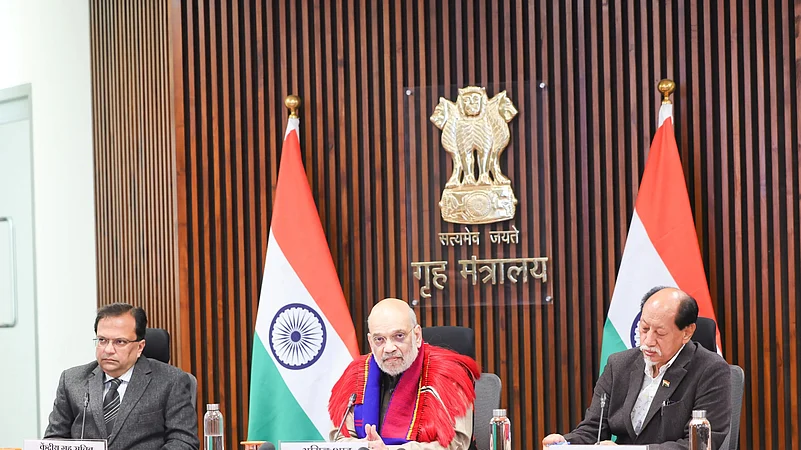
The February 5 MoA, signed in New Delhi in the presence of Union Home Minister Amit Shah, was described as a historic breakthrough. It promised the transfer of powers along with a Rs 5,000 crore economic package for faster development. Chief Minister Rio said the agreement would promote equitable growth and stressed that Nagaland’s overall progress depends on the development of its eastern districts.
However, implementation has faced legal and constitutional hurdles. After the MoA, the state prepared the FNTA Bill and introduced it in the Assembly in late March 2026. The Bill was later deferred after the Ministry of Home Affairs (MHA) raised concerns over granting legislative powers through state legislation. Legal opinions, including that of the state’s Advocate General, pointed out that the state legislature cannot fully delegate its powers to another body without appropriate constitutional mechanisms.
The ENPO expressed disappointment and accused the state government of making a “U-turn” and weakening important provisions related to autonomy. This led to plans for a rally and shutdown on July 10. In response, the emergency Cabinet meeting on July 6, attended by members of the Eastern Nagaland Legislators’ Union (ENLU) and senior officials, worked to restore consensus.
The government has now committed to holding a special Assembly session to pass focused legislation that would grant legislative powers to the FNTA over the transferred subjects, subject to consultation with and approval from the MHA, and in full conformity with the Constitution. It also reiterated that the safeguards under Article 371(A), which protect Naga customary laws, land ownership, and religious practices, remain “sacred and sacrosanct” and will not be diluted.
The Cabinet has also requested the Centre to increase the development package to at least Rs 10,000 crore to help bridge infrastructure gaps and support economic growth.
A Cabinet delegation led by Chief Minister Rio, along with ENLU representatives, will soon visit New Delhi to seek the Centre’s advice, approval, and guidance. The discussions are expected to address the remaining constitutional and procedural issues and clear the way for the formal establishment of the FNTA.
The state government has appealed to the ENPO to reconsider its planned July 10 agitation, saying that concrete steps are now being taken. “Nagaland can achieve comprehensive, inclusive and sustainable development only when Eastern Nagaland is fully developed and progresses alongside all other regions,” the Home Department statement emphasized.
The FNTA is seen as a practical approach to addressing regional aspirations in Northeast India without changing state boundaries. Since 2019, the Centre has signed several agreements aimed at promoting peace and development across the region. If successful, the FNTA could become a model for resolving similar demands while strengthening cooperative federalism.