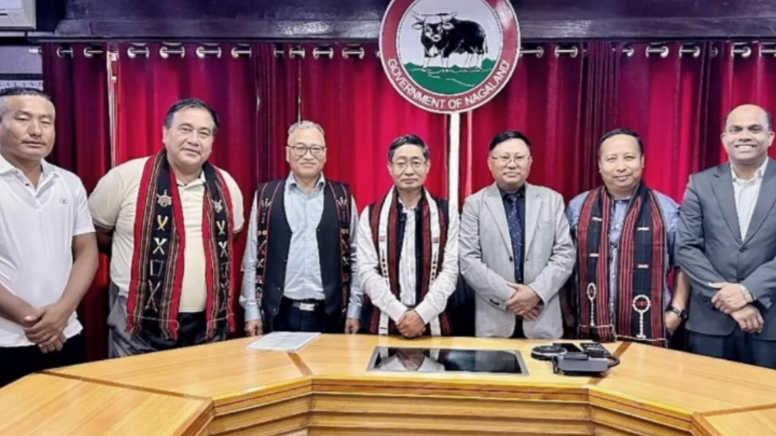
The Five-Tribes Committee on Review of Reservation Policy (CORRP) has strongly objected to the composition of the new commission formed to examine Nagaland’s reservation policy. Following a three-hour closed-door meeting in Kohima with the apex bodies of the Angami, Ao, Lotha, Rengma, and Sema tribes, CORRP announced it will boycott all state government events, including the upcoming Independence Day celebrations.
Call for an All-Government Official Commission
CORRP convener Tesinlo Semy praised the government’s initiative to establish a commission but criticized the inclusion of civil society organizations (CSOs) in its makeup. “The inclusion of civil society organisations compromises their independence and impartiality,” he said. The committee demands that the commission should consist solely of government officials, either serving or retired bureaucrats, to ensure a fair and unbiased review.
Review Commission Was Government-Initiated
CORRP member secretary GK Zhimomi clarified that the committee had never asked for this review; it resulted from a meeting with the state government on June 3, led by Deputy Chief Minister Y Patton. Zhimomi emphasized, “The commission must be independent. Including CSOs in a decision-making body that is meant to objectively assess the reservation policy undermines its fairness.”
Disputing Government Job Distribution Figures
Zhimomi rejected a state minister’s recent claim that 64% of government jobs are held by the five advanced tribes, while over 10 backward tribes only hold 34%. He called these numbers “wildly imaginary” and said CORRP possesses its own data, which will be released at an appropriate time.
Responsibility for Tribal Dialogue Lies with Commission
Regarding talks with tribes currently benefiting from the backward quota, CORRP maintained that such consultations should be conducted by the government-appointed commission. “The government must gather views from all sides and come up with a fair solution,” Zhimomi said. He further warned that if the government ties the implementation of the commission’s recommendations to the national census, CORRP will demand the suspension of the current reservation policy until then.
Non-Participation, Not Boycott
Zhimomi clarified, “This is not a boycott, but a conscious decision of non-participation,” signaling the committee’s protest without severing all communication.
Background: Why Review the Reservation Policy?
The demand to review Nagaland’s reservation policy gained strength after CORRP’s joint memorandum to the government. The committee argued that the policy, which has been in effect since 1977, no longer reflects the current socio-economic and educational conditions of the state’s communities.
Reservation Policy History and Changes
Initially, 25% reservation was allotted to seven tribes in non-technical, non-gazetted government posts for ten years, based on their educational and economic disadvantages and low representation. Over time, this quota increased to 37%, with 25% reserved for seven Eastern Nagaland Backward Tribes and 12% for four other backward tribes.
Protests and Future Outlook
CORRP organized demonstrations on May 29 and July 9 across various districts to voice their demands and concerns. The committee’s refusal to participate in government events marks a new phase in their ongoing struggle for a fair and just review of Nagaland’s reservation policy.