
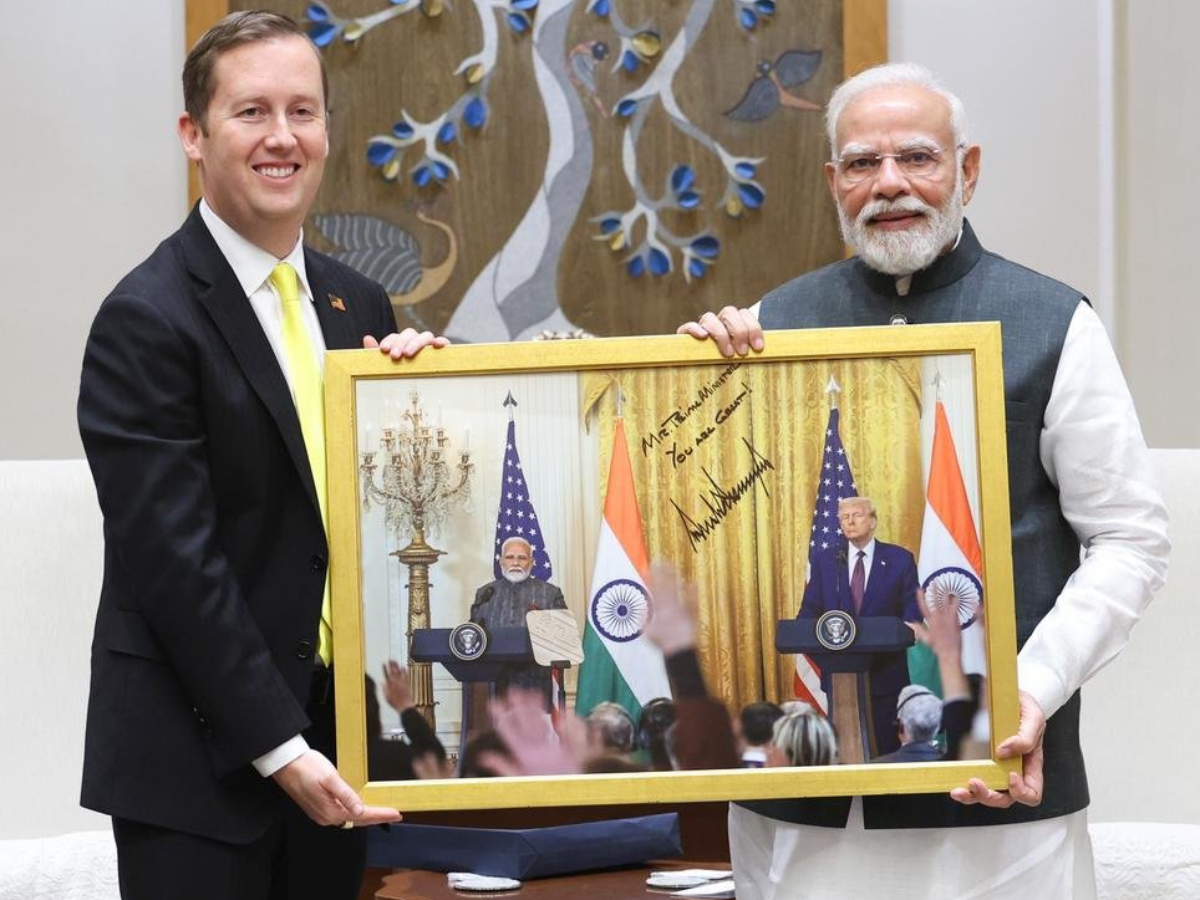
On October 11, 2023, U.S. ambassador Sergio Gor presented Indian Prime Minister Narendra Modi with a framed photo collage of Modi and former U.S. President Donald Trump. The photos, complete with Trump’s handwritten comment “Mr. Prime Minister, you are great,” have renewed attention on the personal ties between the two leaders while Trump’s straightforward, marker written words reflected his style, they also symbolized a relationship that has had its share of highs and lows mingling camaraderie with tension.
Personal Equation Between Modi & Trump
PM Narendra Modi and Donald Trump in their political linking where Trump is calling Modi “a great personal friend,” mustered all his energy to develop a workable relationship with the Indian leader if the first few trades had some anxieties. This particular context is undergirded by a more personal relationship that goes outside the protocol of diplomacy with both leaders frequently sending each other messages of acclaim and appreciation.
This bond has survived and grown stronger, even though political and economic disagreements such as the U.S. putting tariffs on Indian goods during the Trump presidency through thick and thin, tariffs or not Trump always managed to express his admiration for the leadership qualities of Modi.
PM Modi & Trump: Tumultuous Trade & Diplomatic
The diplomatic ties that Modi and Trump share often find many complications along the road ahead due to one principal issue trade during Trump’s presidency with an introduction of heavy tariffs on Indian goods by the U.S, in 2018, relations between the two countries quickly soured. On the other hand, despite all the trade strife, the two leaders had kept on cordial interaction through the thick and thin. The U.S. decision under Trump to impose tariffs on Indian goods came directly from the conflict regarding the importation of oil from Russia. Despite the points of tension, moments of diplomacy did arise, one being Modi praising Trump’s peace plan on Gaza.
ALSO READ: SC Signals 5-Day Relief for Firecracker Ban in Delhi-NCR on Diwali | Check Time Slots
India-U.S. trade talks were revived not too long ago, but agriculture tariffs and Russia’s oil exports remain hot topics. India’s Foreign Minister S. Jaishankar has made it amply clear that India has, so to speak, some red lines with respect to its farm and dairy sectors indicating that discussions would continue to be a fine balancing act.
Friendship Between Modi & Trump Inscribed by Politics
In early September 2023, Modi’s diplomatic meetings with Russian President Vladimir Putin and Chinese President Xi Jinping in China provoked a storm of reaction from Trump, who expressed anger against India’s growing closeness with Russia and China especially in the context of the Shanghai Cooperation Organisation (SCO) summit. Trump’s statement from the time, that the U.S. has “lost India and Russia to China,” encapsulated much of the changing geometry in global diplomacy it also highlighted the complexity of Modi’s relationship with Trump and other world leaders especially as India began to walk a tight rope in balancing foreign policy interests with economic pragmatism.
The diplomatic friction has kept Modi and Trump on friendly terms, albeit sporadically. Their exchanges through all the various channels-phone calls, social media posts have been punctuated by genuine sentiments toward cementing relationships despite the political and economic stresses that define their relationship.
Sanctions, Tariffs & Trade Talks
The bond between Modi and Trump remains on the personal side intact, disagreements over sanctions and trade policies have marred their economic negotiations. A major bone of contention has been Trump’s continuous demands for India to stop buying oil from Russia. In return, India has been adamant that certain sectors should be opened to U.S. businesses. These red lines in agriculture, imply that trade talks are likely to continue for some time without reaching a resolution.
Meanwhile, Trump has remained consistent frequently referring to Modi as great, friend and persona. Such diplomacy continues to straddle the fine line between personal relations and national interests, thereby representing one of the more complex dimensions of U.S.-India relations.
ALSO READ: Will Aliens Arrive on October 29? Scientists Decode 3I/ATLAS
Uncertain Timing for Future Meetings
The date of the next official meeting between Modi and Trump it can be expected that personal warmth and political pragmatism will continue to define their relationship given that their meetings are likely to fall prey to trade disputes and geopolitical tensions. Trump’s style, meanwhile, is as unpredictable as international tariffs particularly his introduction of increased tariffs on China.
In India, opposition leaders frequently point out examples of friendly interactions between Modi and Trump to highlight the warmth of their relationship including the “Howdy Modi” and “Namaste Trump” events. However, in realist diplomacy, such mood may be subjected to the whims of changing global politics.
PM Modi & Trump: A Relationship on a Knife-Edge
The PM Modi-Trump equation currently stands as one of the most amusing relationships in international politics. With both leaders being known for their strong personalities and ability to maneuver politics, the future of India-U.S. relations will not just rely on personal diplomacy but on evolving global politics. Although more talks over trade will likely stall over more issues, for example, tariffs and sanctions much of the attention is drawn to the unique relationship between Modi and Trump in examining the changing dynamics between the two countries.
ALSO READ: What Are Green Crackers? Supreme Court Likely to Lift Ban From this Diwali Under New Guidelines