
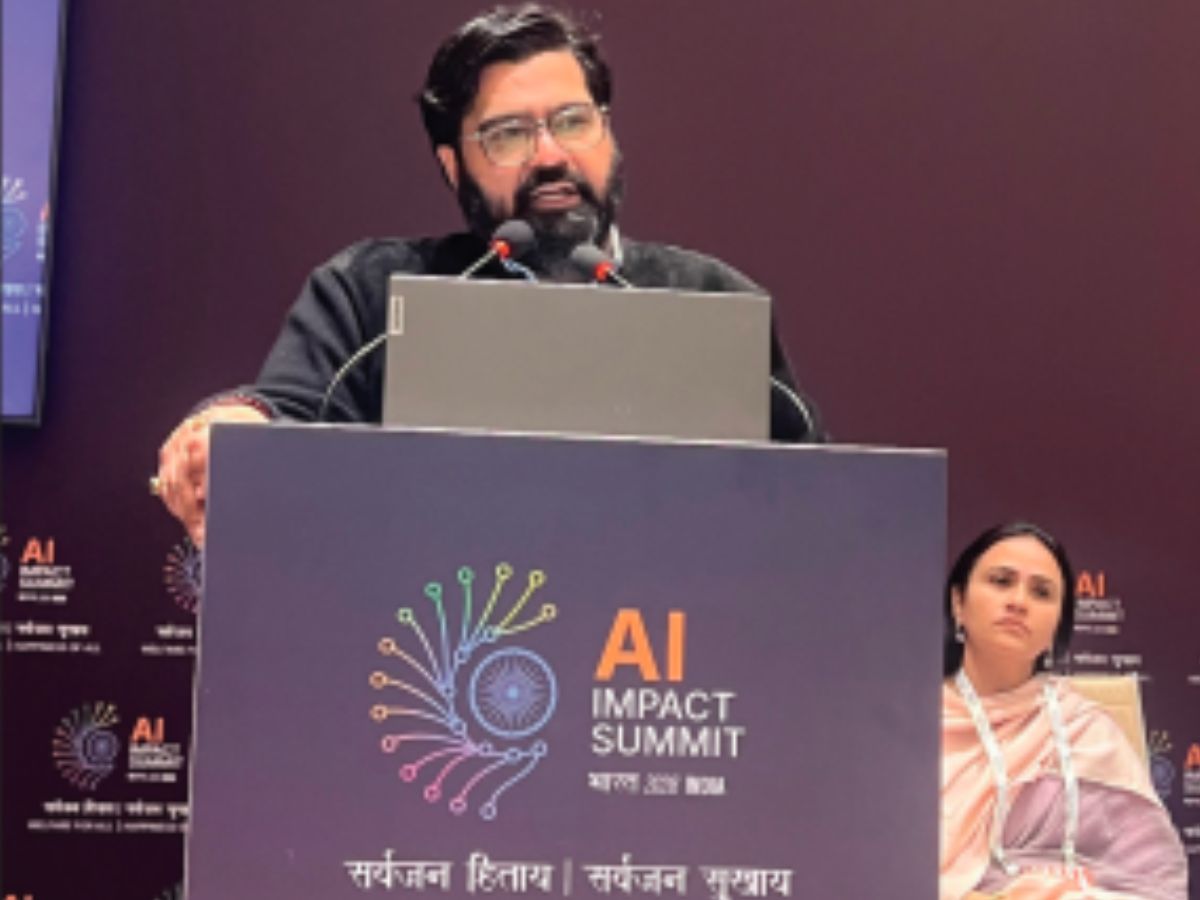
At the India AI Impact Summit held at Bharat Mandapam, MP Kartikeya Sharma presented what is now recognized as the world’s largest breast cancer screening programme, positioning the NaMo Shakti Rath as a global case study in AI-enabled public health delivery.
Addressing global leaders, technologists, oncologists, policymakers and members of the AI ecosystem, Sharma anchored his keynote in the philosophy that defines the NXT framework: innovation must not end with applause, it must translate into architecture.
Opening his address, Sharma shared a deeply personal story. His sister, a doctor pursuing studies at Johns Hopkins, was diagnosed with breast cancer. Despite her medical training, early detection did not occur at the earliest possible stage. Today she is fully recovered, but the experience left a powerful question.
If awareness and expertise cannot always guarantee early detection in advanced medical systems, what happens in rural India?
That question became the foundation of the NaMo Shakti Rath.
He noted that earlier detection can significantly change treatment pathways. What began as a personal concern evolved into a structured national intervention.
The NXT Angle: From Dialogue to Deployment
Sharma reminded the audience that NXT was conceptualized as more than a conclave. It was designed to track ideas beyond the stage and convert them into measurable outcomes.
On 1 March 2025 at Bharat Mandapam, AI-enabled breast cancer detection technology was demonstrated. Instead of allowing the technology to remain a conference highlight, the team built a scalable deployment model.
The result is the NaMo Shakti Rath, now operational across states and widely acknowledged as the world’s largest breast cancer screening initiative conducted through AI-enabled mobile infrastructure.
The Rath was flagged off in Haryana on 17 September and launched in Varanasi on 14 January. Since then, screenings have expanded at scale, with more than 30,000 screenings conducted in Varanasi alone and continuous daily operations across locations.
What distinguishes the programme is not only its reach but its structure.
- AI-enabled thermal imaging
- Non-invasive, radiation-free screening
- No touch methodology
- Instant encrypted cloud-based digital reports
- Unique ID generation and geo-tag tracking
- Real-time digital dashboards
This architecture ensures transparency, accountability and scalability. Sharma emphasized that the innovation lies equally in delivery design as in device capability. Healthcare no longer waits in buildings. It moves to the doorstep.
Expert Endorsements at the Summit
The session featured leading voices from healthcare and social impact sectors.
Aishwarya Sharma, Chairperson, iTV Foundation, shared field insights from mobilisation drives. She observed that in many communities, elderly women participated first and then encouraged younger family members. The campaign, she said, is generating behavioural change and motivating women to prioritise their health across socio-economic backgrounds.
Vicky Nanda, COO, Niramai Health Analytix, stated that late detection remains the biggest challenge in breast cancer outcomes. He explained that Thermalytix is designed for early-stage detection by identifying subtle thermal abnormalities even before a lump becomes clinically palpable. Its non-invasive and no-touch methodology makes it especially suitable for large-scale public screening campaigns, ensuring dignity, comfort, and wider community acceptance.
Dr. Mandeep Malhotra, Senior Oncologist, CK Birla Hospital, described the initiative as an Indian solution to an Indian problem. He congratulated Sharma and the Prime Minister, noting that AI-driven thermal imaging strengthens early detection frameworks and integrates effectively with clinical pathways.
Renuka Prasad, Secretary, Indian Cancer Society, and herself a breast cancer survivor, reinforced the importance of early screening. Her testimony underscored how awareness and timely detection save lives.
Dr. Sandeep Datta, Assistant Secretary, IMA, emphasized that rural healthcare improvement is essential for equitable outcomes. He stated that the Indian Medical Association continues to work toward strengthening rural health systems and observed that the NaMo Shakti Rath reinforces cancer awareness at the grassroots level.
He noted that the campaign addresses denial and delayed reporting while pointing to the future of technology-enabled preventive healthcare.
Complementing Ayushman Bharat
Sharma linked the initiative to the broader preventive healthcare vision under Ayushman Bharat, stating that universal coverage must be matched by universal early detection.
Breast cancer accounts for a significant proportion of cancers among Indian women, and delayed access remains a key challenge. The NaMo Shakti Rath addresses that access gap at scale.
Redefining AI’s Legacy
In his closing remarks, Sharma reframed the global AI conversation. The future will not judge this era by how advanced our algorithms were. It will judge whether technology stood with humanity. A developed nation is not defined solely by GDP metrics or digital exports. It is defined by whether preventable deaths decline.
The NaMo Shakti Rath, he said, is more than a mobile van. It is a structured, scalable public health system on wheels and a global demonstration of how Artificial Intelligence can serve dignity, privacy and preventive care at mass scale.