
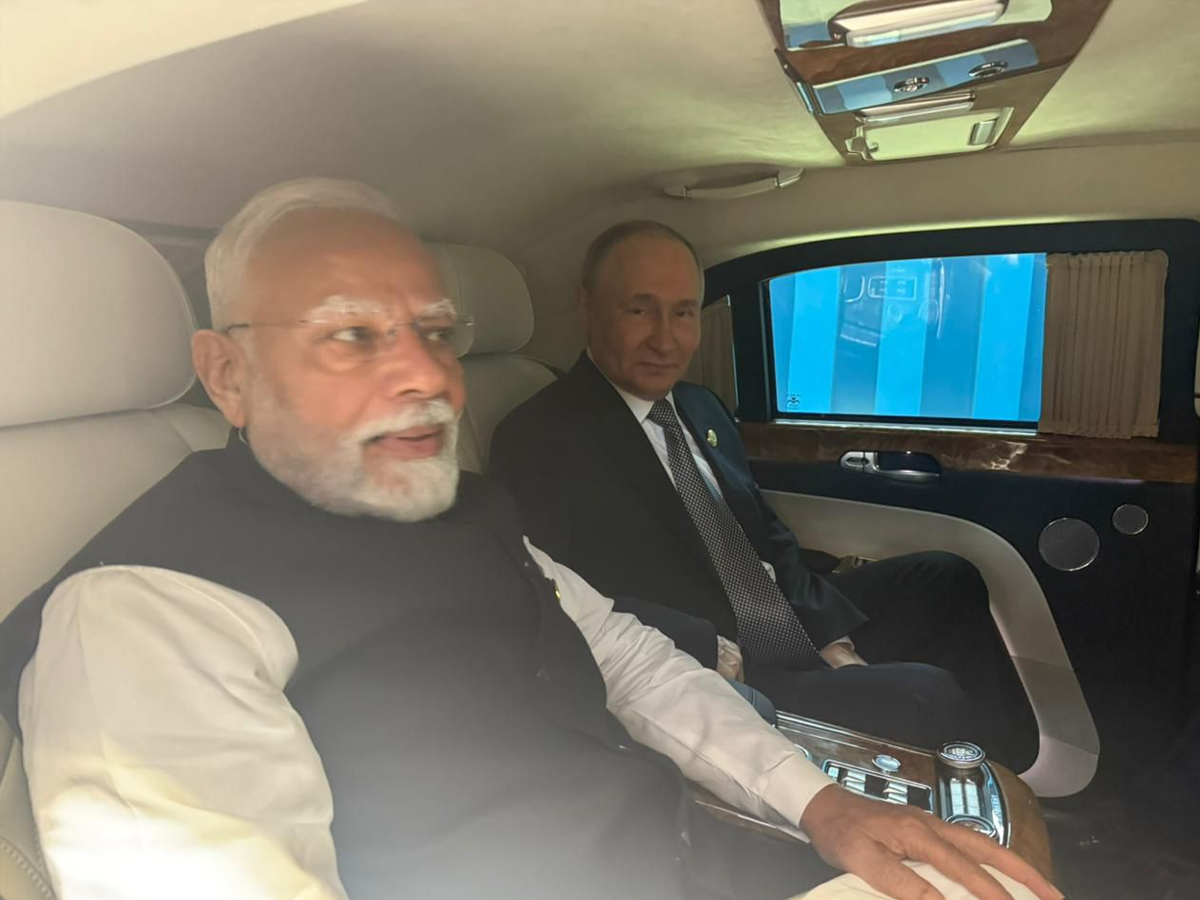
Prime Minister Narendra Modi and Russian President Vladimir Putin surprised everyone at the Shanghai Cooperation Organisation (SCO) Summit in Tianjin. The two leaders skipped the usual official cars and rode together in a Russian-made Aurus sedan, gifted earlier to Putin by China. Their ride to the Ritz-Carlton hotel, where bilateral talks were scheduled, quickly became the highlight of the day.
This carpool shows the potent diplomatic symbol that demonstrates friendliness, confidence, and India’s capacity to engage both China and Russia in a changing global order, rather than concentrating solely on the vehicle itself.
Symbol of Warm Ties
The carpool was more than just a ride. It sent a message of trust and close ties between the two countries. Modi posted about it on X, writing, “After the proceedings at the SCO Summit venue, President Putin and I travelled together to the venue of our bilateral meeting. Conversations with him are always insightful.”
The camaraderie followed a warm embrace earlier at the summit venue. Photos and videos of the hug went viral on social media. Modi later added on X, “Always a delight to meet President Putin!”
Talks Amid Global Trade Tensions
The unusual moment came as both leaders prepared for serious discussions. Energy cooperation, defence ties, and the changing global order were on the table. The talks took place while US President Donald Trump’s steep tariffs on Indian exports cast a shadow.
Washington’s move, linked to India’s continued oil trade with Russia, has unsettled markets worldwide.
Triangular Diplomacy in Action
Another rare scene unfolded at the SCO Summit: Modi was seen chatting with both Putin and Chinese President Xi Jinping. The three leaders exchanged smiles, handshakes, and light moments together. Modi wrote on X, “Interactions in Tianjin continue! Exchanging perspectives with President Putin and President Xi during the SCO Summit.”
These images highlighted India’s role as a balancing power in Eurasian politics, engaging both Moscow and Beijing while keeping its own priorities intact.
India’s Message to SCO
During his speech, Modi set out India’s agenda for the grouping: security, connectivity, and opportunity. He urged members to unite against terrorism, stressing that India has suffered its impact for decades, including in the recent Pahalgam attack. He also took a veiled dig at China’s Belt and Road Initiative, saying projects that ignore sovereignty “lose trust and meaning.” Instead, he promoted India-led projects like Chabahar Port and the International North-South Transport Corridor.
On the sidelines, Modi also met Xi Jinping after seven years. He pressed for cooperation on counter-terrorism but also raised concerns over cross-border threats. This meeting carried extra weight, as ties have remained tense since the 2020 Galwan clashes.