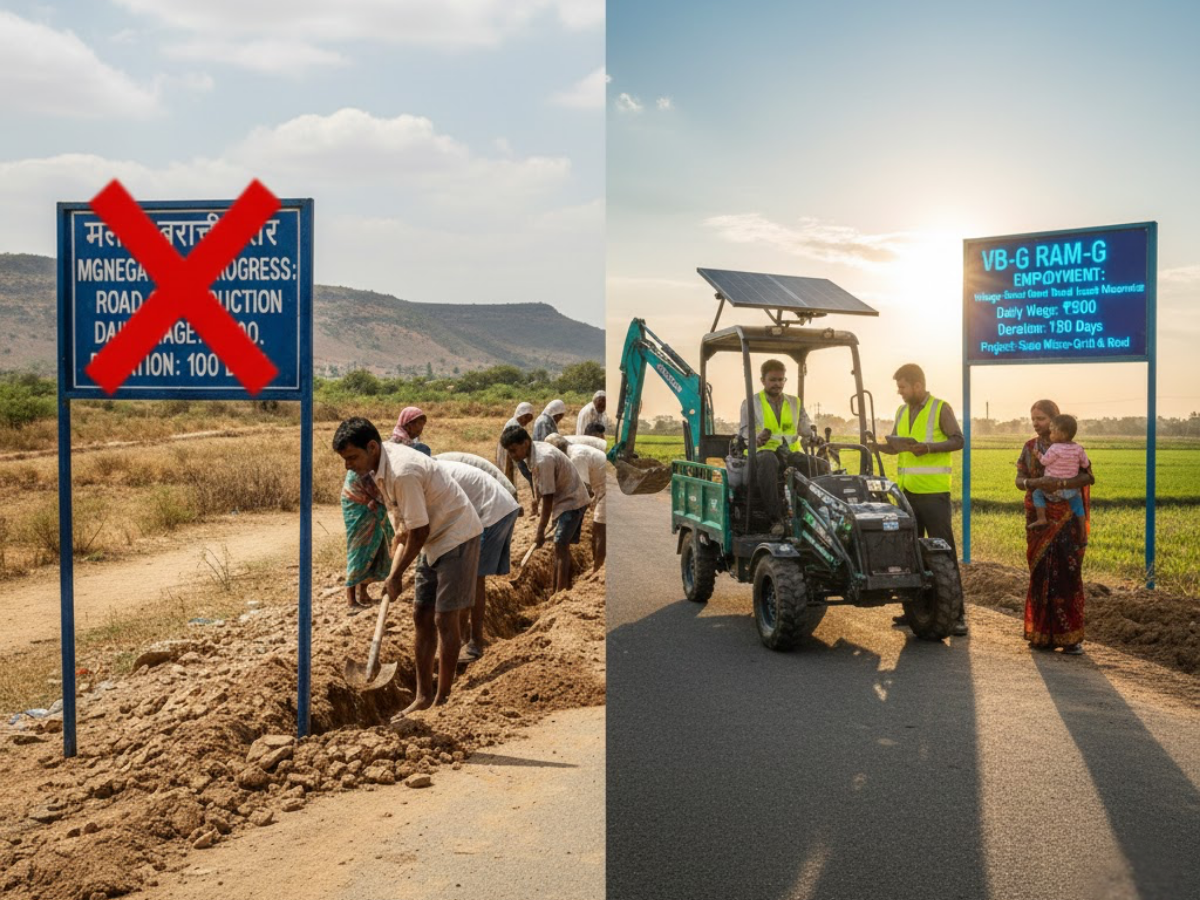
Parliament’s passage of the Viksit Bharat Guarantee for Rozgar and Ajeevika Mission (Gramin), or VB-G RAM G Bill is a watershed moment in the rural employment policy of India. By replacing the longstanding MGNREGA, the government seeks to reshape the architecture of wage employment, village assets and accountability in rural India.
Admirers hail it as an upgrade befitting the Viksit Bharat vision, while its detractors see it as a risky makeover that passes on much of the financial and administrative burden to the states.
What is MGNREGA?
It was enacted in the year 2005 to ensure a legal guarantee of 100 days of wage employment to each rural household. But it was demand-driven work needed to be provided when the citizens demanded work.
Basic asset creation such as water conservation, land development and drought proofing, with the Centre bearing the bulk of the wage costs under this scheme. Over time, MGNREGA became both a social safety net and a political symbol of rights-based welfare.
What’s in the new VB-G RAM G Bill?
This law increases the number of days of guaranteed unskilled rural employment from 100 to 125 days each financial year. It builds on better monitoring mechanisms includes wider use of digital systems in the delivery mechanism and improves the role of gram sabhas and panchayats in planning the project.
ALSO READ: Parliament Passes SHANTI Bill, Allows Private Players in India’s Nuclear Power Sector by 2047
According to the government, these features will ensure a reduction in leakages, improvement in asset quality, and provision of dignity of work, especially for women, the elderly, persons with disabilities and marginalised communities.
MGNREGA vs VB-G RAM G Bill
The debate turns essentially on a philosophical change. While MGNREGA was demand-driven, under the VB-RAM G framework, the model is supply driven with capped allocations. The funding model has also changed.
The scheme is now a centrally sponsored scheme, with the share of costs borne by states. A new stipulation is the mandatory closure for up to 60 continuous days during peak agricultural seasons. While the Centre claims this would facilitate farm labour availability, critics are apprehensive that this might undermine income security.
ALSO READ: Delhi Launches ‘No PUC, No Fuel’ Drive: Over 3,700 Vehicles Fined, Hundreds Turned Back
MGNREGA vs VB-G RAM G Bill: Major Differences
| Aspect | MGNREGA | VB-G RAM G Bill |
|---|---|---|
| Guaranteed workdays | 100 days | 125 days |
| Nature of scheme | Demand-driven | Supply-driven |
| Funding pattern | Centre-heavy | Cost-sharing with states |
| State contribution | Limited | 40% for most states |
| Agricultural pause | Not specified | Mandatory 60-day pause |
| Focus | Basic rural assets | Integrated development |
Four priority areas under the new initiative
The focus of the VB-G RAM G Bill crystallizes around four themes, namely, water security on irrigation channels and groundwater recharge and rural infrastructure on roads, schools, sanitation and public facilities; livelihood linked assets on farming, livestock & fisheries and disaster resilience on shelters, embankments and climate adaptation works.
ALSO READ: India-Oman Sign Free Trade Pact Offering Zero-Duty Access for Over 98% of Indian Exports
Disclaimer: This article is an analytical overview based on publicly available information and does not represent any political party or government position.