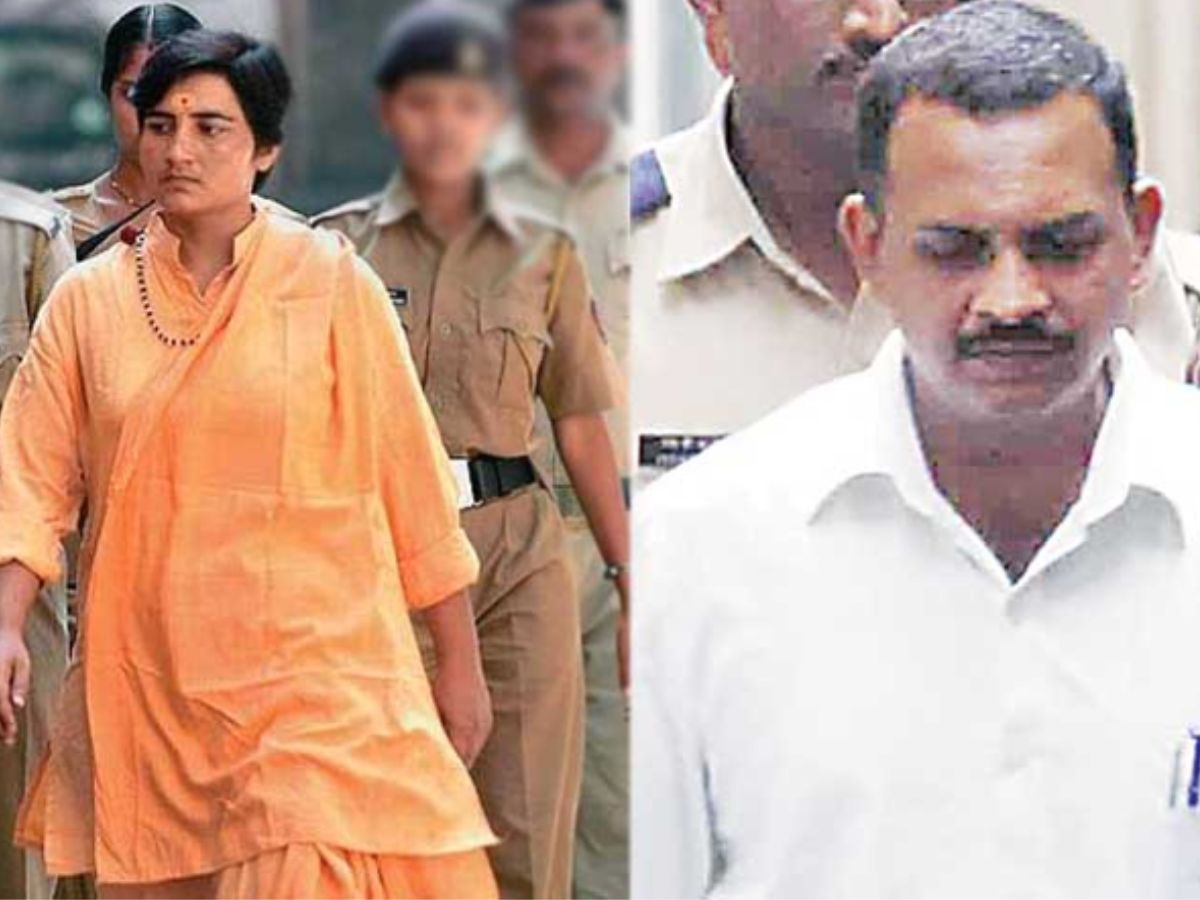
Seventeen years after the deadly blast shook the communal fabric of Malegaon in Maharashtra’s Nashik district, a special National Investigation Agency (NIA) court in Mumbai acquitted all seven accused in the 2008 Malegaon blast case, bringing the curtains down on one of India’s most debated and politically sensitive terror trials. Among the acquitted were high-profile names such as BJP MP Pragya Singh Thakur and Indian Army officer Lt Col Prasad Purohit.
At the heart of the investigation was a motorcycle, an LML Freedom, which investigators claimed was used to plant the improvised explosive device (IED) that killed six people and injured at least 95 others on September 29, 2008. The NIA court’s final ruling on Thursday concluded that the connection between the bike and Pragya Thakur, which for years had been the mainstay of the prosecution’s case, did not stand up to judicial scrutiny.
Court Rejects Motorcycle Link, Cites Gaps in Evidence
Judge A K Lahoti, delivering the verdict, stated that the prosecution had failed to establish that the bomb was indeed placed in the motorcycle allegedly linked to Thakur. “The bike allegedly involved in the blast did not have a clear chassis number. Prosecution could not prove that it was in (Pragya Thakur’s) possession immediately before the blast,” Lahoti observed, as reported by ANI. This crucial gap, among others, proved fatal to the prosecution’s case and paved the way for the acquittals.
The court also pointed to serious flaws in the overall investigative process, including contaminated evidence, lack of a site sketch during the panchnama, and inconsistencies in the medical certificates of injured victims. “No sketch of the spot was done by the investigation officer while doing the panchnama. No fingerprint, dump data or anything else was collected for the spot,” the judge noted.
The Blast, the Arrests, and the Turn in the Narrative
The Malegaon blast occurred during Ramadan, in a Muslim-majority area, triggering immediate fears of communal unrest. The Maharashtra Anti-Terrorism Squad (ATS) took over the initial investigation from the local police and determined that the IED was planted on a two-wheeler. On October 23, 2008, the ATS located Pragya Thakur and arrested her, followed by Lt Col Purohit and other individuals. Eleven people in total were arrested, all allegedly linked to a radical group named Abhinav Bharat. The accused were charged under UAPA, IPC, the Explosive Substances Act, and initially, the Maharashtra Control of Organised Crime Act (MCOCA).
This marked a rare moment in India’s terror jurisprudence where individuals affiliated with right-wing Hindu groups were accused of orchestrating a terrorist attack, a sharp deviation from the usual Islamist terror narratives. Intense discussions were sparked when the terms “Hindu terror” and “saffron terror” started to appear in political and media discourse.
From ATS to NIA: A Tale of Two Investigations
In 2011, the case was transferred to the NIA, which gradually distanced itself from the ATS’s version. In 2016, the NIA filed a supplementary chargesheet stating that MCOCA was wrongly applied and recommended dropping Pragya Thakur’s name from the list of accused. The agency maintained that while Thakur owned the motorcycle, it had long been in the possession of an absconding accused, Ramchandra Kalsangra, and not used by her during the time of the blast.
However, a special court decided that Thakur, Purohit, and five others should still stand trial under UAPA and other criminal laws. The trial began in 2018 and concluded on April 19, 2025. It was one of India’s longest-running terror cases, with hundreds of witnesses and reams of forensic and circumstantial evidence, none of which, the court ruled, conclusively proved the prosecution’s case.
Pragya Thakur Reacts: ‘Bhagwa Has Won’
After the verdict, Pragya Singh Thakur, also known as Sadhvi Pragya, gave a fiery statement reflecting both personal vindication and ideological assertion. “I said this from the very beginning that those who are called for investigation… there should be a basis behind that. I was called for investigation and was arrested and tortured. This ruined my whole life,” she said.
Thakur, a self-proclaimed Hindu ascetic, added, “I was living a sage’s life, but I was made an accused… I am alive because I am a sanyasi.” She accused her detractors of “defaming the bhagwa (saffron) through a conspiracy” and concluded, “Today, bhagwa has won, and Hindutva has won.”
Whether or not the case reaches the High Court in appeal remains to be seen. But for now, the Malegaon trial stands as a textbook example of how justice delayed, politicised investigations, and prosecutorial shortcomings can redefine not just a case, but a country’s conscience.